
Knowing how to find LCM starts with the definition: the least common multiple (LCM) of two or more numbers is the smallest number that all of them divide into evenly. The simplest way to find the LCM is to list the multiples of each number until you find one they share. For larger numbers, prime factorization or the division method are faster.
Knowing how to find LCM matters most when you're adding or subtracting fractions with different denominators.This guide covers all three calculation methods for how to find LCM, when to use each one, and how LCM relates to its close cousin, GCF.
What Is LCM?
The LCM of two numbers is the smallest number both of them can divide into without leaving anything over. Take 4 and 6. The multiples of 4 are 4, 8, 12, 16, and so on. The multiples of 6 are 6, 12, 18, 24, and so on. The first number that shows up in both lists is 12, so the LCM of 4 and 6 is 12. That's the core idea behind how to find LCM no matter which method you use.
Method 1: How to Find LCM by Listing Multiples
This is the most straightforward way to find LCM, and it works best with smaller numbers.
• Multiples of 4: 4, 8, 12, 16, 20
• Multiples of 6: 6, 12, 18, 24, 30
The first shared number is 12, so that's the LCM. Once the numbers get larger, listing multiples by hand starts to take a while, which is where the next two ways to find LCM come in.
Method 2: How to Find LCM Using Prime Factorization
For bigger numbers, breaking each one down into prime factors is usually faster than listing multiples one by one. This is often the preferred way to find LCM once the numbers climb past 20 or so.
Take 12 and 18.
• 12 = 2 × 2 × 3
• 18 = 2 × 3 × 3
Take each prime factor the highest number of times it appears in either list. That gives 2 × 2 × 3 × 3, which equals 36. So the LCM of 12 and 18 is 36. That's how to find LCM whenever prime factorization is the faster route.
Method 3: How to Find LCM Using the Division (Ladder) Method
This method is the fastest option once you're finding the LCM of three or more numbers at once.
Take 12, 15, and 24. Line them up and divide all three by the smallest prime number that divides at least one of them evenly, carrying down any number it doesn't divide. Keep going until every number has been reduced to 1.
• Divide by 2: 6, 15, 12
• Divide by 2: 3, 15, 6
• Divide by 3: 1, 5, 2
• Divide by 5: 1, 1, 2
• Divide by 2: 1, 1, 1
Multiply every divisor used: 2 × 2 × 3 × 5 × 2 = 120. The LCM of 12, 15, and 24 is 120. That's exactly how to find LCM for three numbers at once using the ladder method.
GCF and LCM: What's the Difference?
GCF and LCM often get mixed up because they're calculated using similar steps, but they answer two different questions. LCM is the smallest number that two or more numbers divide into. GCF, or greatest common factor, is the largest number that divides evenly into two or more numbers. Our guide on the greatest common factor covers that side of the comparison in full.
For 12 and 18, the GCF is 6 and the LCM is 36. There's also a handy formula linking the two: multiplying the LCM and GCF of two numbers always equals the product of the numbers themselves. For 12 and 18, that's 36 × 6 = 216, which matches 12 × 18 = 216. Keeping this relationship in mind is a useful shortcut once you already know how to find LCM.
Why Knowing How to Find LCM Matters for Fractions
The most common reason to find LCM is to get a common denominator when adding or subtracting fractions with unlike denominators. If you haven't seen that connection yet, our guides on what is a common denominator and adding fractions with unlike denominators walk through exactly how the LCM gets used in that process.
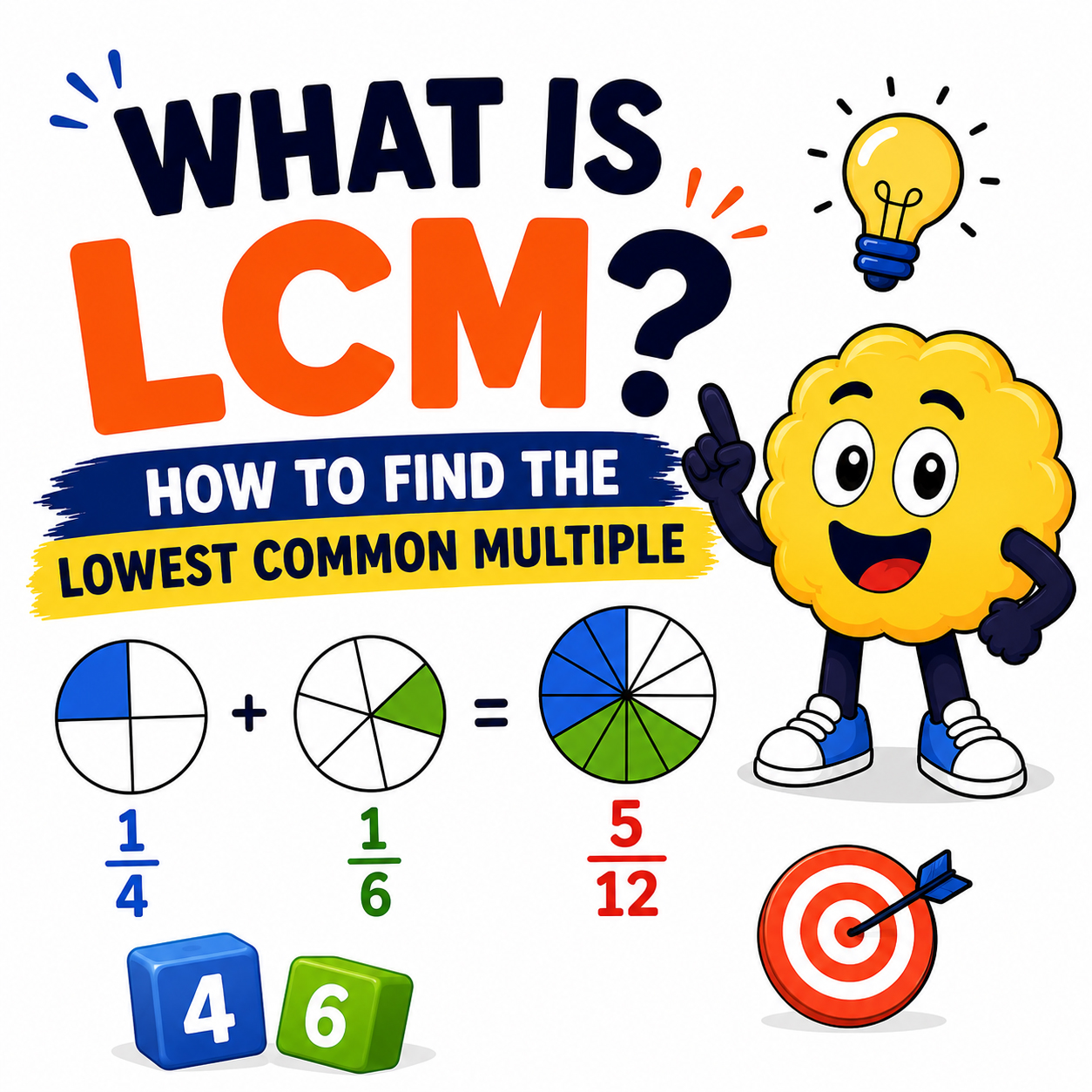
Take 1/4 + 1/6. The LCM of 4 and 6 is 12, so both fractions get rewritten with a denominator of 12: 3/12 + 2/12 = 5/12. Without finding that shared multiple first, the fractions can't be added directly, which is exactly why knowing how to find LCM matters before tackling fraction addition.
LCM in Real Life
Knowing how to find LCM shows up outside of math class more often than it seems. Imagine one bus that arrives every 12 minutes and another that arrives every 18 minutes, both starting at the same stop at the same time. The next time they arrive together is at the LCM of 12 and 18, which is 36 minutes later.
The same idea applies to scheduling repeating events, like two chores that happen on different cycles, or figuring out when two flashing lights will blink at the same moment again. Knowing how to find LCM makes all of these scheduling puzzles solvable in seconds.
When Does My Child Learn How to Find LCM?
Finding the LCM is part of Grade 6 math under CCSS 6.NS.B.4, building directly on the common denominator work students start in Grades 4 and 5. If your child already has a shaky grasp of common denominators, that's usually the gap worth closing before tackling how to find LCM confidently.
Common Mistakes When Learning How to Find LCM
A few habits tend to trip people up when learning how to find LCM.
• Confusing LCM with GCF and grabbing the largest shared factor instead of the smallest shared multiple
• Stopping at the first common number found when listing multiples, even if a smaller one was missed earlier in the list
• Forgetting to use the highest power of each prime factor, which is a common slip when learning how to find LCM with prime factorization
• Trying to list multiples by hand for large numbers instead of switching to a faster way to find LCM, like prime factorization or the ladder method
Key Takeaways
• LCM is the smallest number that two or more numbers divide evenly, which is the core idea behind what is LCM in math.
• GCF and LCM are different. LCM gives the smallest shared multiple, GCF gives the largest shared factor.
• Knowing how to find LCM is the key step behind getting a common denominator when adding or subtracting fractions.
Knowing how to find LCM is one of those background skills that quietly supports a lot of fraction work, and a shaky grasp of it can slow down everything that depends on it.
Once LCM feels solid, the next natural step is simplifying fractions, which uses the same kind of number sense from the other direction.
If your child needs a clearer foundation in how to find LCM, our tutors can help.
Book a free assessment today and explore our Grade 5 math program.
Frequently Asked Questions
What is the LCM of two numbers?
The LCM of two numbers is the smallest number that both of them divide into evenly. For 4 and 6, the LCM is 12. That single example covers the basics of how to find LCM for most simple number pairs.
How do you find the LCM using prime factorization?
Break each number down into its prime factors, then multiply together the highest power of each prime factor that appears in either number. For 12 and 18, that gives an LCM of 36. This is one of the fastest ways to find LCM once the numbers get larger.
What is the difference between GCF and LCM?
LCM is the smallest number that two or more numbers divide into. GCF is the largest number that divides evenly into two or more numbers. They answer opposite questions even though they're calculated using similar steps.
How do you find the LCM of 3 numbers?
The division, or ladder, method is the best way to find LCM for three or more numbers. Divide all the numbers by the smallest shared prime factor repeatedly, carrying down numbers that aren't divisible, until everything reduces to 1, then multiply all the divisors together.
What does LCM mean in math, and what is the LCM meaning behind it?
LCM stands for least common multiple. It refers to the smallest number that two or more given numbers can divide into without leaving a remainder.