
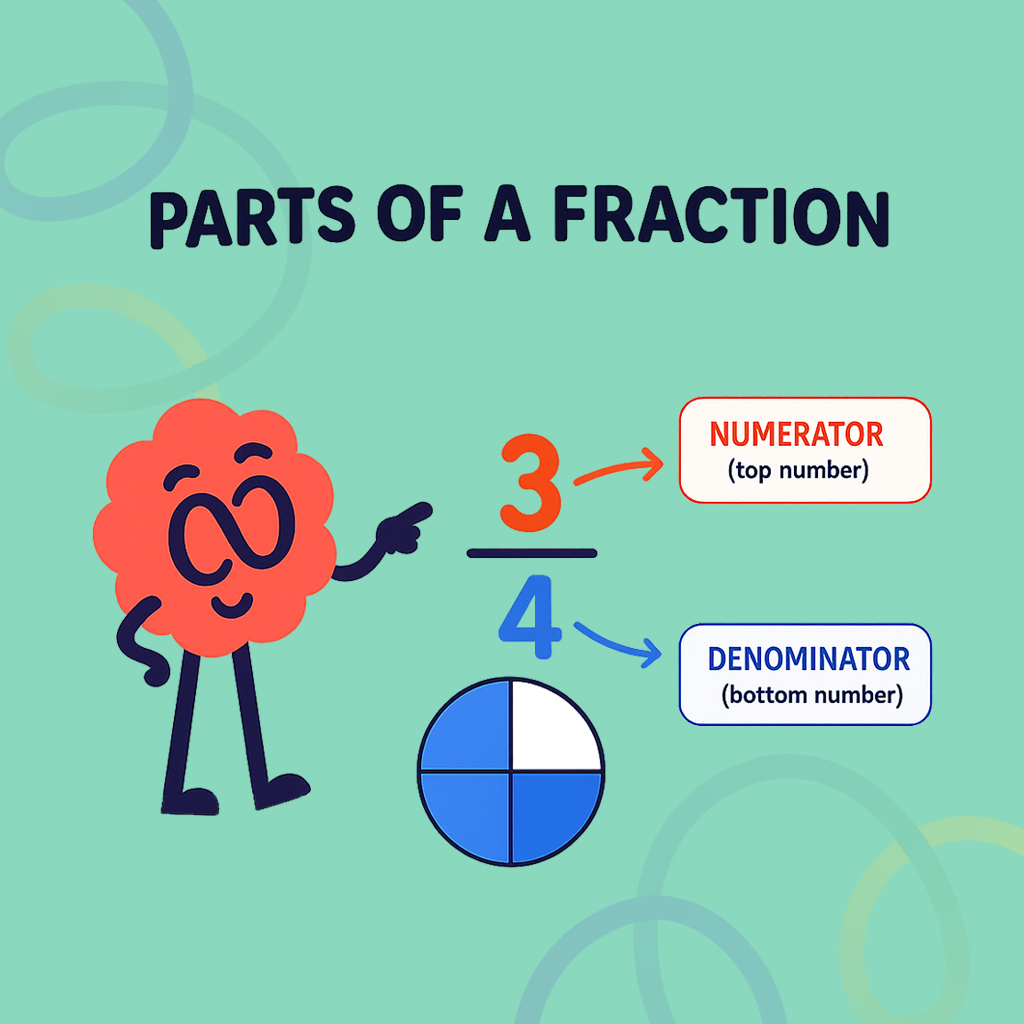
When you look at a fraction like 3/4, you are actually looking at two pieces of information working together. The top number and the bottom number each have a specific job — and together they tell you exactly how much of something you have. Understanding what a numerator and denominator are is one of the most important first steps in learning fractions.
What Is a Numerator and Denominator?
A fraction has two parts: the numerator (top number) and the denominator (bottom number). The numerator shows how many parts you have, while the denominator shows how many equal parts the whole is divided into. Understanding these parts of a fraction is one of the first steps in learning fractions.
If you’re not yet familiar with the parts of a fraction, don’t worry. It’s one of the most common challenges in Grade 2 and Grade 3 math and it’s usually easy to clear up with a few simple explanations.
The Two Parts of a Fraction
Before you can compare, add, or simplify fractions, you need to understand the two parts of a fraction.
Take the fraction 3/4.

- The top number in a fraction is the numerator.
- The bottom number in a fraction is the denominator.
Together, these parts of a fraction tell us how much of a whole we have.
The denominator tells us that the whole has been divided into 4 equal parts. The numerator tells us that we have 3 of those parts.
If you’re still learning the basics, start with our guide on What Is a Fraction? . Once they understand the parts of a fraction, they can move on to Types of Fractions.
What Is a Numerator?
A common question is: what is a numerator?
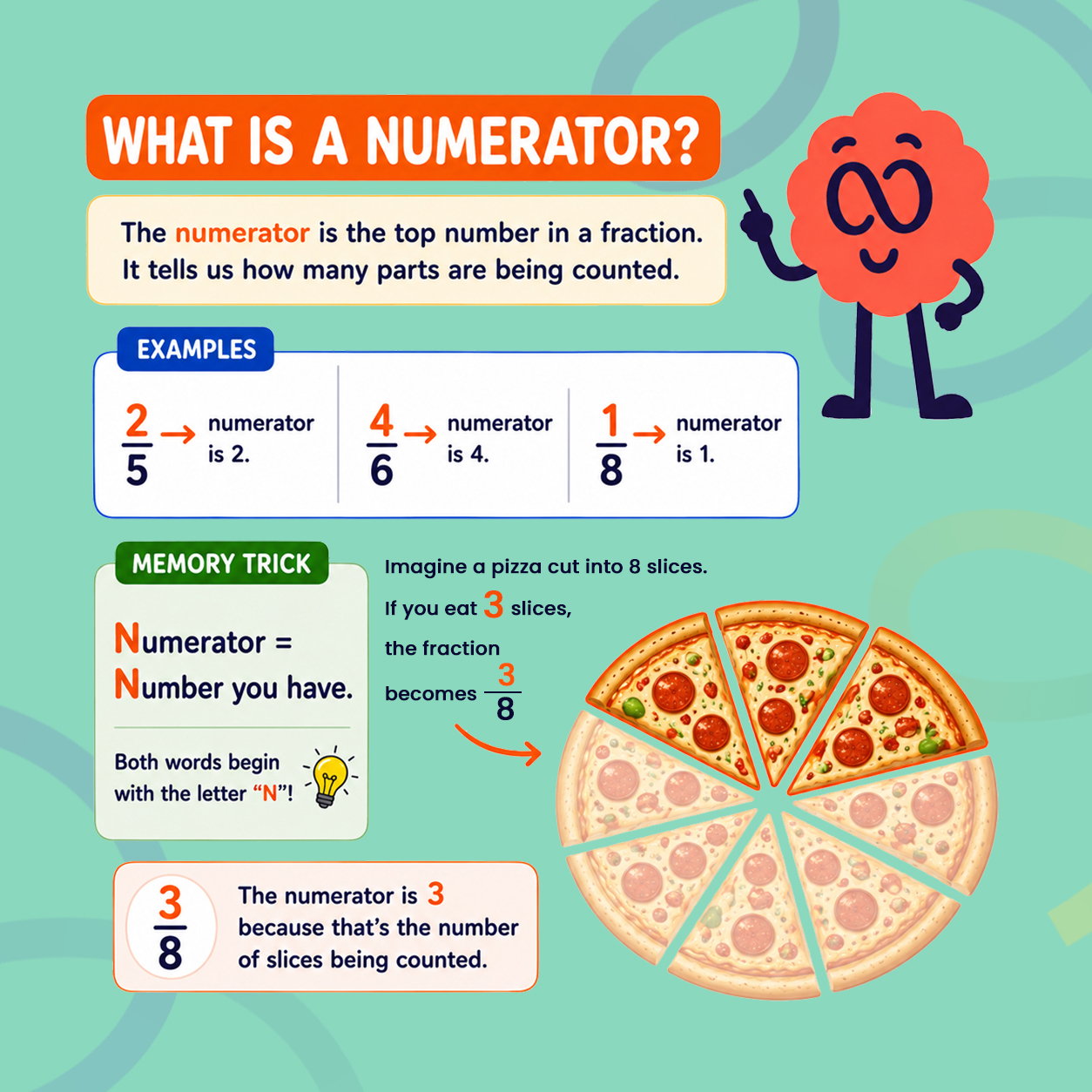
The numerator is the top number in a fraction. It tells us how many parts are being counted.
For example:
- In 2/5, the numerator is 2.
- In 4/6, the numerator is 4.
- In 1/8, the numerator is 1.
A simple memory trick is:
Numerator = Number you have.
Both words begin with the letter "N"
Imagine a pizza cut into 8 slices. If you eat 3 slices, the fraction becomes 3/8. The numerator is 3 because that’s the number of slices being counted.
When you begin comparing fractions, the numerator becomes even more important. For example, between 2/5 and 4/5, the fraction with the larger numerator is greater because both fractions have the same denominator. You can learn more in our guide to Comparing Fractions.
What Is a Denominator?
Another common question is, what is a denominator?
The denominator is the bottom number in a fraction. It tells us how many equal parts make up the whole.
For example:
- In 2/5, the denominator is 5.
- In 3/8, the denominator is 8.
A handy phrase to remember is:
"Down-ominator."
The denominator is down at the bottom.
Think about a chocolate bar divided into 6 equal pieces. Even if you eat only 2 pieces, the denominator remains 6 because the whole chocolate bar was divided into 6 equal parts.
Understanding the fraction numerator and denominator helps you see how fractions represent parts of a whole rather than two unrelated numbers.
How to Remember What Is a Numerator and Denominator?
Learning the parts of a fraction becomes much easier with simple memory tricks.
1. Number You Have
The numerator is the number you have.
If 3 slices of pizza are left, the numerator is 3.
2. Down-ominator
The denominator is the bottom number in a fraction.
It tells us how many equal pieces exist altogether.
3. Ask Two Questions
When looking at any fraction, ask:
- How many pieces are there in total?
- How many pieces do we have?
This simple habit helps you understand the fraction numerator and denominator without memorizing rules.
Real-World Examples of the Parts of a Fraction
The best way to teach the parts of a fraction is through everyday examples.
Pizza Slices
A pizza cut into 8 slices with 5 slices remaining can be written as 5/8.
Clock Quarters
When 15 minutes have passed, one-quarter of the hour is gone. That's 1/4.
Egg Cartons
A carton holds 12 eggs. If 6 eggs remain, you have 6/12 of the carton left.

These examples help you connect the parts of a fraction to real situations you already understand.
As you become more confident, you’ll start exploring Equivalent Fractions, where different fractions can represent the same amount.
A Common Confusion: Why People Mix Them Up
This is where a lot of people get stuck.
It’s easy to look at 3/5 and think the 3 tells you how many pieces make the whole. It sounds reasonable, but the bottom number does that job.
A simple way to keep it straight:
"Look at the bottom number first. That's the total number of equal pieces. Now look at the top number. That's how many pieces we're talking about."
Don’t overthink it. Most people mix up the numerator and denominator a few times before it starts to make sense.
What Comes Next?
Once you understand the parts of a fraction, you can begin working with more advanced fraction skills.
These include:
- Comparing fractions
- Equivalent fractions
- Mixed numbers
- Fraction operations
- Adding and subtracting fractions
One of the next major topics is How to Add Fractions, where you use your understanding of the numerator and denominator to solve fraction problems correctly.
Key Takeaways
- Every fraction has two important parts: the numerator and denominator.
- The top number tells you how many parts you're talking about.
- The bottom number tells you how many equal parts make up the whole.
- Using things like pizza slices, clocks, and egg cartons can make fractions much easier to understand.
- Once you understand the parts of a fraction, you’ll find topics like equivalent fractions, comparing fractions, and adding fractions much easier to learn.
Frequently Asked Questions
What are the parts of a fraction?
The parts of a fraction are the numerator and denominator. The numerator is the top number and the denominator is the bottom number.
What is a numerator?
The numerator is the top number in a fraction. It shows how many parts are being counted.
What is a denominator?
The denominator is the bottom number in a fraction. It shows how many equal parts make up the whole.
Why are the numerator and denominator important?
The numerator and denominator work together to show a part of a whole. Without understanding these parts of a fraction, it’s easy to struggle with comparing fractions and fraction operations.
If you’re in Grade 2 or Grade 3 and just starting with fractions, early support can make a big difference. Our Grade 2 and Grade 3 math programs build confidence step by step. Book a free assessment today.