
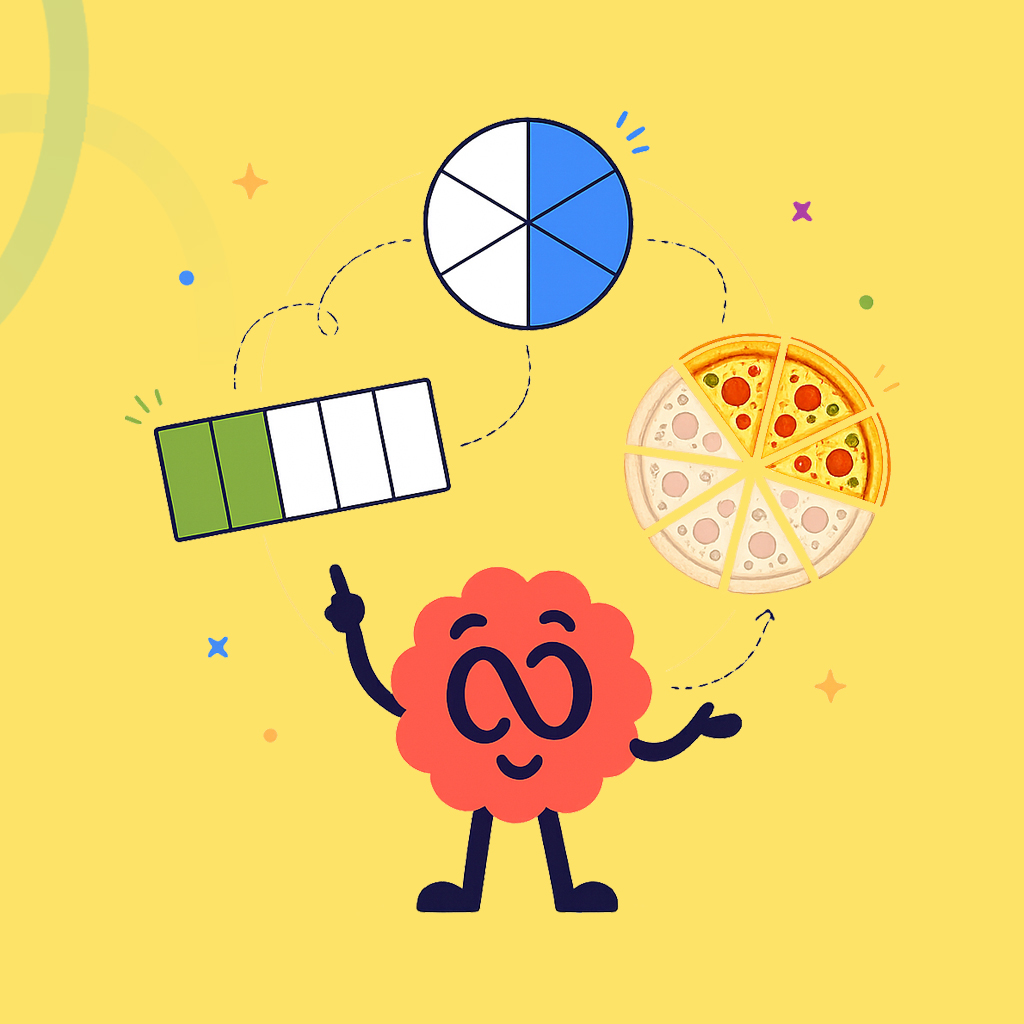
What is a fraction? A fraction shows how much of something you have when it has been split into equal parts. The top number tells us how many parts we are talking about. The bottom number tells us how many equal parts make up the whole.
If you are beginning to learn fractions, don’t worry if the concept seems unfamiliar. Think about sharing a pizza or cutting a sandwich into equal pieces.
What Is a Fraction?
When students first encounter fractions, they often think of them as strange numbers. Once fractions are seen in real life, they usually stop feeling so confusing.
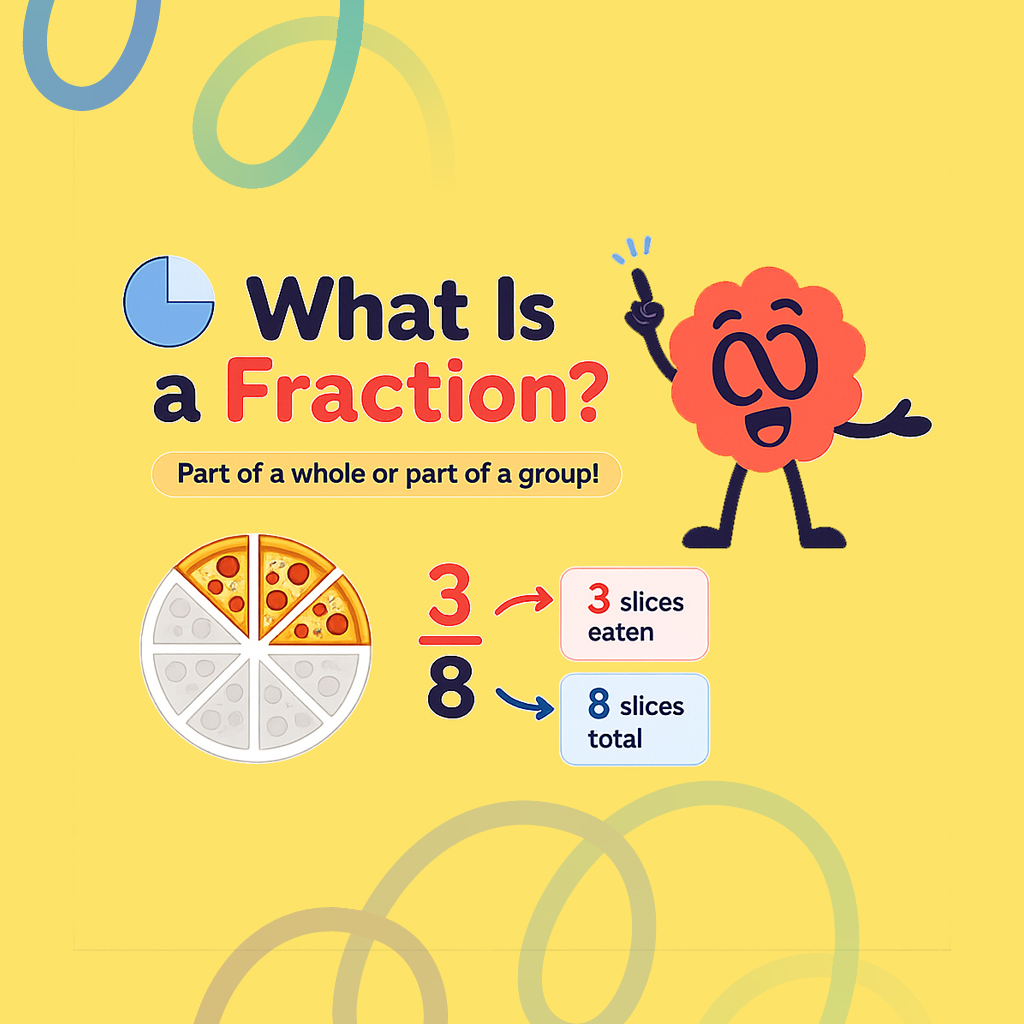
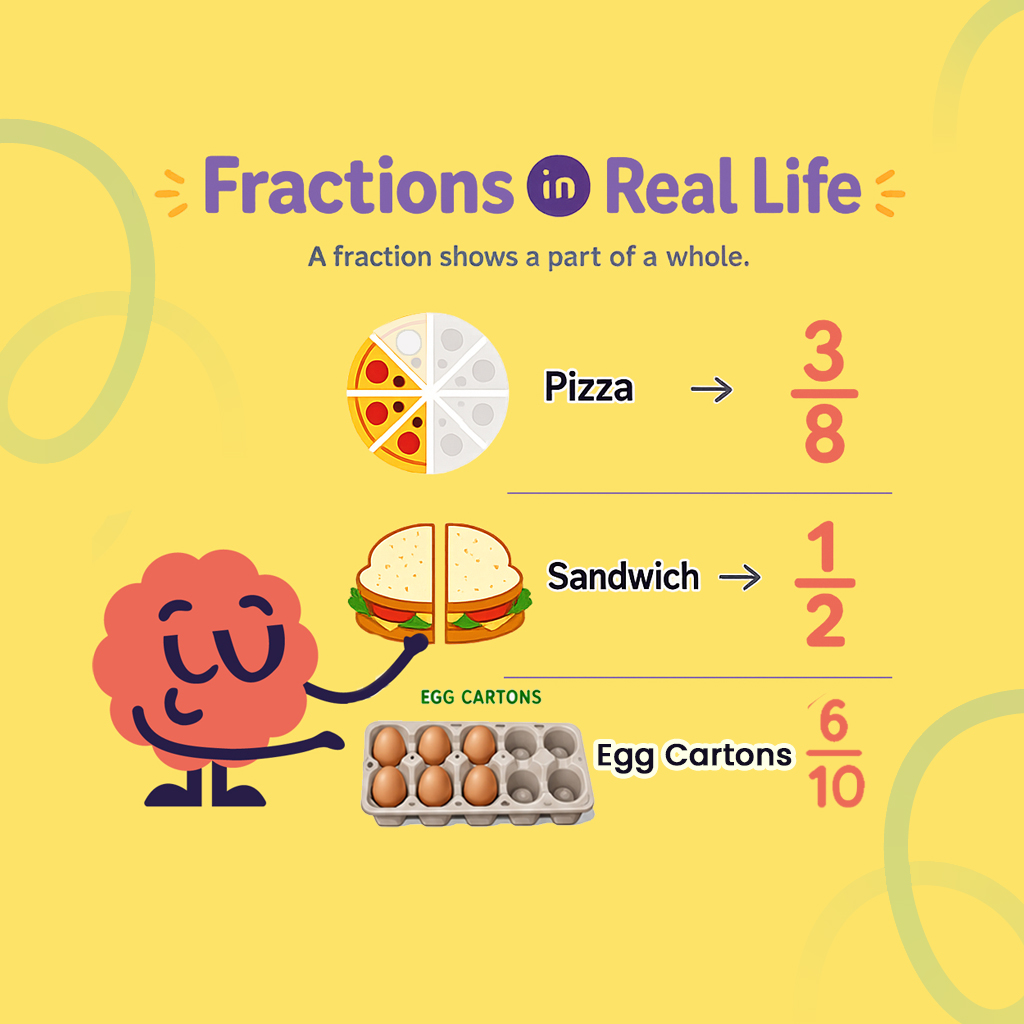
Imagine a pizza cut into 8 equal slices. Eating 3 slices means consuming 3/8 of the pizza.
In the fraction 3/8:
- 3 is the numerator (the number of slices eaten)
- 8 is the denominator (the total number of equal slices)
What Is a Fraction in Math?
A fraction is a mathematical way of showing part of a whole or part of a group. Instead of counting entire objects, fractions help us describe pieces or portions.
So if you’re still asking what is a fraction, think of it as a way of showing equal parts of something.
What Is a Fraction? A Real-Life Example
Fractions make more sense when you can see them.
Think about four cookies on a plate. Eating one cookie means having one out of four, or 1/4.
That’s why food examples work so well. You can see the fraction instead of just reading numbers on a page.
Most students understand fractions faster when they can see them in real situations.
The Parts of a Fraction: Numerator and Denominator
Every fraction has two numbers that work together.
Numerator
The numerator is the top number. It tells us how many parts we have.
Example: In 3/5, the numerator is 3. This means we have 3 parts.
Denominator
The denominator is the bottom number. It tells us how many equal parts the whole has been divided into.
Example: In 3/5, the denominator is 5. This means the whole is divided into 5 equal parts.
A Simple Memory Trick
Many people find it helpful to remember: Denominator = “Down”-ominator. The denominator is the number down at the bottom.
This simple trick can help quickly identify which number is which. As you progress, you will learn more about numerators and denominators and how they work together when comparing and simplifying fractions.
Fractions in Real Life: Everyday Examples
One reason fractions can feel confusing is that they are often seen only on worksheets. The best way to understand fractions is through everyday experiences.
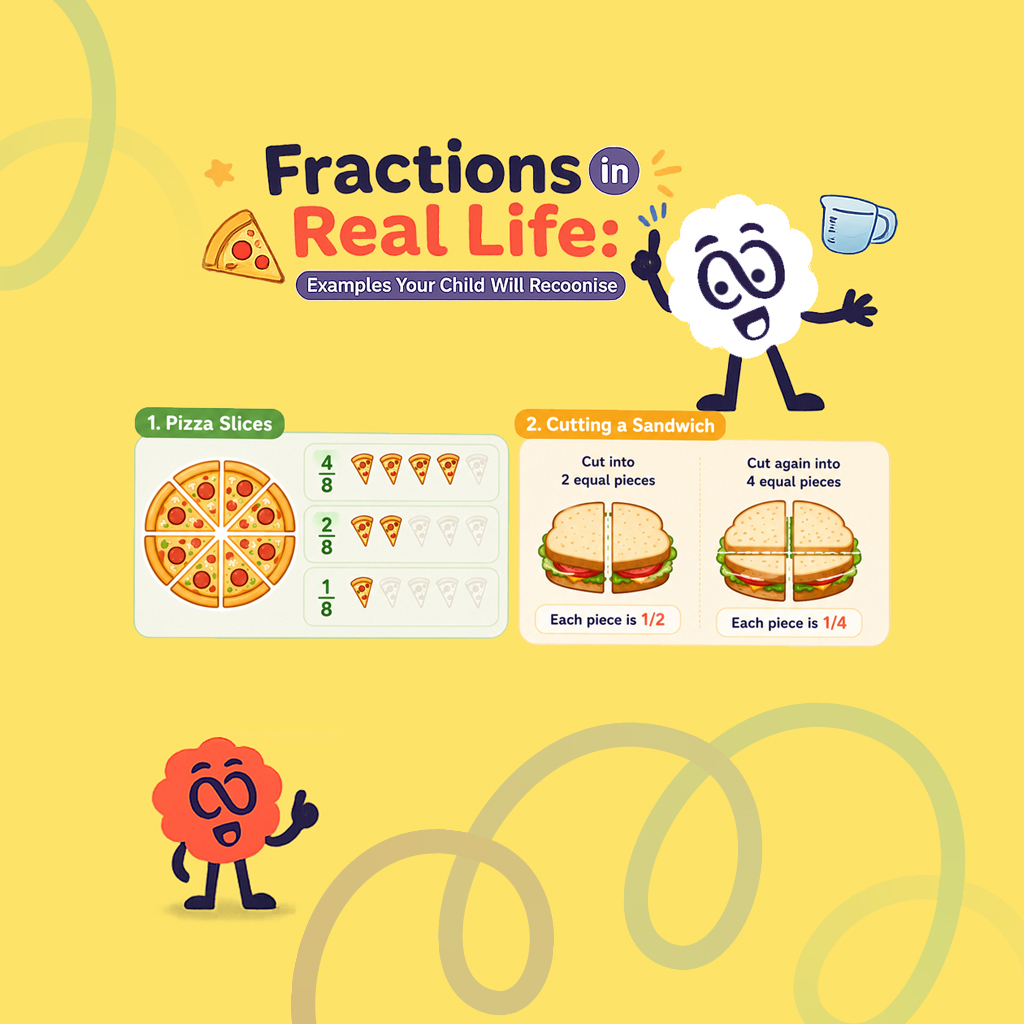
Pizza Slices
A pizza cut into 8 equal slices:
- 4 slices = 4/8
- 2 slices = 2/8
- 1 slice = 1/8
Cutting a Sandwich
Cut a sandwich into 2 equal pieces. Each piece represents 1/2. Cut it again into 4 equal pieces. Each piece now represents 1/4.
Measuring Ingredients
When baking, measuring cups such as 1/2 cup, 1/4 cup and 3/4 cup are fractions in action.
Reading the Clock
When we say “quarter past the hour” or “half past the hour”, we are using fractions. A quarter represents 1/4, and half represents 1/2.
That’s why answering what is a fraction with real examples often works better than memorizing definitions.
Types of Fractions You Will Encounter
As students move through elementary school, they will encounter different types of fractions.
Proper Fractions
The numerator is smaller than the denominator. Examples: 1/2, 3/4, 2/5
Improper Fractions
The numerator is larger than the denominator. Examples: 5/4, 7/3
Mixed Numbers
A whole number combined with a fraction. Examples: 1 1/2, 2 3/4
You will also learn about equivalent fractions, which are fractions that look different but represent the same value. For example: 1/2, 2/4 and 4/8 all represent the same amount.
When Are Fractions Introduced in School?
Here is a general guide to when fractions are introduced.
Grades 1–2
Students learn: equal parts, halves, quarters and visual fraction models.
Grade 3
Students begin comparing fractions, understanding numerators and denominators, and representing fractions on number lines.
Grades 4–5
Students move into adding fractions, subtracting fractions, equivalent fractions, simplifying fractions and mixed numbers.
Every student learns at a different pace, so don’t worry if concepts take time to click.
Common Mistakes Students Make with Fractions (And How to Fix Them)
These are the most frequent mistakes students make when learning fractions.
Mistake 1: Unequal Parts
Students may divide something into unequal pieces and still call them fractions. Remember that fractions always require equal parts.
Mistake 2: Confusing Numerator and Denominator
Students often reverse the numbers. Using the “Down-ominator” memory trick can help.
Mistake 3: Adding Denominators
A very common mistake: 1/4 + 1/4. Students sometimes write 2/8 instead of 2/4 or 1/2. This happens because both numbers get added automatically. Visual models such as pizza slices can make the correct answer easier to understand.
Mistake 4: Memorizing Without Understanding
Many students learn fraction rules without understanding what the fractions actually represent. Always start with visual examples before moving to formulas.
How to Practice Fractions in Everyday Life
No worksheets or expensive materials are needed.
Activity 1: Pizza Fractions
Try asking:
- If we eat 2 out of 8 slices, what fraction is left?
- What fraction have we eaten?
Activity 2: Cookie Sharing
Share cookies among people and think about what fraction each person gets.
Activity 3: Kitchen Measuring
While cooking, try:
- Can you find 1/2 cup?
- What would two 1/4 cups equal?
These activities build confidence without feeling like extra study.
Final Thoughts
Fractions are one of the most important foundations in elementary mathematics. While they can seem intimidating at first, they become much easier when connected to real-life experiences.
You don’t need to be a math expert. Simply seeing fractions in pizzas, sandwiches, recipes, and everyday situations can make a huge difference in understanding and confidence.
If you are just starting out with fractions, our 3rd, 4th and 5th grade math programs build fraction confidence step by step.
Frequently Asked Questions
What is a fraction in math?
A fraction is a number that shows part of a whole or part of a group. For example, if a pizza is cut into 8 equal slices and you eat 3 of them, you have eaten 3/8 of the pizza.
What is a fraction to a beginner?
For beginners, a fraction is usually easiest to understand as a piece of something. Half a sandwich, one quarter of a pizza, or one cookie out of four cookies are all examples of fractions.
What is the definition of fraction?
The definition of fraction is a number that shows equal parts of a whole or a group. Fractions help us describe amounts that are smaller than one whole.
What are fractions used for?
We use fractions in everyday life more often than most people realize. They appear when we cook, share food, measure ingredients, tell time, and divide things into equal parts.
What is the difference between a numerator and a denominator?
The numerator is the top number in a fraction. It tells us how many parts we have. The denominator is the bottom number. It tells us how many equal parts the whole has been divided into.
Why do students find fractions difficult?
Many students find fractions challenging because fractions work differently from whole numbers. It takes time to understand that the bottom number cannot always be added, subtracted, or compared in the same way as regular counting numbers. With practice and real-life examples, most students become more confident.
Book a Free Assessment