
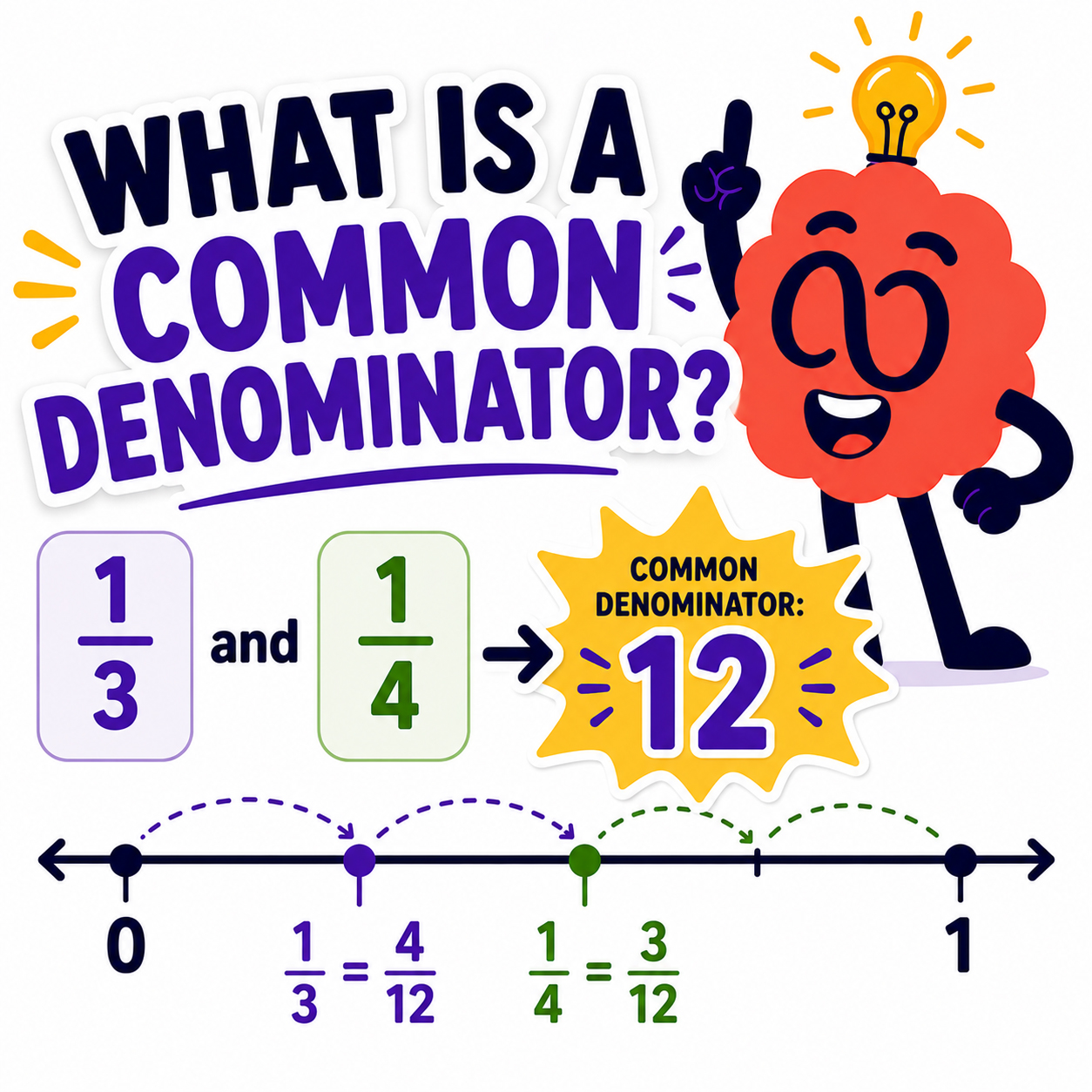
A common denominator is a shared multiple of the denominators of two or more fractions. For example, 1/3 and 1/4 share the number 12, since both 3 and 4 divide evenly into it. This shared bottom number is what lets fractions be added or subtracted once they no longer match on their own.
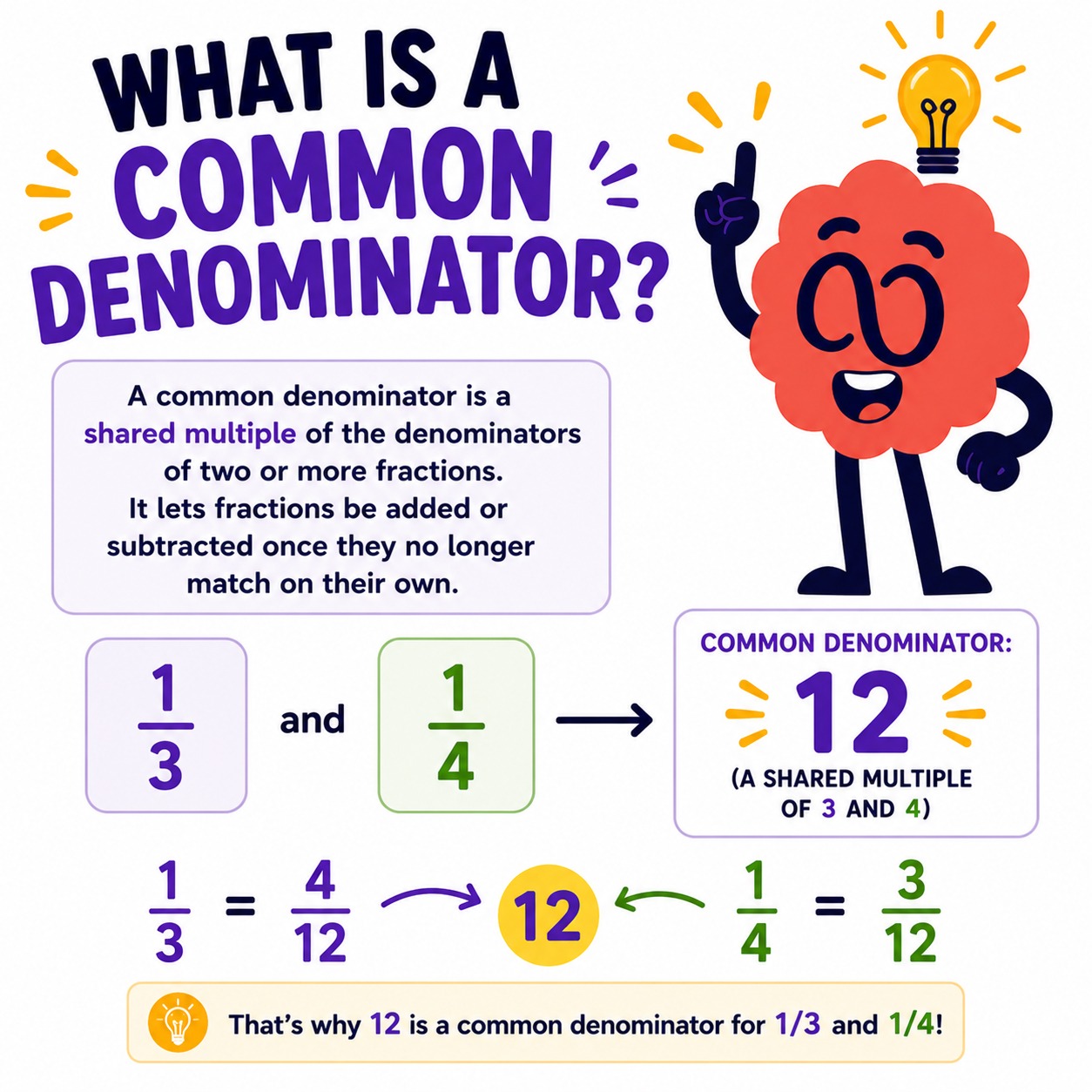
Here is the part that usually gets skipped. You cannot add 1/3 and 1/4 directly, the same way you cannot add 3 apples and 4 oranges and call the answer 7 of one thing. A third and a fourth are different sized pieces, so adding the top numbers alone does not mean anything.
Rewriting both fractions with a shared bottom number fixes that. Once the pieces are the same size, the numerators can finally be added or subtracted in a way that actually makes sense. That is the whole job here. It is not an extra step tacked onto fraction problems. It is what makes the operation valid in the first place.
This question comes up a lot, and the answer is simpler than it sounds. Any shared multiple of two denominators works. For 1/2 and 1/3, that could be 6, 12, 18, 24 and so on. All of them are valid.
The least common denominator, or LCD, is just the smallest one on that list. For 1/2 and 1/3, it is 6. Using a larger shared multiple like 24 still gives a correct answer, but it usually means more simplifying at the end. The LCD just keeps the numbers smaller along the way. Either approach works. The smaller option is only more convenient, not more correct.
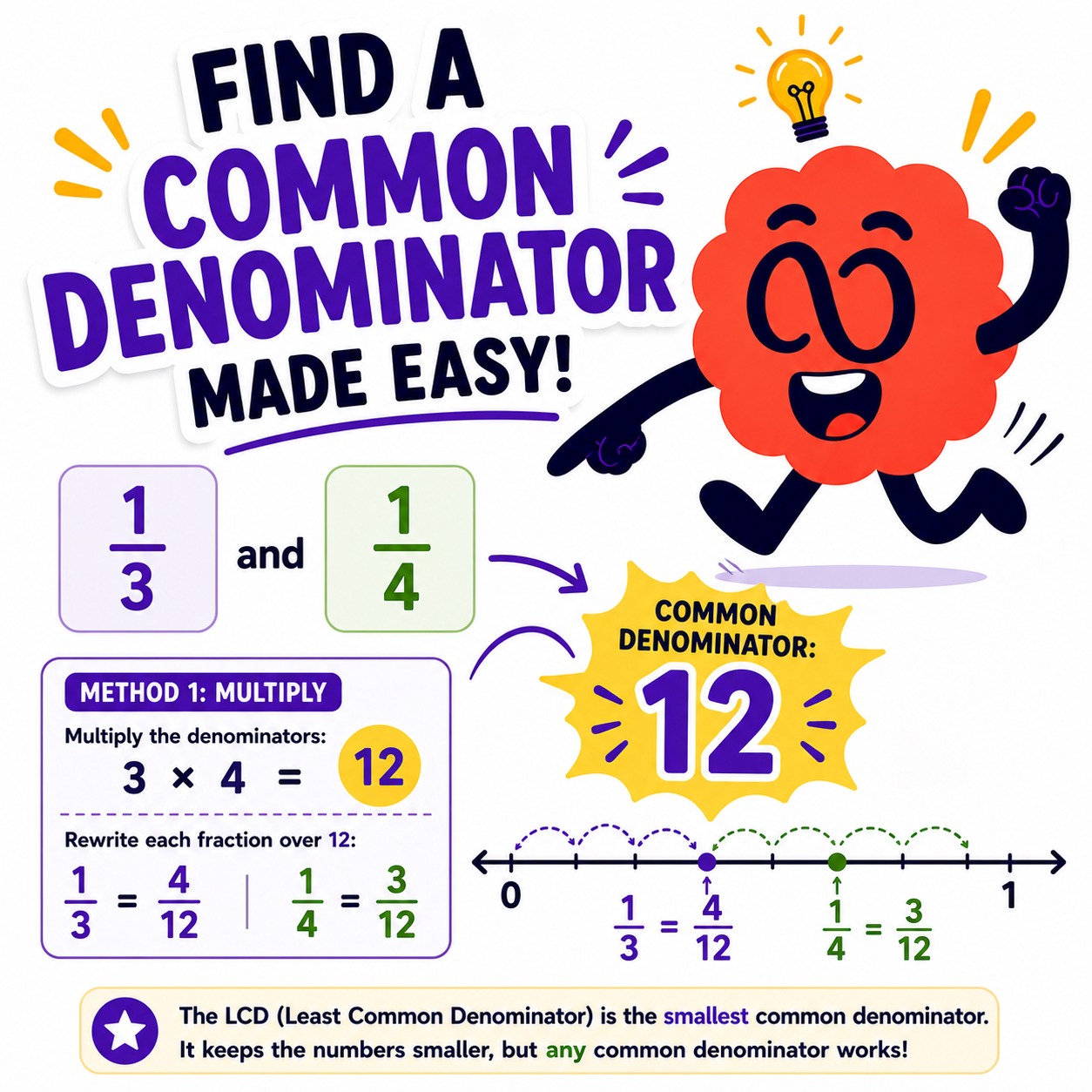
Using multiplication is one of the quickest ways to find a common denominator. Multiply the two denominators together.
For 1/3 and 1/4, multiply 3 by 4 to get 12. Both fractions can now be rewritten over 12: 1/3 becomes 4/12, and 1/4 becomes 3/12. This works for any pair of fractions, no exceptions, which makes it a safe fallback even when the numbers look awkward. Rewriting each fraction this way is really just creating an equivalent fraction with a matching bottom number, so it helps to be comfortable with how that works before relying on this shortcut.
The tradeoff is that multiplying straight across does not always give the smallest possible result, which can leave extra simplifying to do afterward.
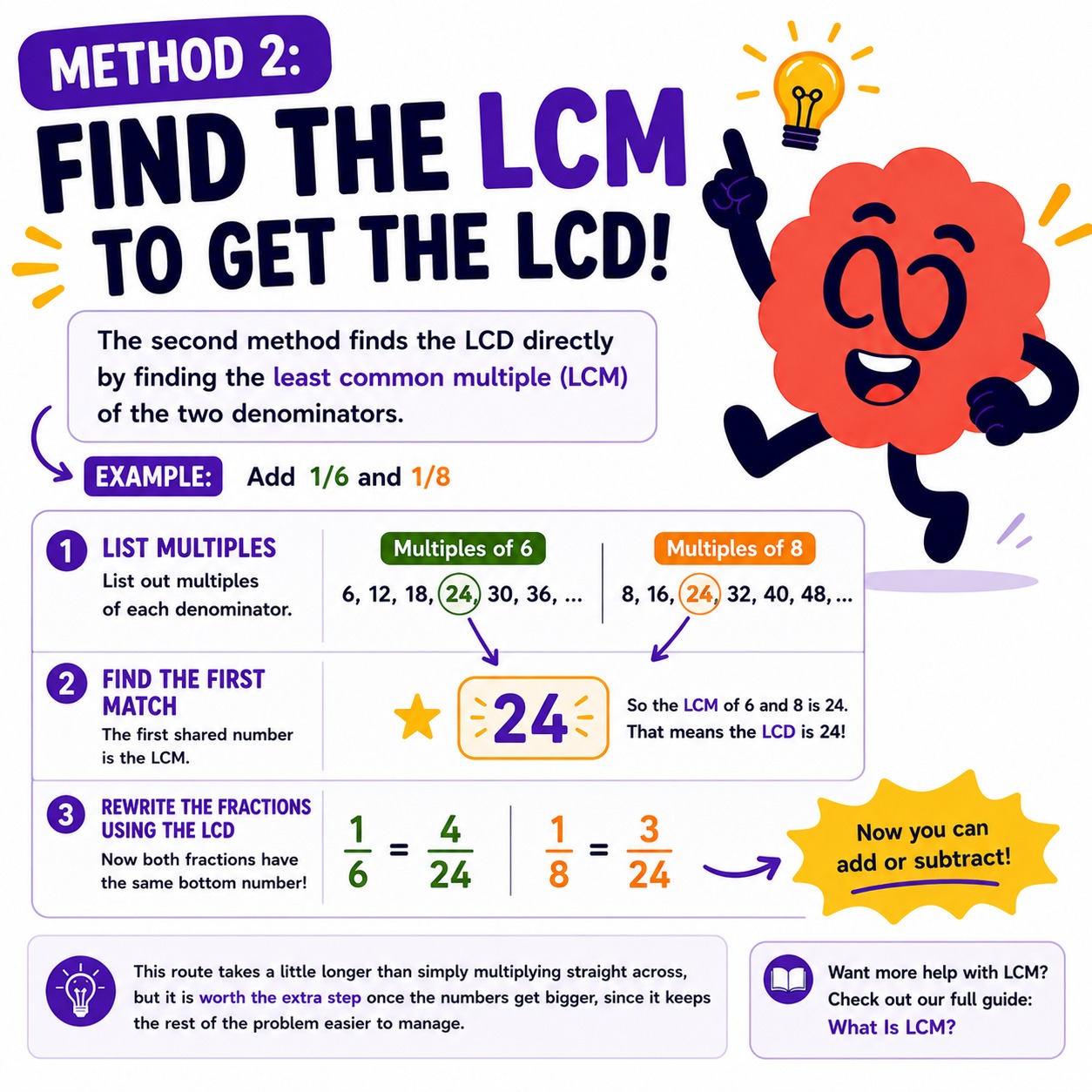
The second method finds the LCD directly by finding the least common multiple, or LCM, of the two denominators.
For 6 and 8, list out multiples of each until one matches: 6, 12, 18, 24 and 8, 16, 24. The first shared number is 24, so that is the LCM and also the smallest option available here. Our full guide on What Is LCM? walks through this process step by step if multiples are still a shaky concept.
This route takes a little longer than simply multiplying straight across, but it is worth the extra step once the numbers start getting bigger, since it keeps the rest of the problem easier to manage.
Once both fractions share the same bottom number, adding or subtracting is the easy part. Take 1/3 + 1/4. Using 12, the problem becomes 4/12 + 3/12, which adds up to 7/12.
That is the entire method behind adding fractions with different denominators. Our complete walkthrough on adding fractions and the dedicated guide to adding fractions with unlike denominators both build on this same idea, as does subtracting fractions, which uses the identical setup before the operation changes from addition to subtraction.
This is not technically wrong, just inefficient. Using 12 for 1/2 and 1/3 works fine, but 6 would have been simpler. The fraction will still come out correct either way. The only cost is extra simplifying at the end.
A bigger, genuinely wrong mistake is adding the bottom numbers themselves, turning 1/3 + 1/4 into something over 7. The denominators are never added together. Only the numerators are, and only after both fractions already match on the bottom.
This skill is typically introduced in grade 4, first with simple cases and then extended to genuinely different denominators. The Common Core math standards call for grade 5 students to add and subtract fractions with unlike denominators by replacing them with equivalent fractions first, which is exactly the skill this post covers. By grade 5, finding a shared multiple becomes a routine first step inside addition, subtraction, and comparison problems, used without much separate instruction since it is assumed to already be in place.
• Any shared multiple of two denominators will work, while the least common one is simply the smallest.
• Multiplying straight across always works but can leave bigger numbers to simplify.
• Finding the LCM takes a bit longer but keeps the numbers smaller.
• Never add the bottom numbers themselves, only the top numbers once they match.
It is a shared multiple of the denominators of two or more fractions, which allows them to be rewritten in matching terms so they can be added, subtracted or compared.
The least common denominator, or LCD, is the smallest shared multiple of two or more denominators. It is found by calculating the least common multiple of the numbers involved.
There are two common methods. The first multiplies the denominators together, which works for any pair of fractions. The second finds the least common multiple of the denominators, which gives the smallest possible result.
A common denominator is any shared multiple of the denominators involved. The least common version is specifically the smallest of those shared multiples, which keeps the resulting numbers easier to work with.
Finding a common denominator is the skill that unlocks adding and subtracting fractions with different denominators. Once students understand how a common denominator works, fraction operations become much easier.
Once the idea of a common denominator makes sense, adding and subtracting fractions becomes much less intimidating.
Book a free assessment today and explore our Grade 3, Grade 4, and Grade 5 math programs.