
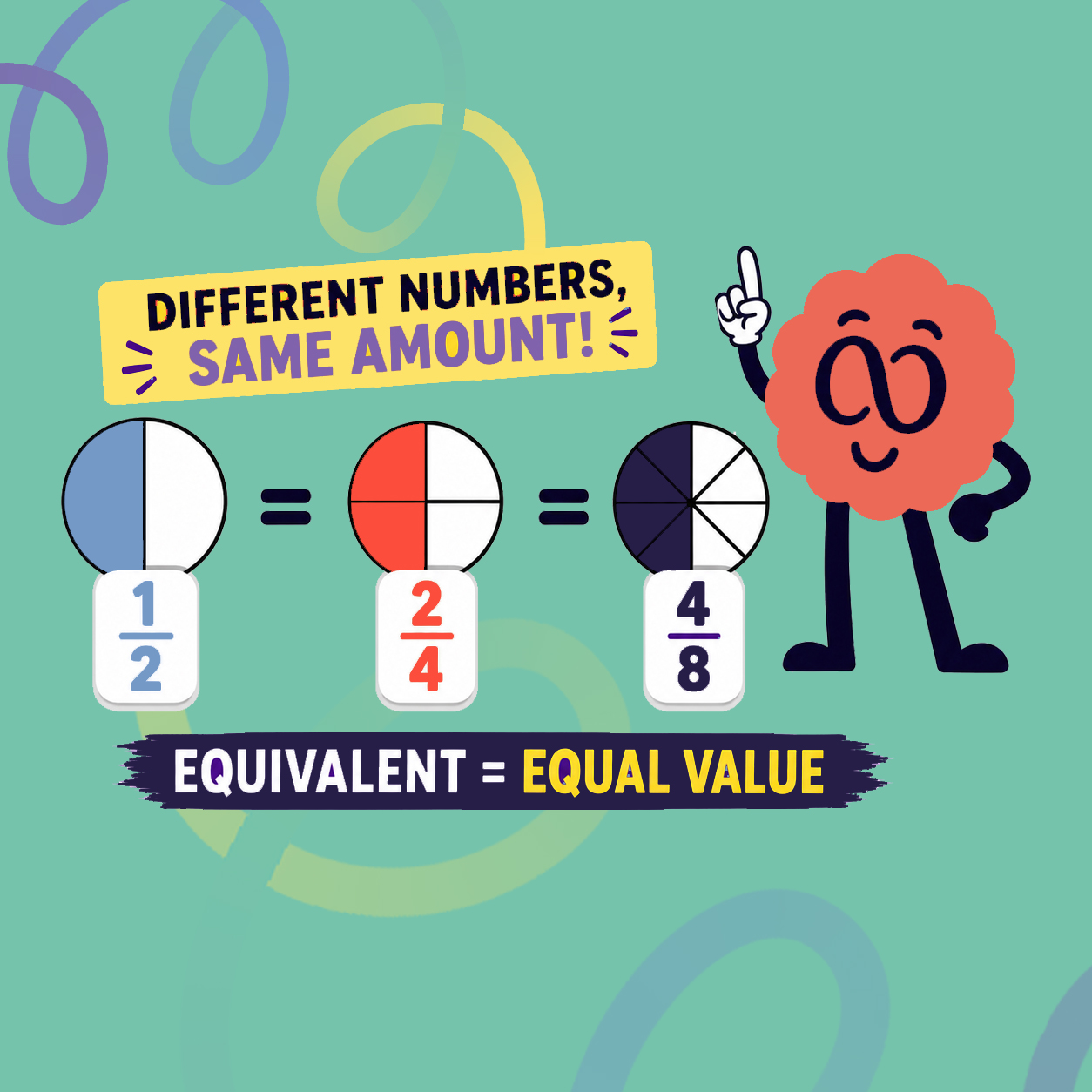
What are equivalent fractions? Equivalent fractions are fractions that look different but represent the same value. For example, 1/2, 2/4, and 4/8 all represent one-half, even though the numerators and denominators are different.
Understanding equivalent fractions makes it easier to find common denominators, and perform other fraction operations.
Equivalent fractions have different numerators and denominators but represent the same amount. For example, 1/2 and 2/4 are equivalent because they both represent half of a whole, even though the numbers look different.
If you're still getting comfortable with the basics, start with our What Is a Numerator and Denominator? guide. This skill builds directly on that foundation.
What Are Equivalent Fractions, Really?
So let’s look at it this way. Imagine two pizzas that are exactly the same size.
Cut the first pizza into 2 equal slices and take 1 slice. You have 1/2 of the pizza.
Cut the second pizza into 4 equal slices and take 2 slices. You have 2/4 of the pizza.
You ate the same amount of pizza both times. The slices just got cut differently.
That’s the whole idea. Different numbers, same amount.
How to Find Equivalent Fractions
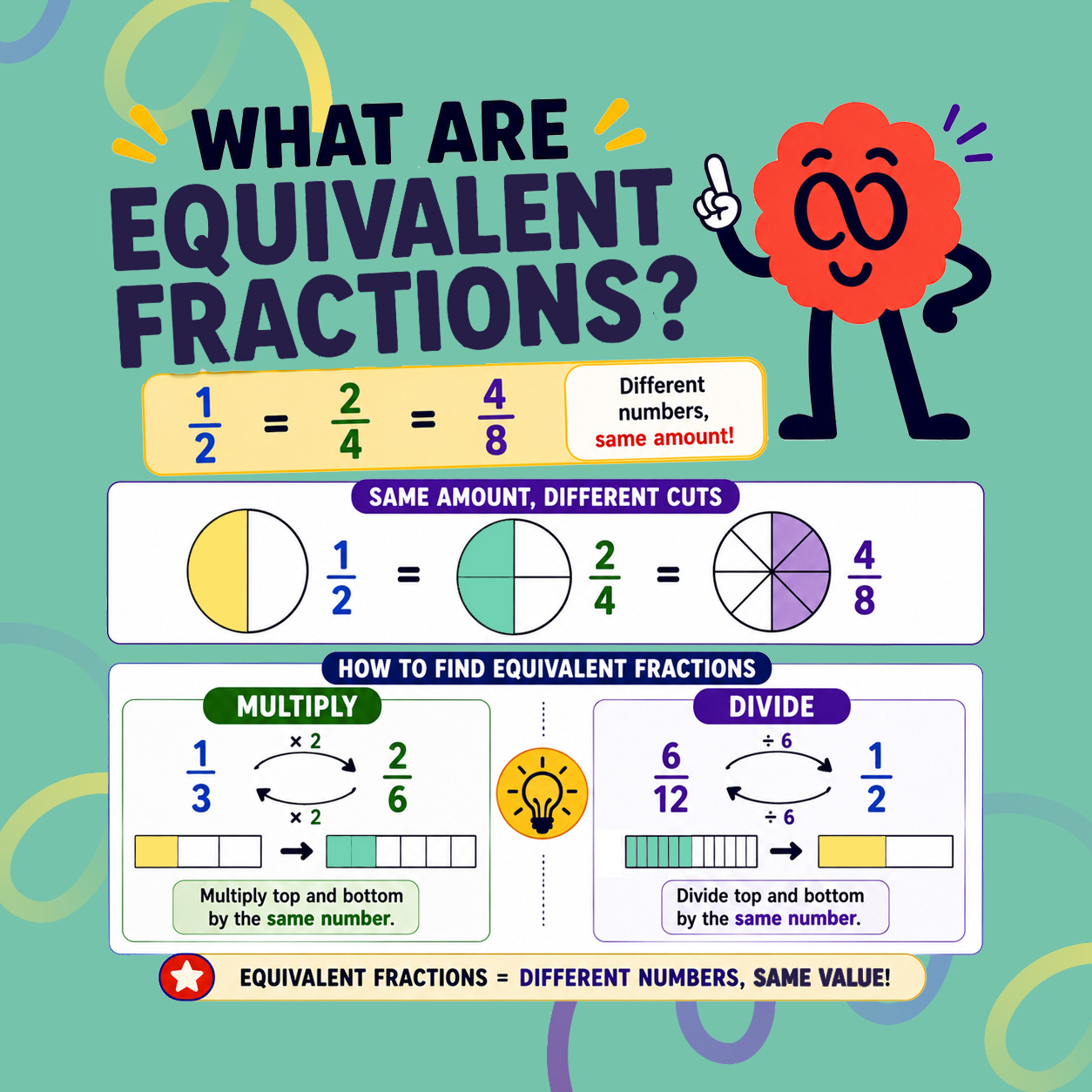
Learning how to find equivalent fractions is easier than it might seem. The basic rule is simple: multiply or divide both the numerator and denominator by the same number.
Method 1: Multiply the Numerator and Denominator
Start with the fraction 1/3.
Choose a whole number, such as 2, and multiply both parts of the fraction by that number.
1 × 2 = 2
3 × 2 = 6
This gives you 2/6.
Since both numbers were multiplied by the same value, 1/3 and 2/6 are equivalent fractions.
Method 2: Divide the Numerator and Denominator
You can also work in reverse by dividing.
Take the fraction 6/12.
Divide both the numerator and denominator by 6.
6 ÷ 6 = 1
12 ÷ 6 = 2
This gives you 1/2.
Because both numbers were divided by the same value, 6/12 and 1/2 represent the same amount.
Equivalent Fractions Examples
Seeing a few side-by-side examples makes the idea click faster than any explanation.
1/2 is equivalent to 2/4, 3/6 and 4/8
2/3 is equivalent to 4/6, 6/9 and 8/12
1/4 is equivalent to 2/8, 3/12 and 4/16
Notice the pattern in each row. Every fraction in that row covers the same amount of space, even though the numbers keep changing.
How to Check if Two Fractions Are Equivalent
This is often the moment when people ask, “How do I know for sure if two fractions are equivalent?”
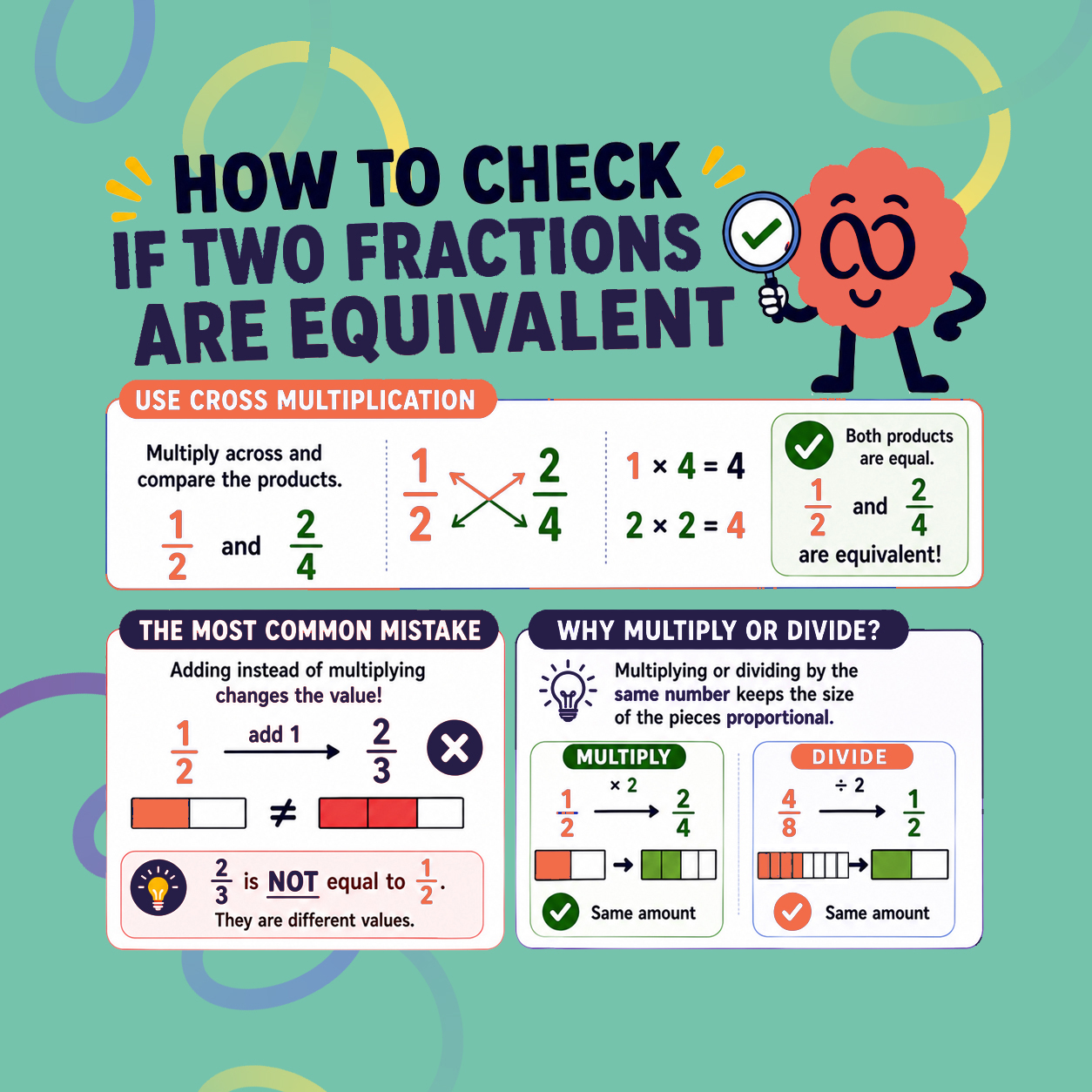
A reliable way to check is cross multiplication. Multiply the numerator of one fraction by the denominator of the other, then do the same in reverse.
Take 1/2 and 2/4.
1 × 4 = 4
2 × 2 = 4
Both answers match, which confirms 1/2 and 2/4 are equal in value.
If you want extra practice with this method, see How to Cross Multiply Fractions.
The Most Common Mistake: Adding Instead of Multiplying
When kids first learn equivalent fractions, they often add the same number to the numerator and denominator instead of multiplying.
For example, someone might take 1/2 and add 1 to both numbers:
2/3 ❌
But 2/3 is not equal to 1/2. It’s a completely different value.
It usually happens because adding feels more natural than multiplying. A helpful way to think about it:
“We have to multiply or divide, not add, because adding changes the size of the pieces unevenly.”
Once you see why adding breaks the fraction, this mistake mostly goes away.
Equivalent Fractions vs Simplifying Fractions
A common question is whether equivalent fractions and simplifying fractions are the same thing.
They’re closely related, but not quite the same.
Finding one usually means making a fraction bigger by multiplying. Simplifying a fraction means making it smaller by dividing until you reach the simplest form.
1/2 → 2/4 is finding an equivalent fraction.
4/8 → 1/2 is simplifying.
If you want a full walkthrough of the second skill, check out How to Simplify Fractions.
Practice Finding Equivalent Fractions at Home
In real life, this idea shows up more often than people realize.
1. Measuring Cups
A recipe calls for 1/2 cup of sugar, but you only have a 1/4 cup scoop.
Ask: “How many scoops make 1/2 cup?”
Two scoops of 1/4 cup equal 1/2 cup, which means 2/4 and 1/2 are equal in value.
2. Sharing Snacks
Two kids split a candy bar into 2 equal pieces. A third kid splits an identical bar into 4 equal pieces and takes 2.
Ask: “Did they get the same amount?”
Yes, because 1/2 and 2/4 are equivalent.
3. Folding Paper
Fold a strip of paper in half, then in half again.
Ask: “How many sections do you have now, and how many would you need to color in to match the first fold?”
This hands-on activity makes the idea easy to see instead of just read about.
Quick Check: 3 Questions to Test Understanding
A quick way to check your understanding is to explain the reasoning behind each answer rather than memorizing rules.
Try these questions.
Question 1
Are 3/4 and 6/8 equal in value? How do you know?
Question 2
What number would you multiply 2/5 by to get a denominator of 15?
Question 3
Why doesn’t adding the same number to the numerator and denominator create an equivalent fraction?
Listen for the reasoning, not just the answer. If you can explain why two fractions represent the same value, that’s real understanding.
Key Takeaways
• These fractions look different but represent the same amount.
• To find one, multiply or divide the numerator and denominator by the same number.
• Cross multiplication is a fast way to check if two fractions are equivalent.
• The most common mistake is adding instead of multiplying.
• These two ideas are related but move in opposite directions.
• Real-world examples like measuring cups and folded paper make this idea easier to understand.
Frequently Asked Questions
What are equivalent fractions?
Equivalent fractions are fractions that look different but represent the same value. For example, 1/2 and 2/4 both equal half of a whole, just written differently.
How do you find equivalent fractions?
Multiply or divide the numerator and denominator by the same whole number. As long as you do the same operation to both numbers, the result will be an equivalent fraction.
How can you tell if two fractions are equivalent?
Use cross multiplication. Multiply the numerator of each fraction by the denominator of the other. If both answers match, the fractions are equivalent.
What Is the Rule for Equivalent Fractions?
There is no separate formula to memorize. As long as you multiply or divide the numerator and denominator by the same nonzero number, the fraction's value stays the same. That's the key rule behind equivalent fractions.
Are 2/4 and 1/2 equivalent fractions?
Yes. Both fractions represent exactly half of a whole, even though the numbers are different.
What is the difference between equivalent fractions and simplifying fractions?
Finding them usually means multiplying to make a larger version of a fraction. Simplifying means dividing to reach the smallest possible version.
Why do equivalent fractions matter?
They’re the foundation for comparing fractions, adding fractions with different denominators and simplifying fractions later on.
Once you understand equivalent fractions, the next step is Comparing Fractions, where this same skill helps figure out which fraction is bigger.
Equivalent fractions are a common building block in Grade 3 through Grade 5. Our tutors pinpoint exactly where you're getting stuck and explain fractions in a way that makes sense.
Book a free assessment today and explore our Grade 3, Grade 4 and Grade 5 math programs.