
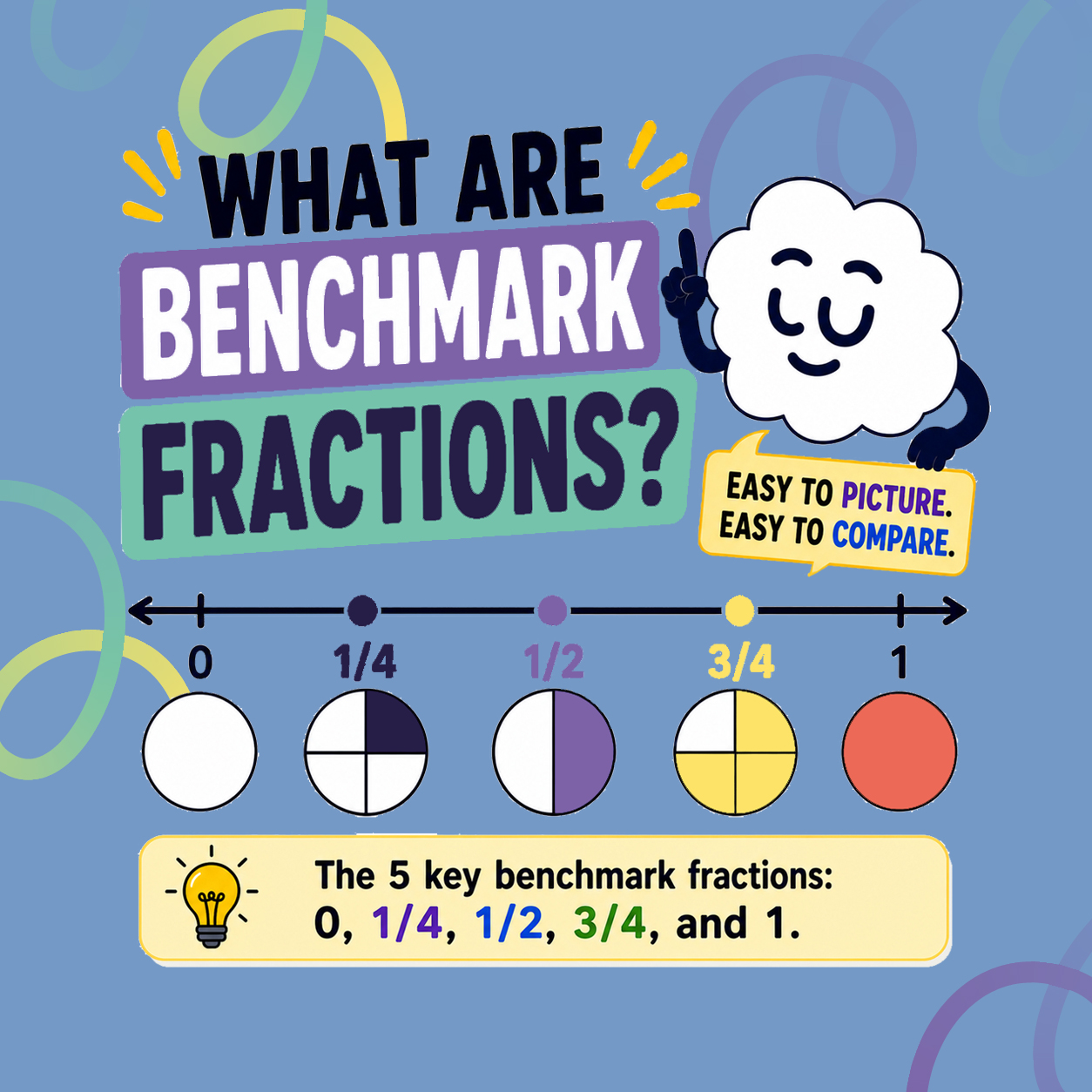
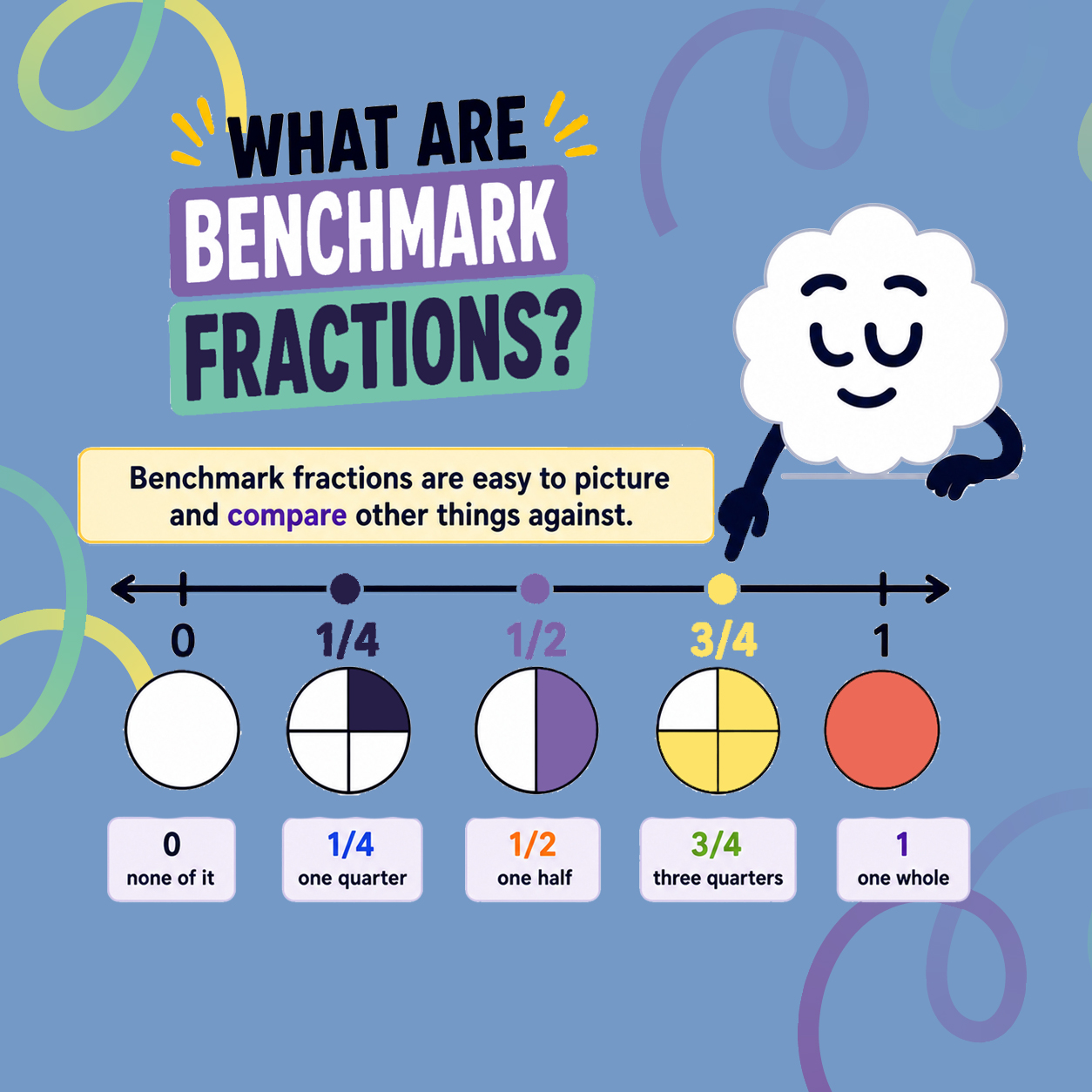
Benchmark fractions are just fractions that are easy to picture and compare other things against. The five everyone agrees on are 0, 1/4, 1/2, 3/4, and 1
What makes a number a benchmark is not anything fancy. It is just that most people already carry a mental picture of it. You know what half a pizza looks like without thinking twice. That is the whole point of benchmark fractions: they borrow a picture you already have stored in your head.
Before this clicks fully, it helps to be solid on what a fraction actually represents in the first place.
Why This Shortcut Matters: Estimation Without a Calculator
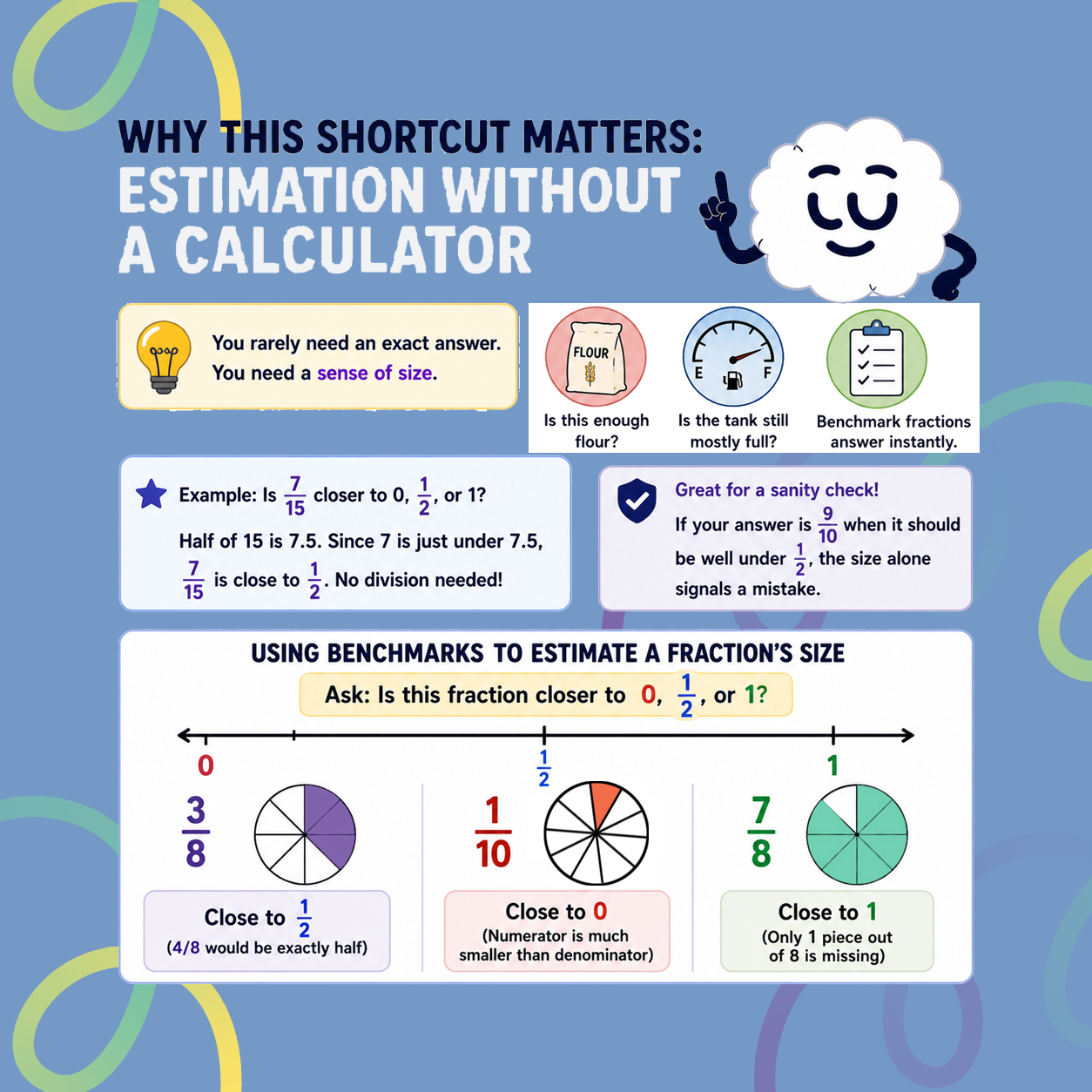
Here is the thing about most fraction questions in real life. You rarely need an exact answer. You need a sense of size. Is this enough flour? Is the tank still mostly full? Benchmark fractions answer that kind of question instantly.
Think about it this way. If someone asks whether 7/15 is closer to nothing, half, or a whole, there is no need to do division. 7/15 sits just under half of 15, so it lands close to 1/2. That is the entire calculation.
This matters because it also works as a sanity check on homework. If you solve a problem and land on something like 9/10 when the real answer should be well under 1/2, the size alone signals a mistake, often before you even look at the steps.
Using Benchmarks to Estimate a Fraction's Size
The method comes down to one question: is this fraction closer to 0, 1/2 or 1?
Try it with a few examples. 3/8 is close to 1/2, since 4/8 would be exactly half. 1/10 is close to 0, because the numerator is so small next to the denominator. 7/8 is close to 1, since only one piece out of eight is missing.
You can run this check on almost any fraction in a few seconds, in your head. And if seeing it laid out helps, our guide to fractions on a number line shows exactly where these benchmarks sit.
Using the 1/2 Pivot to Compare Two Fractions
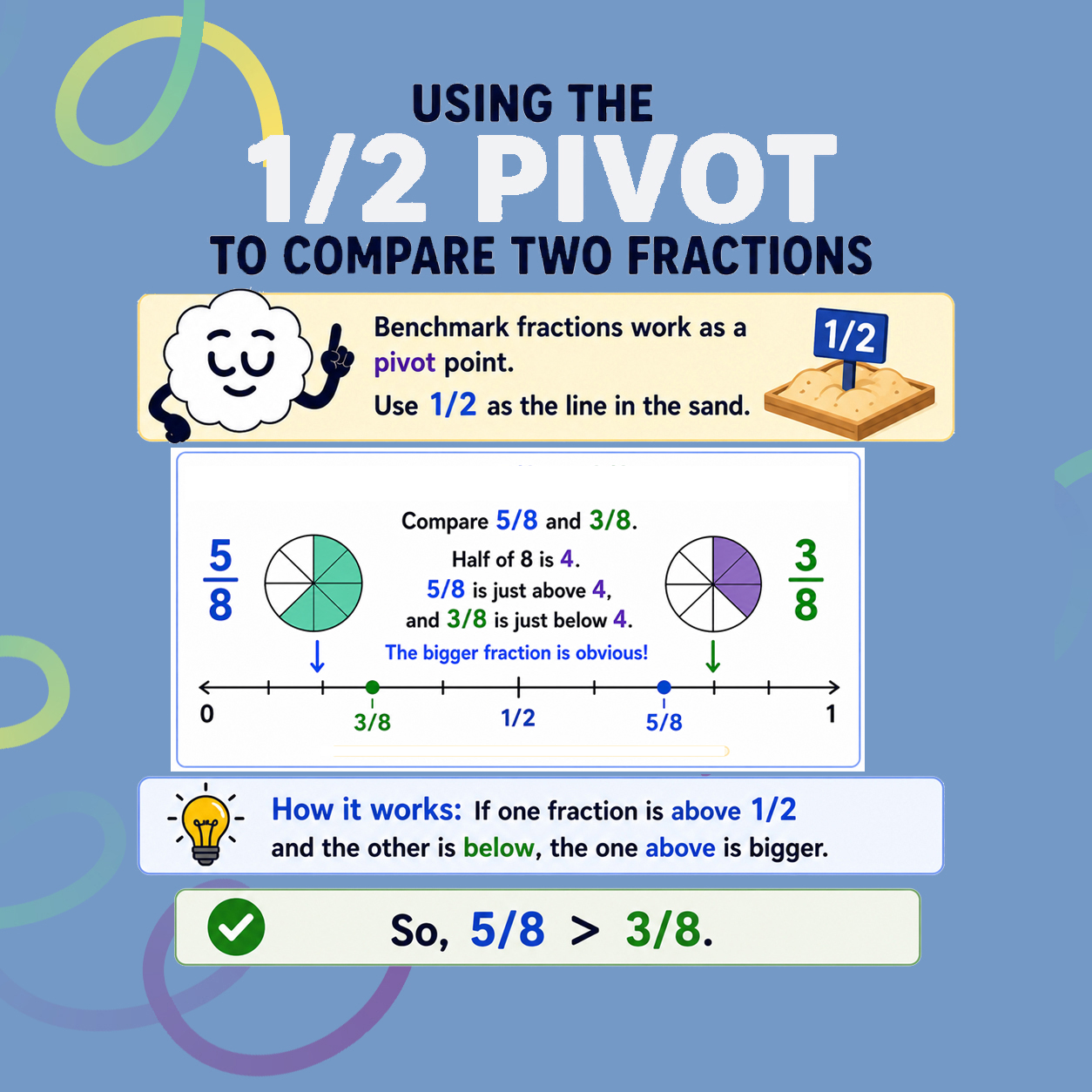
Benchmark fractions also work as a pivot point when two fractions need to be compared quickly. Use 1/2 as the line in the sand.
Take 5/8 and 3/8. Half of 8 is 4. Since 5/8 sits just above that line and 3/8 sits just below it, the bigger fraction is obvious right away, with no common denominator and no division involved.
This shortcut will not replace the full method for comparing fractions when two numbers sit close together, and sometimes it pays to convert one fraction first using equivalent fractions before judging size. But for a quick read, the 1/2 pivot earns its keep nine times out of ten.
Benchmark Fractions in Real Life
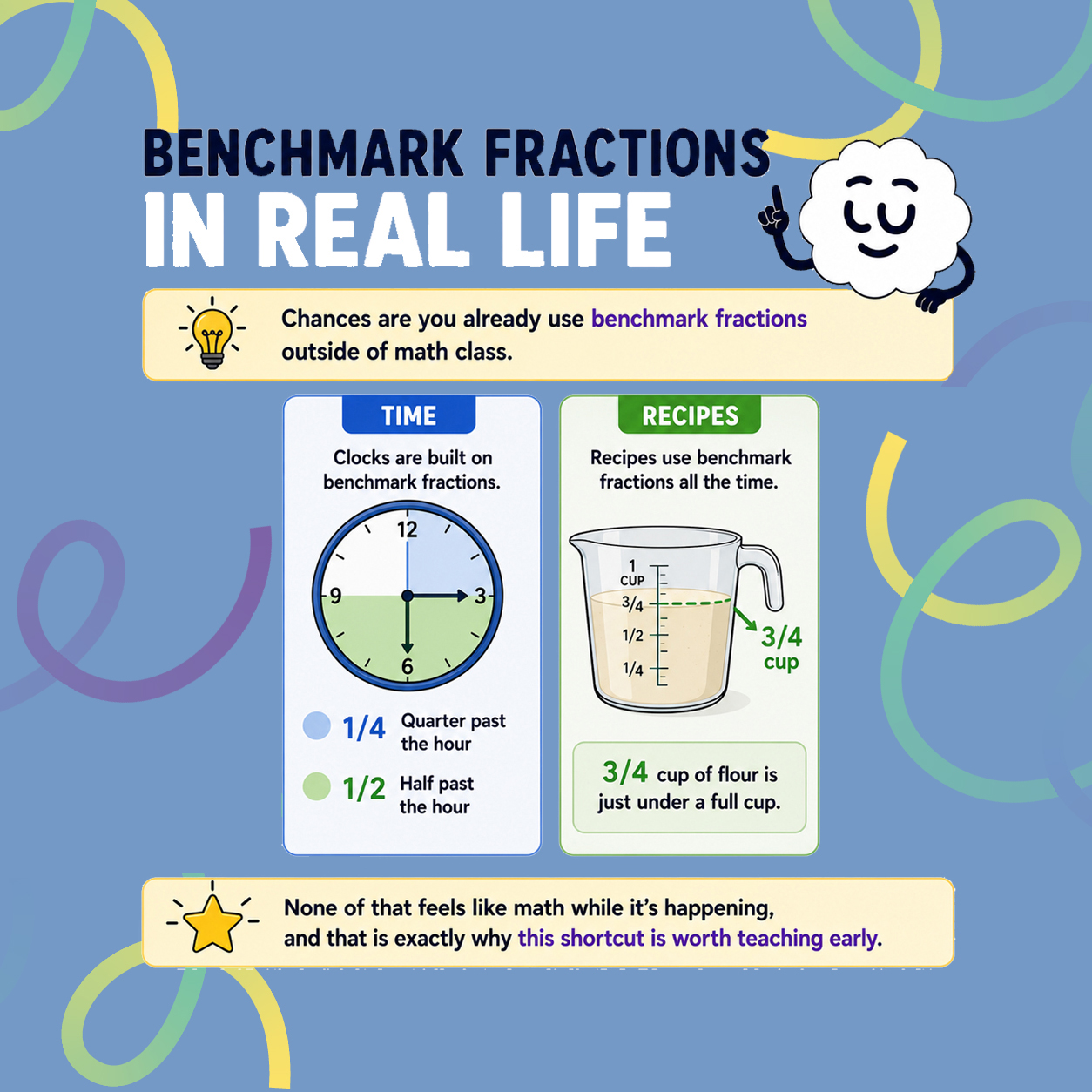
Chances are you already use benchmark fractions outside of math class.
Time works this way. Quarter past the hour is 1/4. Half past is 1/2. Recipes lean on the same idea. A recipe asking for 3/4 cup of flour is really saying just under a full cup. Sharing does too. If two people split a pizza and one takes slightly more, most people would say they got just over half, not fifty three percent.
None of that feels like math while it is happening, and that is exactly why this shortcut is worth teaching early.
When Will You Learn This Skill?
In grade 3, kids start identifying and using 1/2 visually, usually with shapes or simple number lines. In grade 4, 1/4 and 3/4 join the mix, along with comparing fractions against those benchmarks. By grade 5, this kind of thinking shows up inside estimation and word problems rather than as its own lesson.
The Common Core math standards call out comparing fractions to a benchmark such as 1/2 as a grade 4 expectation, so this is not an extra topic bolted on for fun. It sits inside the core curriculum. If you're working through grade 3 fraction basics right now, our guide built specifically for 3rd grade fractions breaks down what else to expect that year.
The Most Common Mistake With Benchmarks
People often assume only 1/2 counts and then try to force every fraction to compare against it, even when 1/4 or 3/4 would be the faster fit. A fraction like 7/8 reads far more easily as close to 1 than as some awkward half comparison. Let the nearest benchmark do the work instead of reaching for the most familiar one out of habit.
Quick Takeaways
• Memorize the five reference points: 0, 1/4, 1/2, 3/4 and 1.
• Ask whether a fraction is closer to 0, 1/2 or 1 before doing any actual math.
• Use 1/2 as a pivot to compare two fractions without finding a common denominator.
• Look for this kind of thinking in everyday moments like cooking and telling time.
Frequently Asked Questions
What are benchmark fractions?
Benchmark fractions are common, easy to picture fractions used as reference points for estimating and comparing other fractions. The most widely used set is 0, 1/4, 1/2, 3/4 and 1.
What are the 5 benchmark fractions?
The five standard benchmark fractions are 0, 1/4, 1/2, 3/4 and 1. Some teachers also bring in 1/3 and 2/3, but those five form the core set used in most classrooms.
How do you use benchmark fractions?
Compare the fraction in question to the closest benchmark by asking whether it leans toward 0, 1/2 or 1. You can also use 1/2 as a pivot point to compare two fractions to each other without finding a common denominator.
What are benchmark numbers in fractions?
Benchmark numbers is just another name for the same idea.
Are benchmark fractions the same as equivalent fractions?
No. Equivalent fractions are different ways of writing the same value, like 1/2 and 2/4. These reference points exist to estimate or compare fractions instead.
Benchmark fractions are not a separate math topic to memorize and forget after the test. They are a shortcut that turns a calculation into a quick glance, and once it sticks, it tends to stay for good.
Benchmark fractions are a grade 3 to 5 mental math tool that makes estimation and comparison much faster. If you still reach for a long calculation where a quick benchmark check would do, our tutors teach the shortcut directly.
Book a free assessment today and explore our Grade 3, Grade 4 and Grade 5 math programs.