
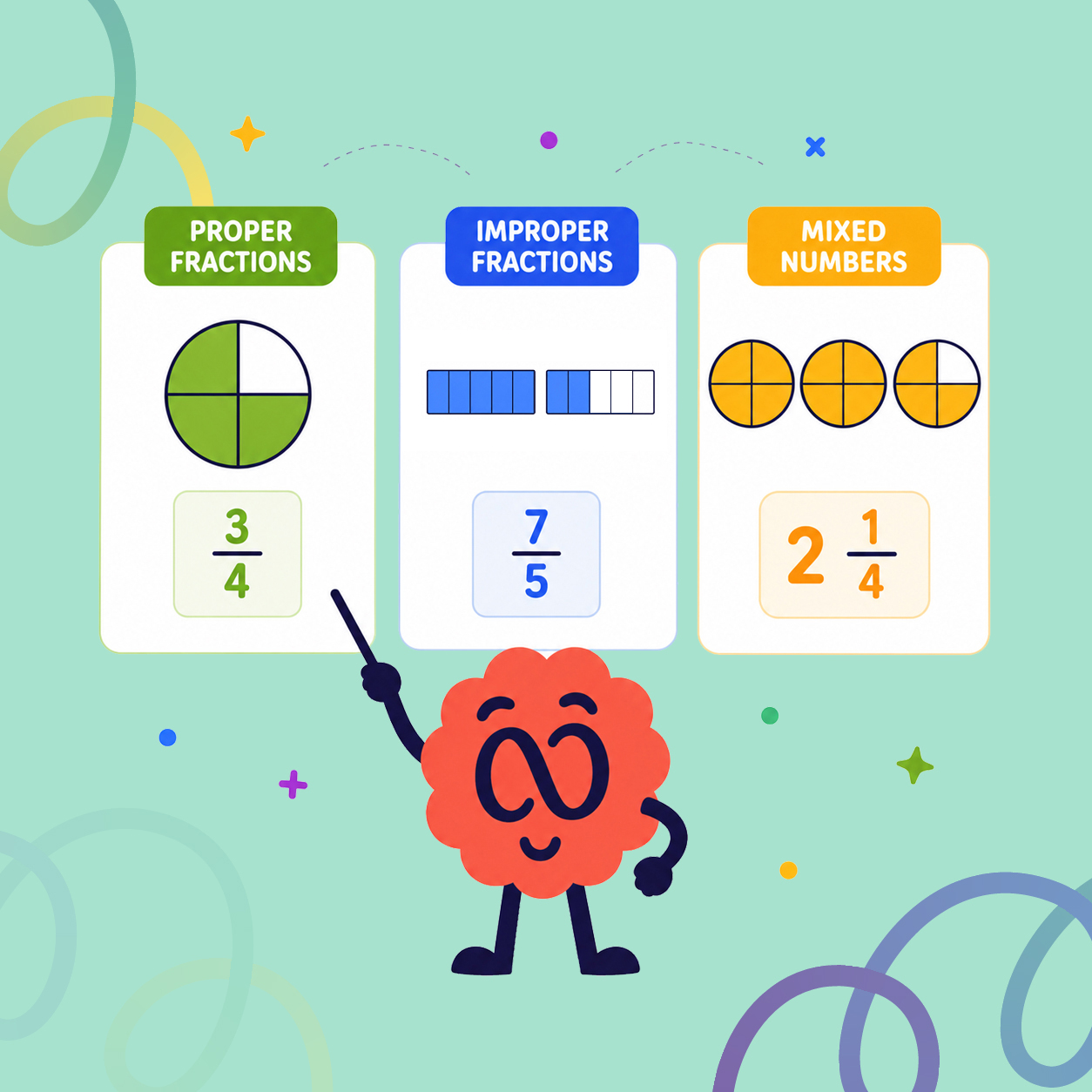
Fractions are not all the same. Depending on their numerator and denominator, a fraction can look and behave very differently. That's why math groups them into different types — and knowing each type makes working with fractions much easier.
But how many types of fractions are there, and which ones actually matter for students in elementary school? Let's find out.
How Many Types of Fractions Are There?
One of the most common questions is: “How many types of fractions are there?”
And here’s where the confusion starts. Some websites say there are 4 types of fractions. Others say there are 5, 7 or even 13 types of fractions. So which answer is correct?
Technically, all of them can be correct. Different math resources group fractions in different ways. But for most students in Grades 3 through 5, only a few types of fractions really matter:
- Proper fractions
- Improper fractions
- Mixed numbers
- Equivalent fractions
- Unit fractions
These are the types of fractions most likely to appear in class, on homework and on tests.
If you are completely new to fractions, you may also want to read our guide: What Is a Fraction?
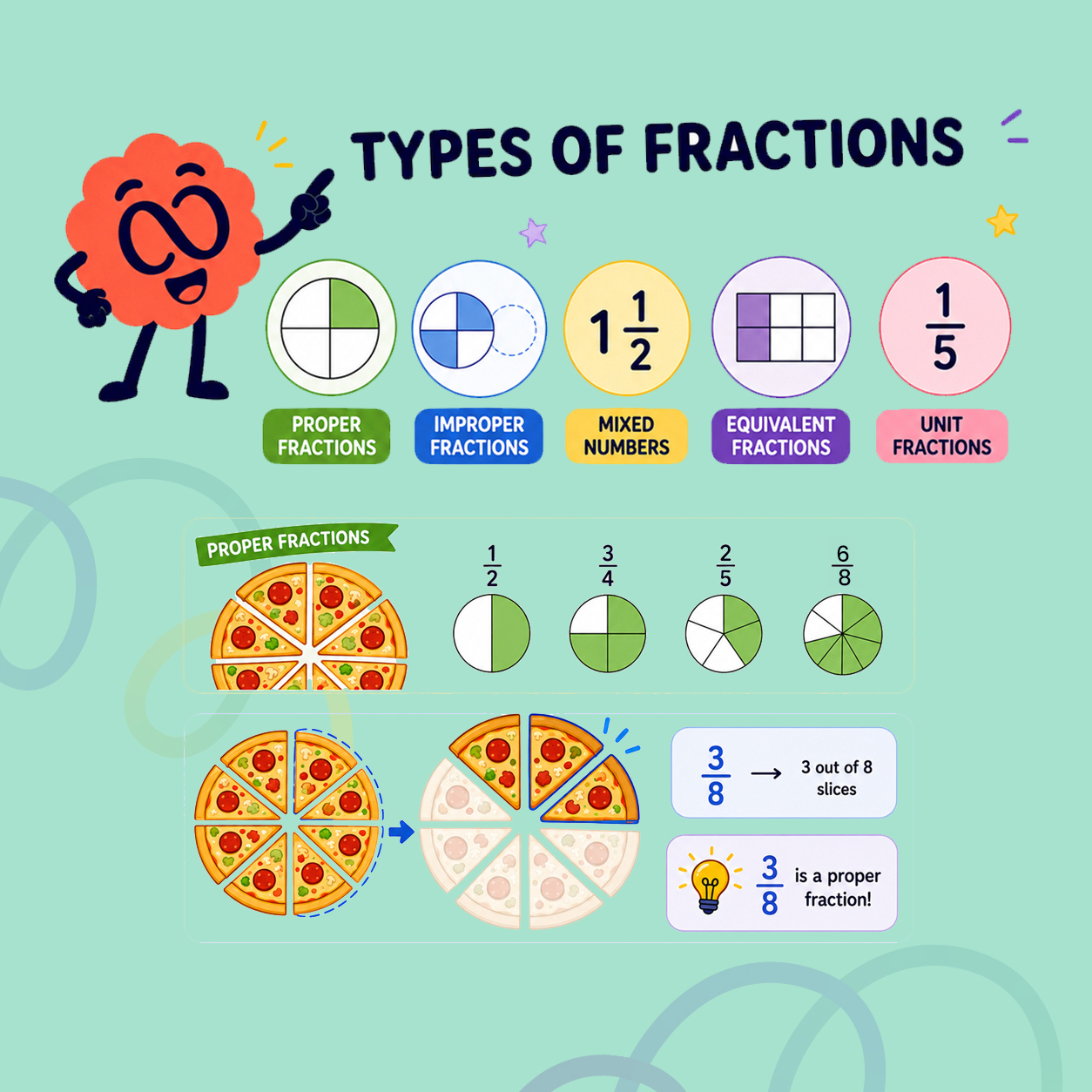
Proper Fractions
Proper fractions are usually the first types of fractions students learn.
A proper fraction has:
- A numerator that is smaller than the denominator
- A value that is less than one whole
Examples include: 1/2, 3/4, 2/5, 7/10
Let’s make this real. Imagine a pizza cut into 8 equal slices. Eating 3 slices means consuming 3/8 of the pizza. Since the entire pizza has not been eaten, 3/8 is a proper fraction.
A Question Students Often Ask
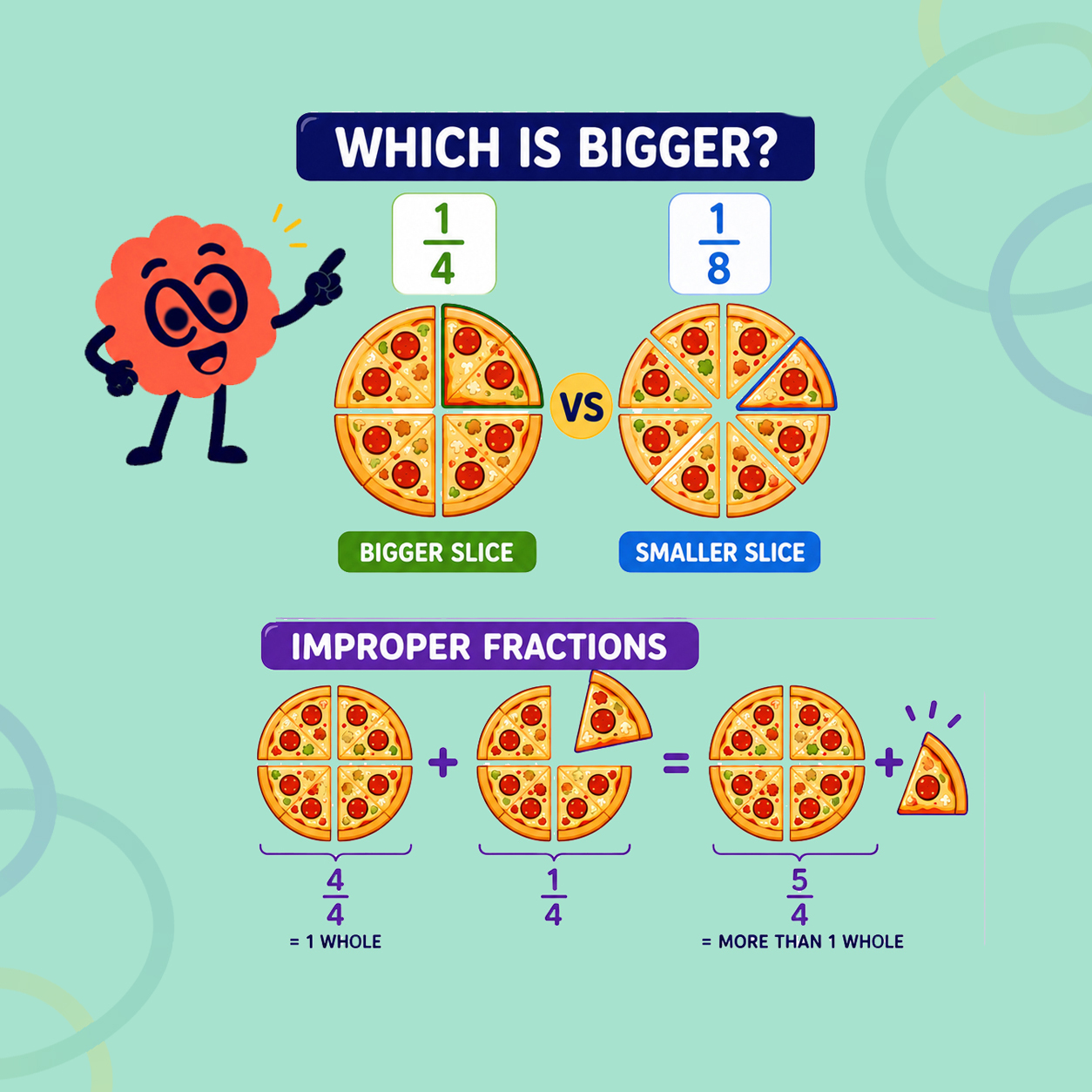
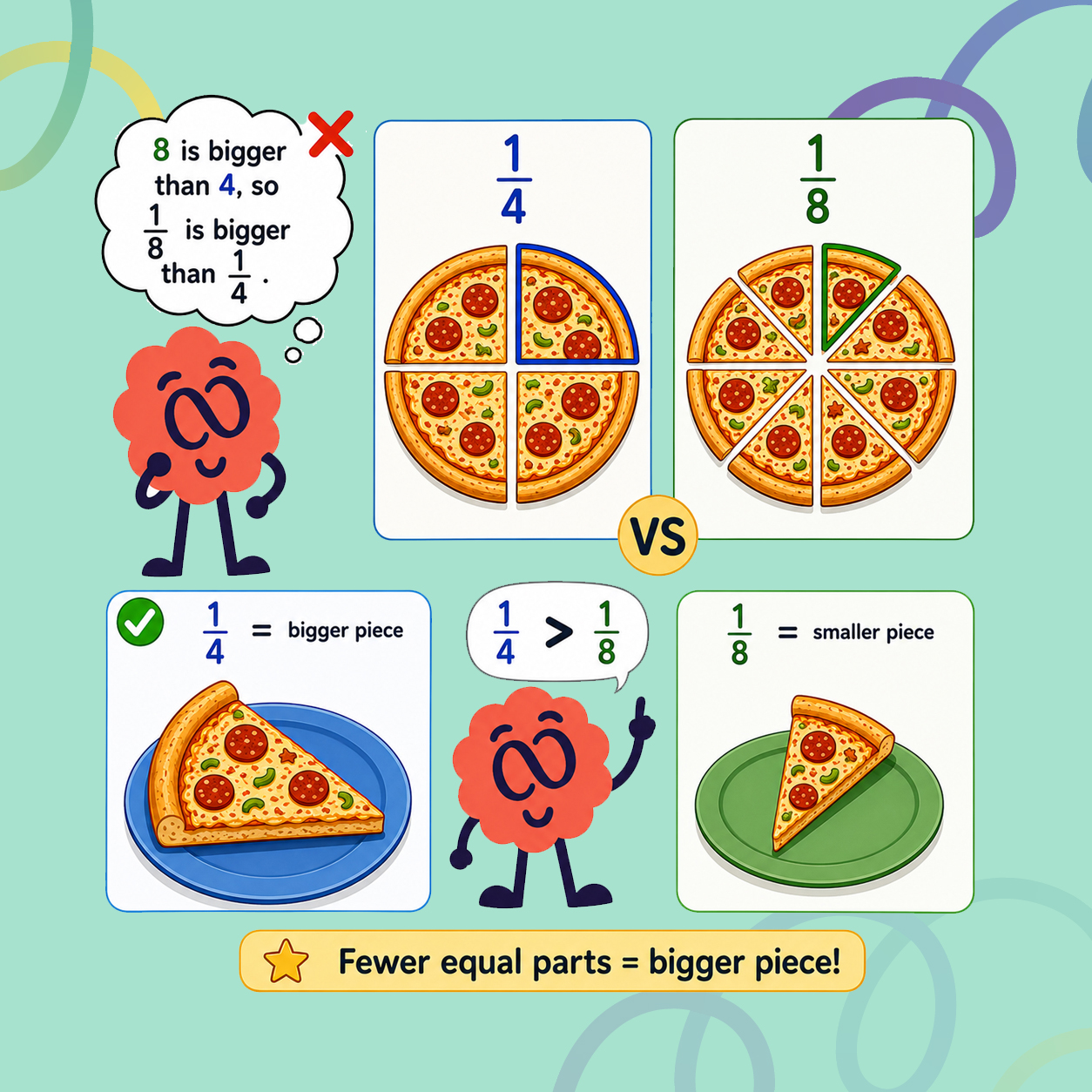
Which is bigger: 1/4 or 1/8?
Many students think 1/8 is bigger because 8 is larger than 4. But the opposite is true. If you cut a pizza into 8 pieces, each piece is smaller than if you cut it into 4 pieces. So: 1/4 is larger than 1/8.
Tip
Food examples work great for understanding proper fractions. Pizza slices, chocolate bars, sandwiches and cookies make fractions much easier to visualize than a worksheet.
Improper Fractions
Among all the types of fractions, improper fractions often cause the most confusion.
An improper fraction has:
- A numerator larger than the denominator
- A value greater than one whole
Examples include: 5/4, 7/3, 9/8, 11/5
The word “improper” sounds like something is wrong. But that’s not true at all. An improper fraction is perfectly correct. The word simply tells us that the fraction represents more than one whole.
A Simple Example
Imagine four slices making one whole pizza. If someone eats five slices, they have eaten 5/4 pizzas. That is more than one whole pizza. And that’s why 5/4 is called an improper fraction.
Tip
If “improper” sounds like something is wrong, remember: “Improper doesn’t mean incorrect. It just means the fraction is larger than one whole.” That simple reminder helps right away.
Mixed Numbers
Mixed numbers are another important group within the types of fractions.
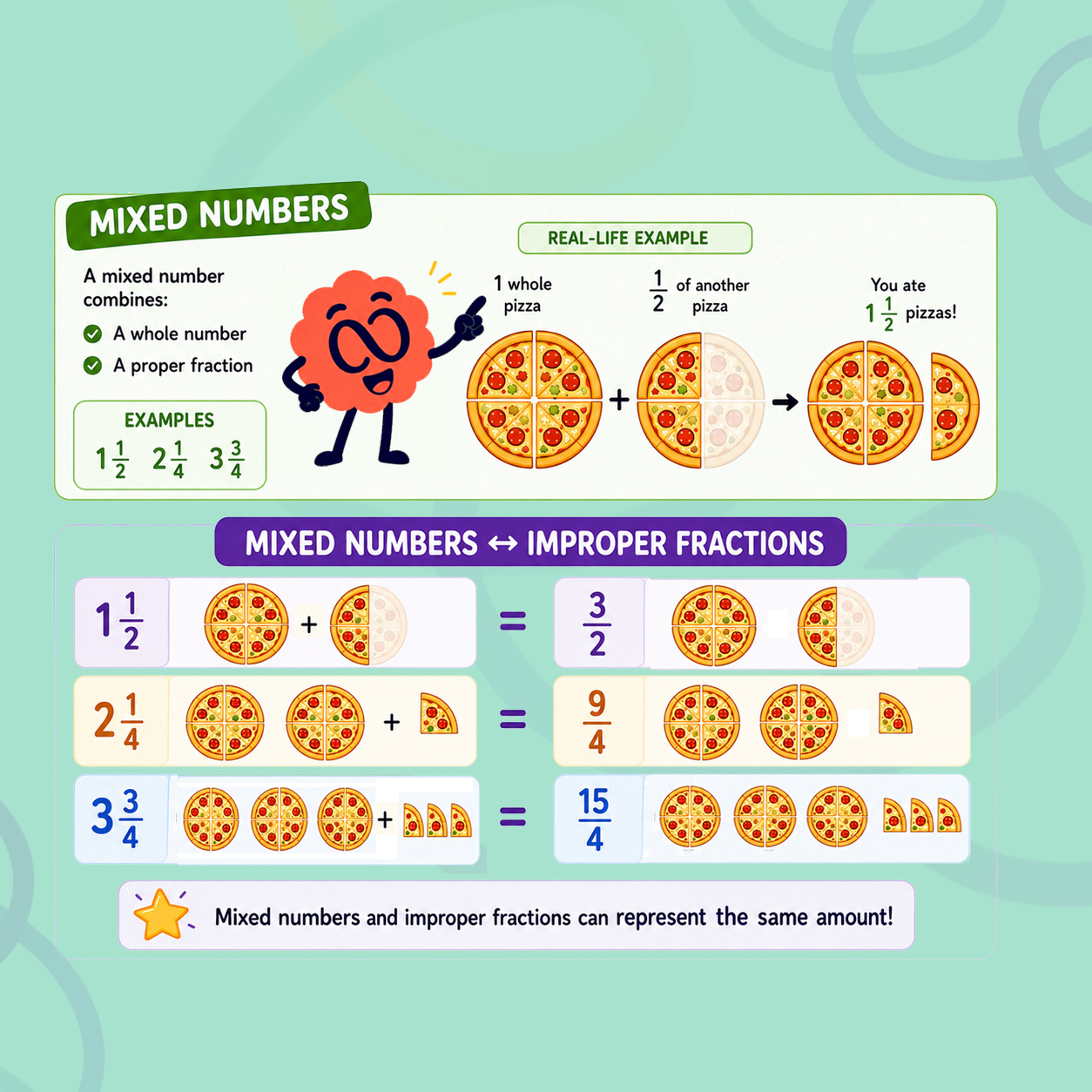
A mixed number combines a whole number and a proper fraction.
Examples include: 1½, 2¼, 3¾
Many students actually find mixed numbers easier to understand because they look more like numbers we use every day.
Real-Life Example
Imagine eating one whole pizza and half of another. That’s 1½ pizzas. Most students find this easier to picture than 3/2.
How Mixed Numbers Connect to Improper Fractions
Mixed numbers and improper fractions can represent the same amount. For example:
- 1½ = 3/2
- 2¼ = 9/4
- 3¾ = 15/4
Students usually learn how to switch between these forms in Grades 4 and 5. For a deeper explanation, check out our guide on Improper Fractions and Mixed Numbers.
Equivalent Fractions
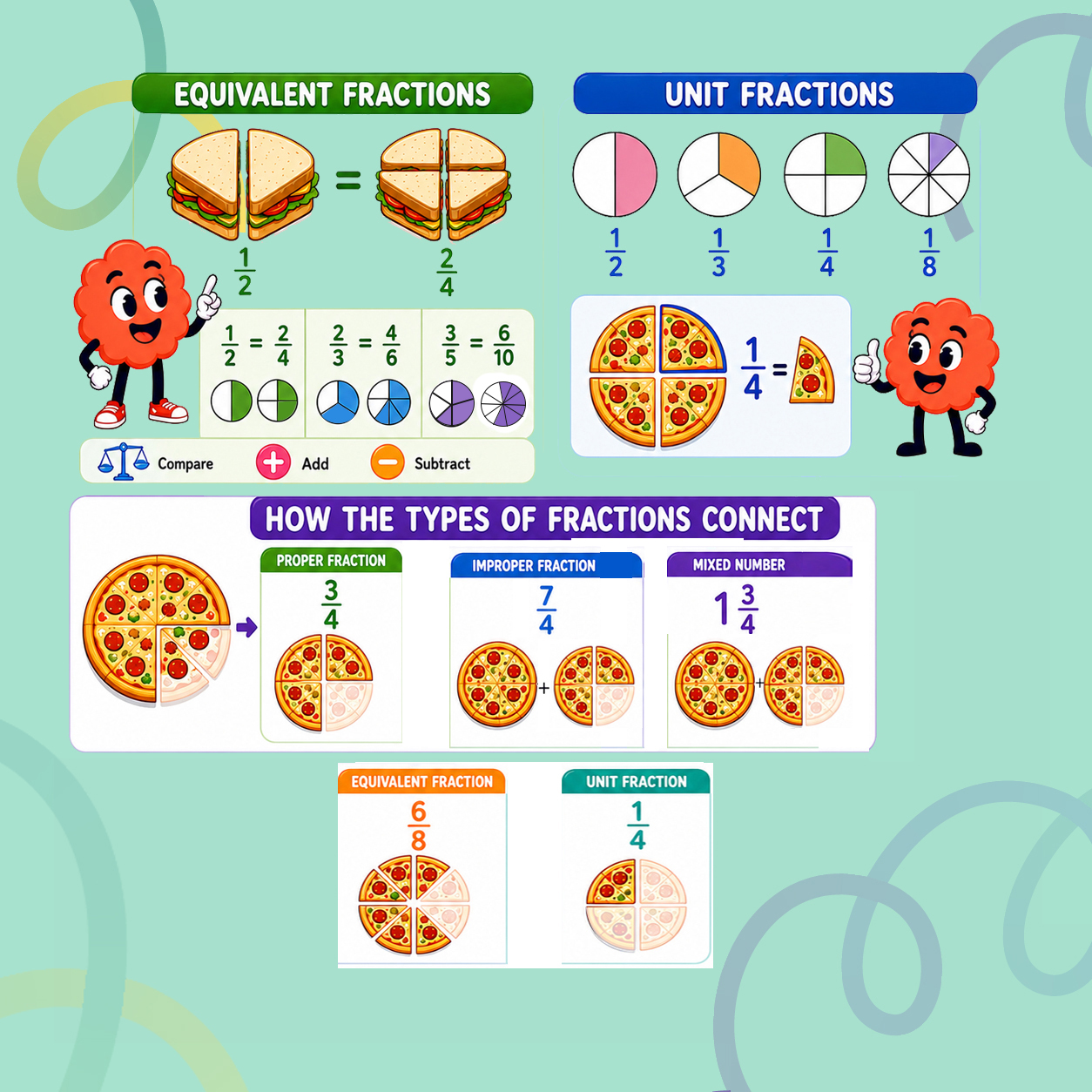
Equivalent fractions are fractions that look different but represent exactly the same value.
Examples include: 1/2 = 2/4, 2/3 = 4/6, 3/5 = 6/10
Think about a sandwich. If you cut it into 2 equal pieces, half the sandwich is 1/2. If you cut it into 4 equal pieces, half the sandwich is 2/4. The sandwich hasn’t changed. Only the way we describe it has changed.
Equivalent fractions are one of the most useful types of fractions because they are used when: comparing fractions, adding fractions and subtracting fractions.
Learn more in our guide on Equivalent Fractions.
Unit Fractions
Unit fractions are often introduced early in the fraction journey. A unit fraction always has a numerator of 1.
Examples include: 1/2, 1/3, 1/4, 1/8
Unit fractions help understand equal parts. For example: 1/4 means one piece out of four equal pieces. That’s why teachers often start with unit fractions before moving to other types of fractions.
For more examples, see our guide on What Is a Unit Fraction?
How the Types of Fractions Connect
[[table]]
Type|Example
Proper Fraction|$\frac{3}{4}$
Improper Fraction|$\frac{7}{4}$
Mixed Number|$1\frac{3}{4}$
Equivalent Fraction|$\frac{6}{8}$
Unit Fraction|$\frac{1}{4}$
[[/table]]
Once these connections are clear, fractions become much easier. Instead of memorizing different rules, you start seeing how all the ideas fit together.
Common Mistakes Students Make With Fractions
Most students struggle with the same few things.
Thinking Improper Means Wrong
This is very common. Remember that improper fractions are correct fractions. They are simply larger than one whole.
Mixing Up Mixed Numbers and Improper Fractions
Students often think they are different values. Remember that 1½ = 3/2.
Thinking Bigger Numbers Mean Bigger Fractions
Students may think 1/8 is bigger than 1/4 because 8 is larger than 4. A food example is the best way to show why this is not true.
How to Practice Fractions in Everyday Life
No special worksheets or expensive apps are needed. Simple everyday activities can help.
Try asking:
- Is half a sandwich a proper fraction?
- Is 5/4 a proper fraction or an improper fraction?
- Can we turn 3/2 into a mixed number?
- Which is bigger, 1/4 or 1/8?
You can practise using:
- Measuring cups while cooking
- Pizza slices
- Chocolate bars
- Fruit cut into equal pieces
Fractions are easiest to understand when seen in real-life situations.
Final Thoughts
The most important types of fractions are proper fractions, improper fractions, mixed numbers, equivalent fractions and unit fractions. Once you understand how these types of fractions connect, many fraction problems become easier to solve.
And remember, fractions take time. If you feel confused today, that’s normal. Small steps and regular practice often make a big difference.
Frequently Asked Questions
What are the 7 types of fractions?
Different resources classify fractions differently. Common categories include proper fractions, improper fractions, mixed numbers, unit fractions, equivalent fractions, like fractions and unlike fractions.
What are the main types of fractions students learn?
Most students learn proper fractions, improper fractions, mixed numbers, equivalent fractions and unit fractions.
What is a proper fraction?
A proper fraction has a numerator that is smaller than the denominator. Examples include 1/2 and 3/4.
What is an improper fraction?
An improper fraction has a numerator that is greater than or equal to the denominator. Examples include 5/4 and 7/3.
What is a mixed number?
A mixed number combines a whole number and a proper fraction. For example, 2¼.
Are mixed numbers and improper fractions the same?
Yes. They can represent the same value. For example, 1½ and 3/2 are equal.
What are equivalent fractions?
Equivalent fractions look different but have the same value. For example, 1/2 and 2/4.
When are improper fractions and mixed numbers introduced?
Most students begin learning improper fractions and mixed numbers in Grade 4 and continue working with them in Grade 5.