
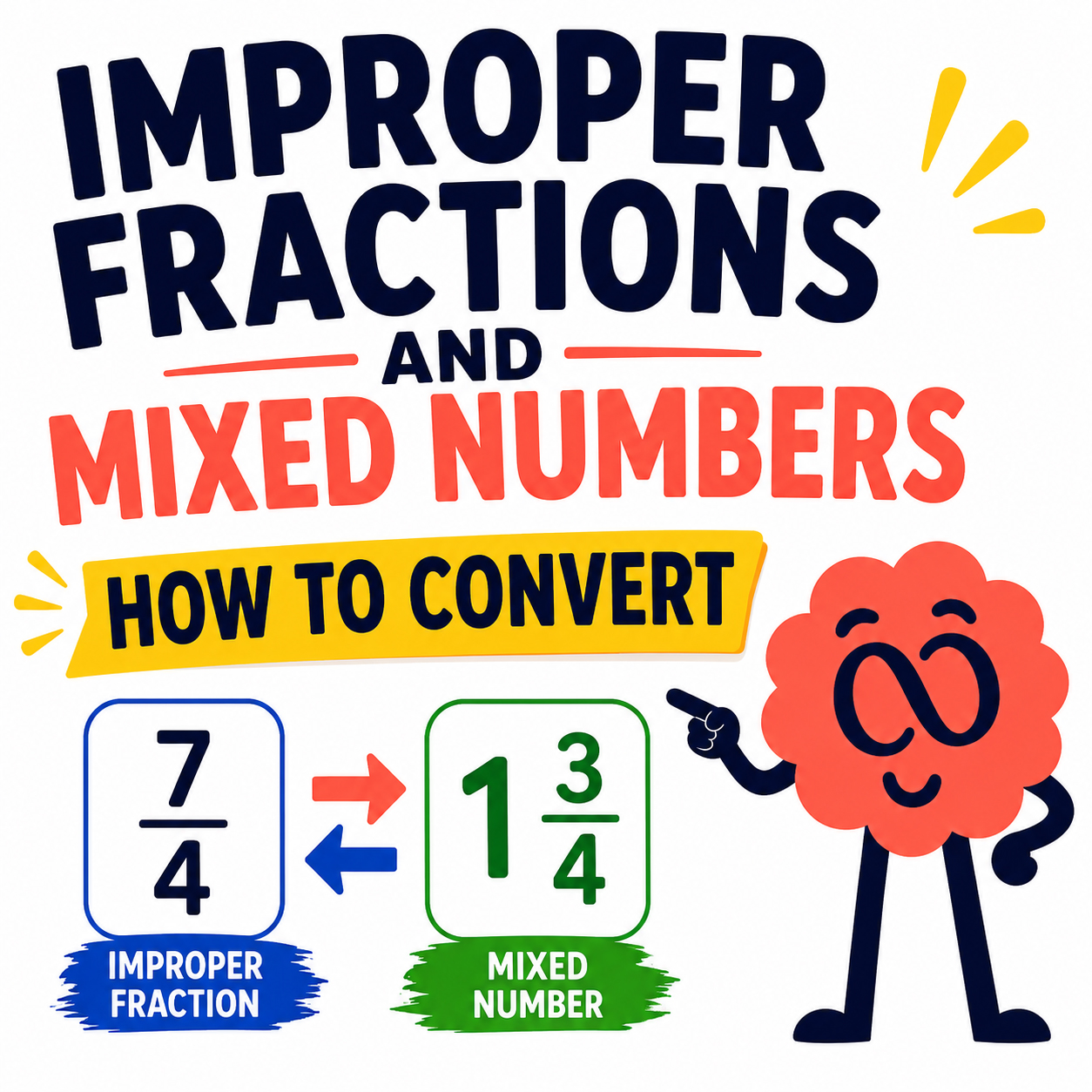
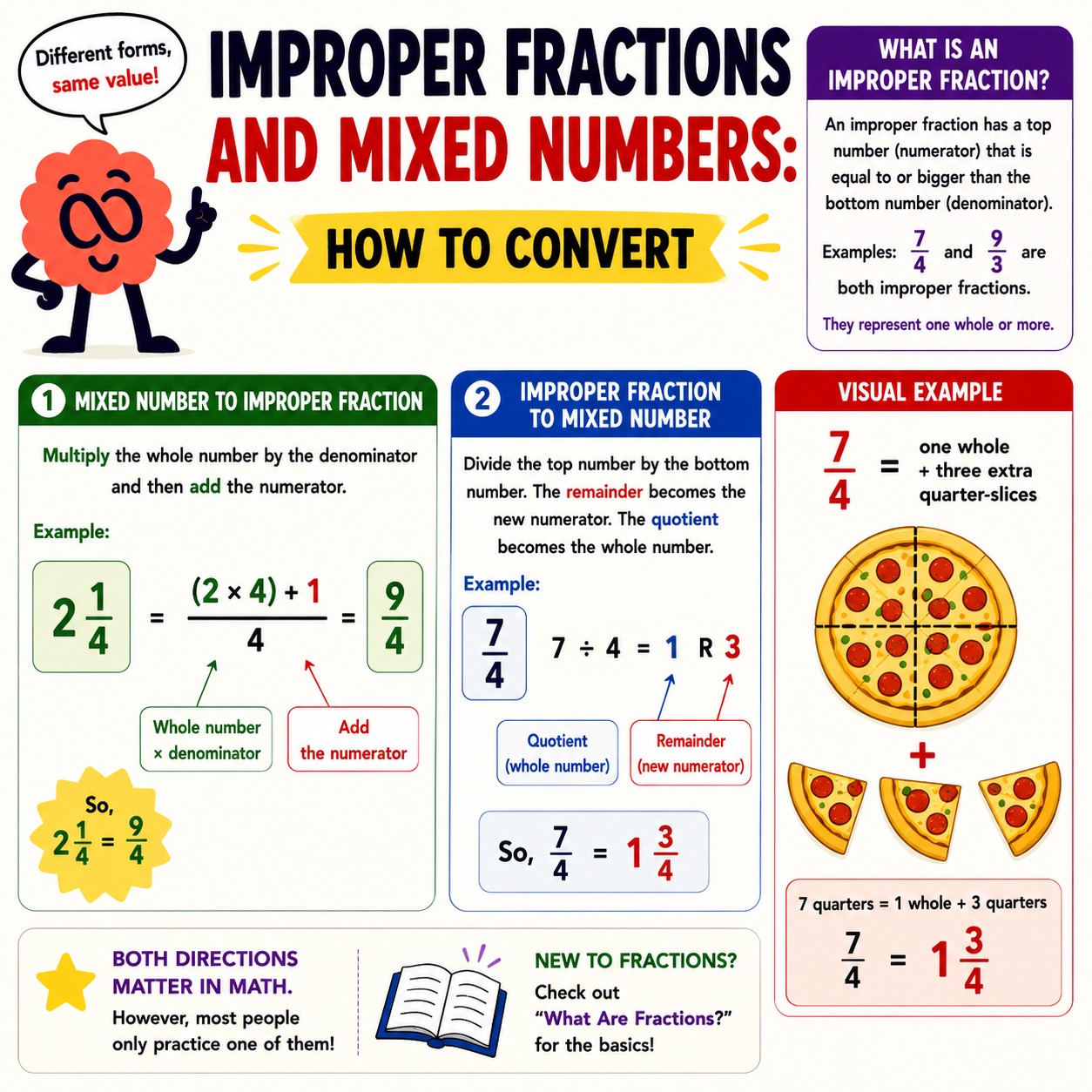
An improper fraction has a top number (numerator) that is equal to or bigger than the bottom number (denominator). For example, 7/4 and 9/3 are both improper fractions. In other words, they represent one whole or more.
To convert a mixed number to an improper fraction, multiply the whole number by the denominator and then add the numerator. So 2 ¼ becomes 9/4. Going the other way, to convert an improper fraction to a mixed number, divide the top number by the bottom number. The remainder then becomes the new numerator.
Both directions matter in math. However, most people only practice one of them. What Are Fractions? It is a good starting point if you need the basics first.
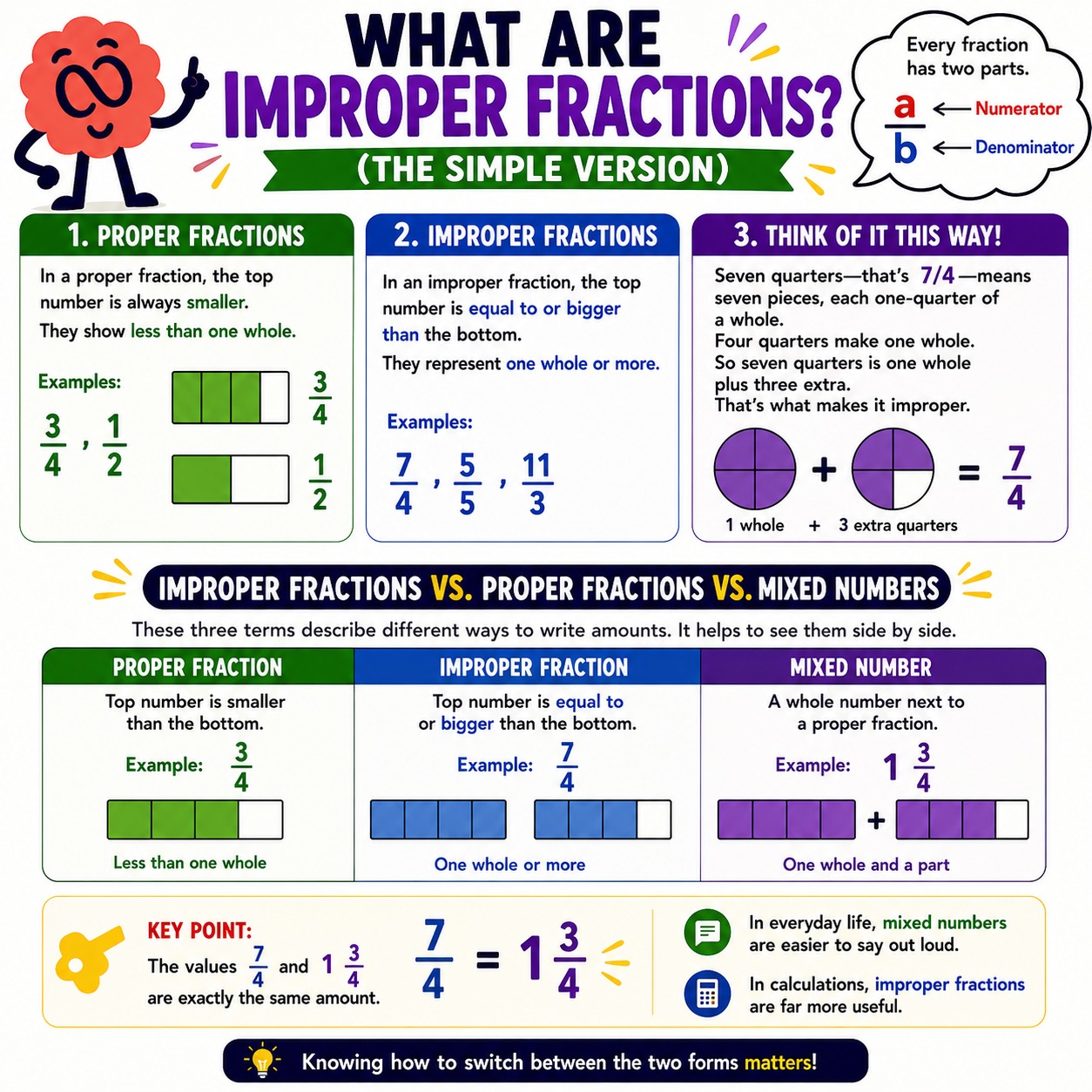
Every fraction has two parts. The top number is the numerator. The bottom number is the denominator. In a proper fraction, the top number is always smaller. So 3/4 and 1/2 are proper fractions. They show less than one whole.
Improper fractions work differently. Here, the top number is equal to or bigger than the bottom. So 7/4, 5/5, and 11/3 are all improper fractions. As a result, they represent one whole or more.
Think of it this way. Seven quarters that’s 7/4 means seven pieces, each one-quarter of a whole. Four quarters make one whole. So seven quarters is one whole plus three extra. That’s what makes it improper.
These three terms describe different ways to write amounts. It helps to see them side by side.
• Proper fraction: top number is smaller than the bottom. Example: 3/4
• Improper fraction: top number is equal to or bigger than the bottom. Example: 7/4
• Mixed number: a whole number next to a proper fraction. Example: 1 ¾
Here’s the key point. The values 7/4 and 1 ¾ are exactly the same amount. However, they just look different. In everyday life, mixed numbers are easier to say out loud. In calculations, though, improper fractions are far more useful. That’s why knowing how to switch between the two forms matters.
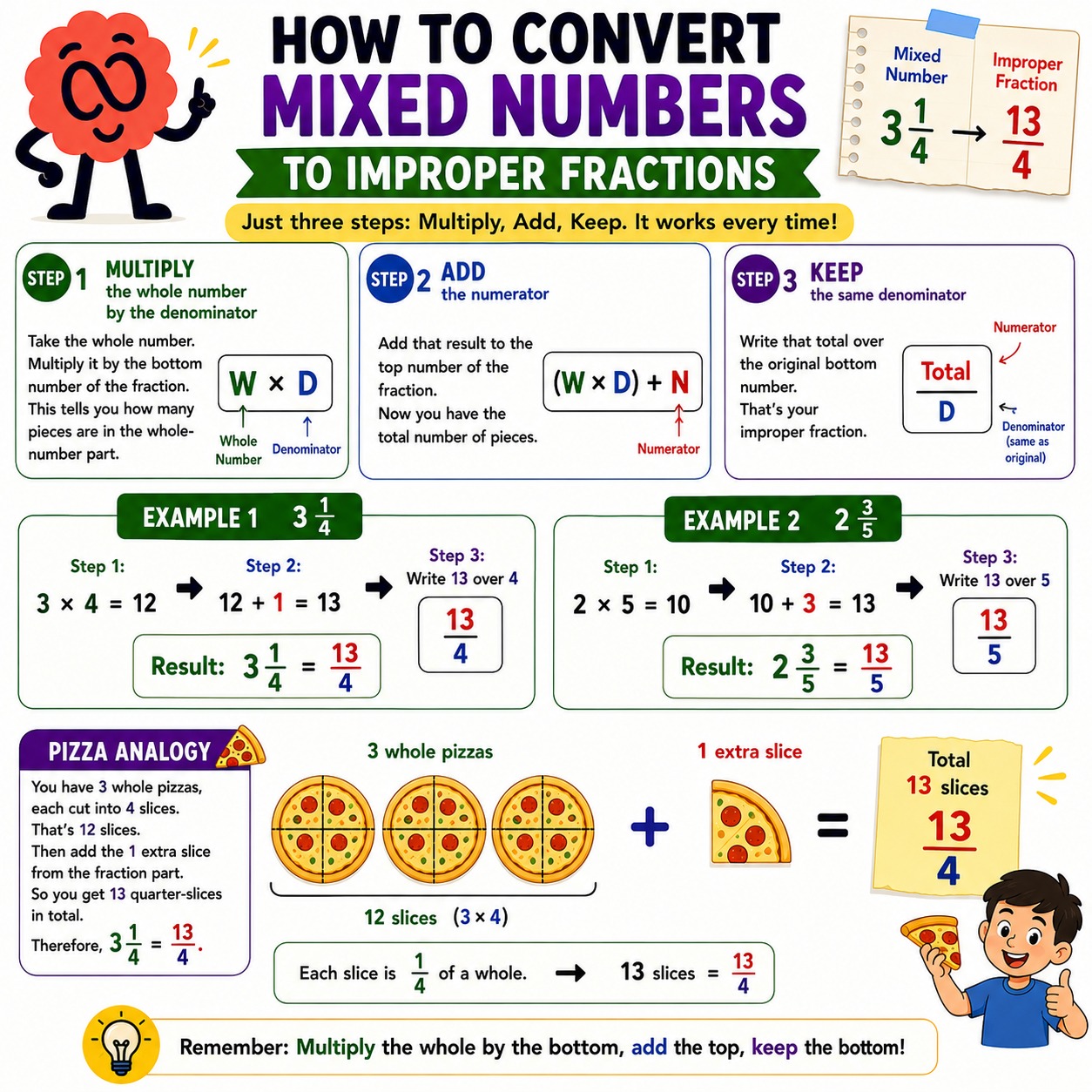
How to Convert Mixed Numbers to Improper Fractions has just three steps. Multiply, add, keep. It works the same way every time.
Take the whole number. Multiply it by the bottom number of the fraction. This tells you how many pieces are in the whole-number part.
Add that result to the top number of the fraction. Now you have the total number of pieces.
Write that total over the original bottom number. That’s your improper fraction.
Worked example — 3 ¼:
Step 1: 3 × 4 = 12
Step 2: 12 + 1 = 13
Step 3: Write 13 over 4
Result: 3 ¼ = 13/4
Second example — 2 ⅗ :
Step 1: 2 × 5 = 10
Step 2: 10 + 3 = 13
Step 3: Write 13 over 5
Result: 2 ⅗ = 13/5
A pizza analogy helps here. You have 3 whole pizzas, each cut into 4 slices. That’s 12 slices. Then add the 1 extra slice from the fraction part. So you get 13 quarter-slices in total. Therefore, 3 ¼ = 13/4.
Going the other way uses division with a remainder. This is How to convert improper fractions to mixed numbers. Additionally, this is the form most tests expect the final answer in.
Carry out the division. The whole-number part of the result becomes the whole number in the mixed number.
Whatever is left over becomes the new top number (numerator).
Write that remainder over the original bottom number, next to the whole number. Done.
Worked example — 17/5:
Step 1: 17 ÷ 5 = 3, remainder 2
Step 2: Remainder is 2
Step 3: Write 3 ⅖
Result: 17/5 = 3 ⅖
Second example — 11/4:
Step 1: 11 ÷ 4 = 2, remainder 3
Step 2: Remainder is 3
Step 3: Write 2 ¾
Result: 11/4 = 2 ¾
Mixed numbers look cleaner on a page. In calculations, however, they are harder to use. For example, multiplying 1 ½ by 2 ⅓ as mixed numbers gets messy fast. As improper fractions, though, it’s much simpler. You get 3/2 × 7/3 = 21/6 = 3 ½ .
The same idea applies to division. Converting first keeps the steps clean and reduces errors. Our How to Multiply Fractions guide shows this in practice. So does our How to Divide Fractions guide. In short, use improper fractions to work. Use mixed numbers to present the answer.
You run into improper fractions more often than you might think. A recipe calls for 1 ½ cups of flour. That is 3/2 as an improper fraction. Similarly, a plank of wood that is 2 ¾ inches long is 11/4 inches in improper form.
Neither version is wrong. However, they suit different situations. Mixed numbers are easier to say. Improper fractions, on the other hand, are easier to calculate with. For instance, doubling a recipe that uses 3/2 cups is simple. Just multiply by 2 to get 6/2, which equals 3 cups. Furthermore, dividing or scaling measurements is cleaner when you start in improper form.
Improper fractions are first introduced in Grade 4. The Common Core standard is 4.NF.B.3. At this stage, students learn that a fraction like 5/4 means more than one whole. They also begin converting between forms.
By Grade 5, that conversion needs to feel automatic. Students who aren’t confident with it tend to struggle once fraction multiplication and division arrive. So while the skill starts in Grade 4, it matters well beyond it.
Here’s what matters most about improper fractions and mixed numbers.
• An improper fraction has a top number equal to or bigger than the bottom number. It represents one whole or more.
• To convert mixed numbers to improper fractions: multiply, add, keep. Same denominator throughout.
• To convert improper fractions to mixed numbers: divide, find the remainder, keep the denominator.
• The most common mistake is adding the whole number to the top number without multiplying first.
• Use improper fractions for calculations. Use mixed numbers to present answers clearly.
An improper fraction is one where the top number (numerator) is equal to or bigger than the bottom number (denominator). For example, 7/4 and 9/3 are both improper fractions. Since the top number is bigger, the value is one whole or more.
Multiply the whole number by the denominator. Then add the numerator. Finally, write that total over the original denominator. For example, 3 ¼ becomes (3 × 4 + 1)/4 = 13/4. The denominator stays the same throughout.
Divide the top number by the bottom number. The quotient becomes the whole number. Then the remainder becomes the new top number, written over the original denominator. So 17/5 becomes 3 ⅖ , because 17 ÷ 5 = 3 remainder 2.
It is an improper fraction. The top number (7) is bigger than the bottom number (4). So it represents more than one whole. As a mixed number, 7/4 is the same as 1 ¾ . Both show the same value.
Mixed numbers are easier to understand in everyday life. Improper fractions, however, are much easier to use in calculations. Converting between the two forms lets you pick whichever version fits the situation best.
A proper fraction has a top number smaller than the bottom, such as 3/4. An improper fraction has a top number equal to or bigger than the bottom, such as 7/4. A mixed number pairs a whole number with a proper fraction, such as 1 ¾ . Importantly, the improper fraction and the mixed number show the same value. For a full comparison, see our Types of Fractions guide.
Converting between improper fractions and mixed numbers shows up in nearly every fraction topic from Grade 4 onward. If the process still feels shaky, a tutor can make it click fast with clear, step-by-step practice.
Book a free assessment today and explore our Grade 4 and Grade 5 math programs.