
How to Subtract Fractions
Learning how to subtract fractions can feel tricky at first. Many people are comfortable subtracting whole numbers but get confused when fractions enter the picture. That’s completely normal. The good thing is that how to subtract fractions follows the same steps every time, which makes it much easier to learn once those steps become familiar.
If you’re not yet comfortable with adding fractions, start with our How to Add Fractions guide. Fraction subtraction builds on many of the same skills.
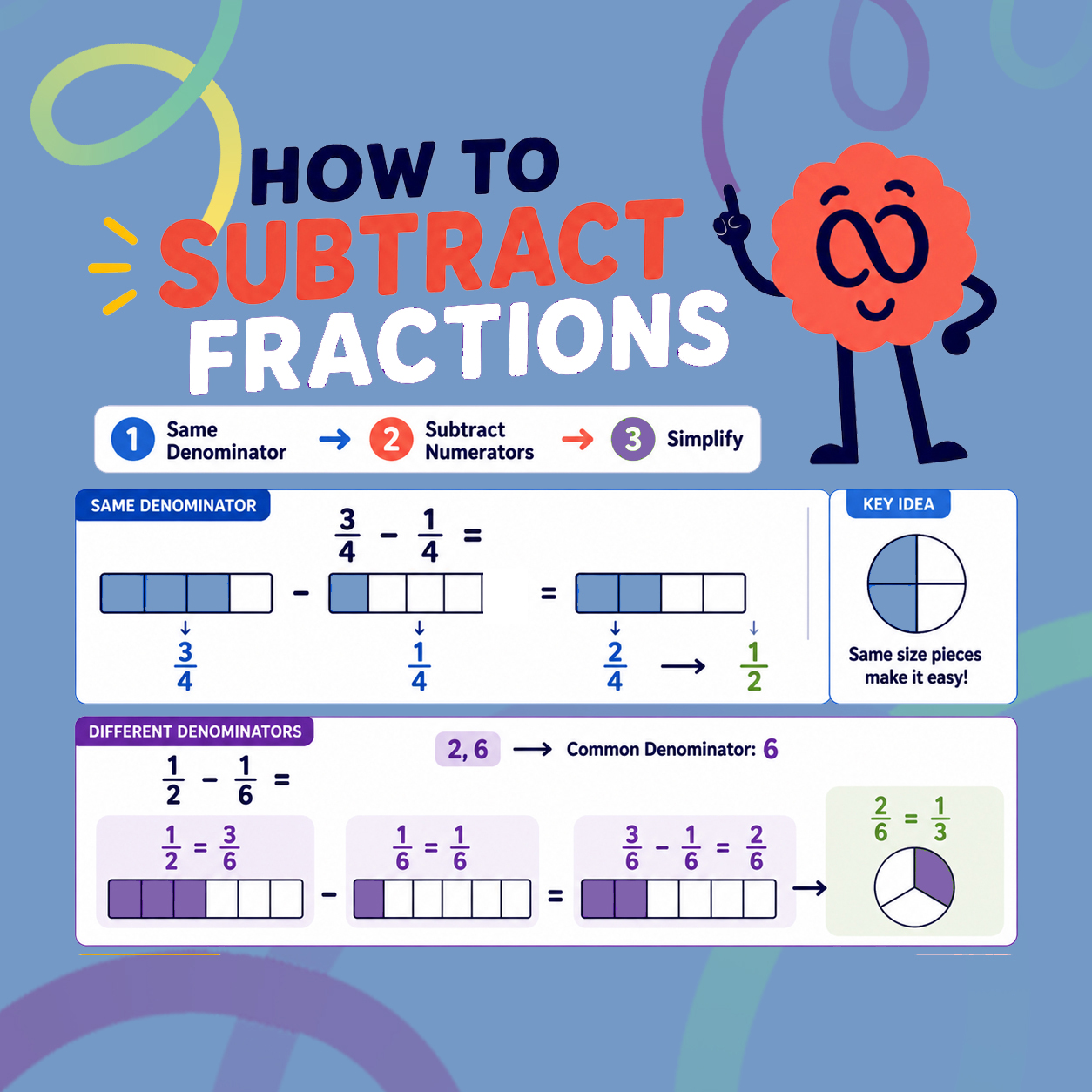
How to Subtract Fractions: The 3-Step Method
When people ask how to subtract fractions step by step, this is the method worth learning first.
Before starting, make sure you understand numerators and denominators. If you still mix up the top and bottom numbers, revisit Parts of a Fraction before moving on.
Step 1: Check the Denominators
Let's start with a simple example:
3/4 − 1/4
Both fractions already have the same denominator, so there's nothing to change.
Step 2: Subtract the Numerators
Now subtract the top numbers:
3 − 1 = 2
So:
3/4 − 1/4 = 2/4
Step 3: Simplify the Fraction
The fraction 2/4 can be simplified to 1/2.
If you need extra practice with this step, see How to Simplify Fractions .
Final answer:
3/4 − 1/4 = 1/2
A common question is, “What is the formula for subtracting fractions?”
Here’s the thing. There isn’t a separate formula to memorize. Learning how to subtract fractions uses the same three basic steps every time.
How to Subtract Fractions with Different Denominators
Learning how to subtract fractions with different denominators is where most people start feeling unsure.
Let's look at a simple example:
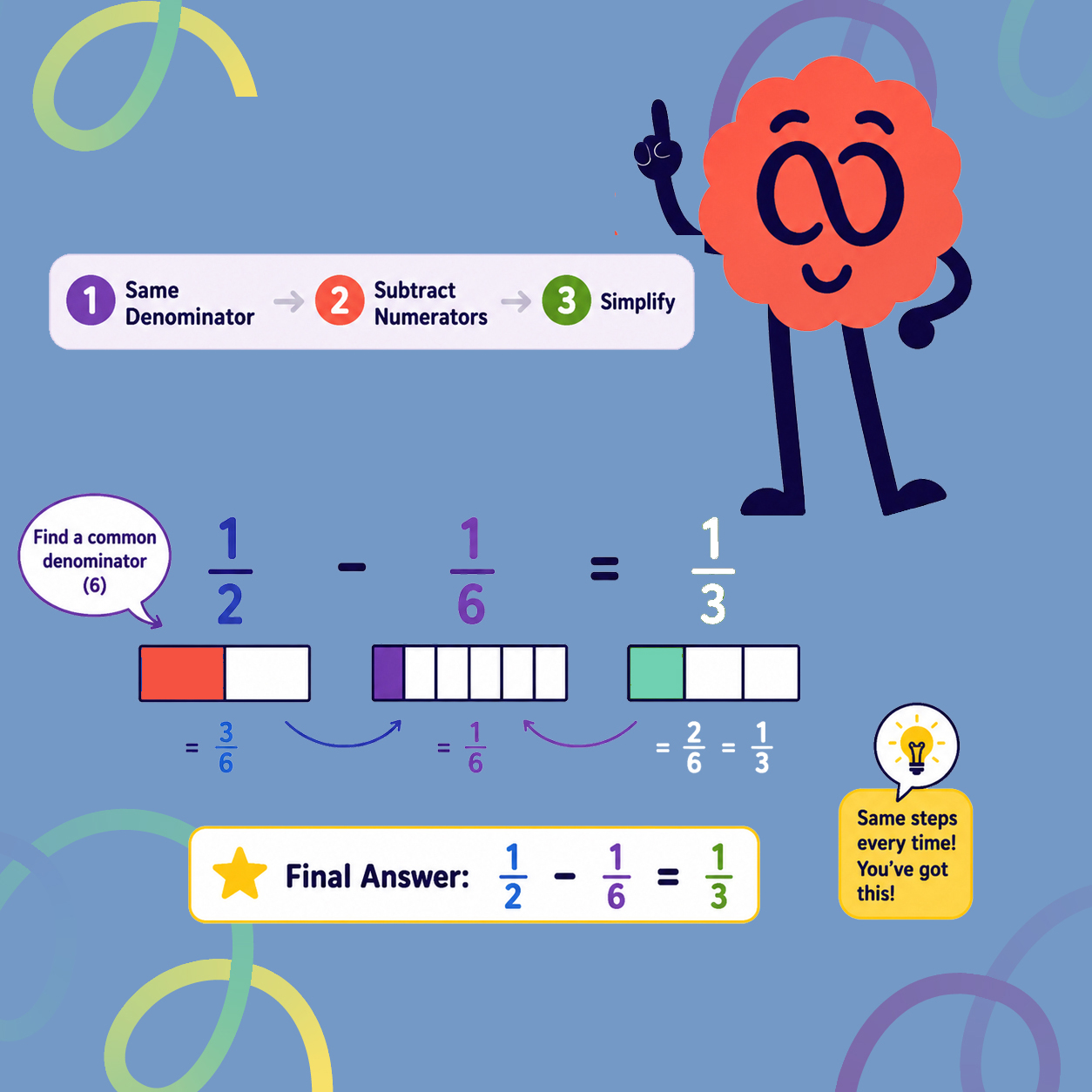
How Do You Solve 1/2 − 1/6?
The first step is finding a denominator both fractions can share.
The denominators are:
- 2
- 6
A common denominator is 6.
Convert the fractions:
1/2 = 3/6
1/6 = 1/6
Now subtract the numerators:
3 − 1 = 2
Result:
2/6
Simplify:
1/3
Final answer:
1/2 − 1/6 = 1/3
This is often the moment when people ask:
"Why do we have to change the fractions first?"
A simple explanation is:
"We need the pieces to be the same size before we can compare or remove them."
Think about cutting two cakes into different-sized slices.You can't easily take one slice away from another unless the pieces are the same size.
That's why a common denominator matters.
If you need extra help with this idea, see What Is a Common Denominator?.
How to subtract fractions with different denominators is one of the most commonly searched fraction topics because this is the step that feels unfamiliar. The good news is that once you understand common denominators, the rest of the problem becomes much easier.
How to Subtract Mixed Fractions
Another challenge appears when learning how to subtract mixed fractions.
Take this example:
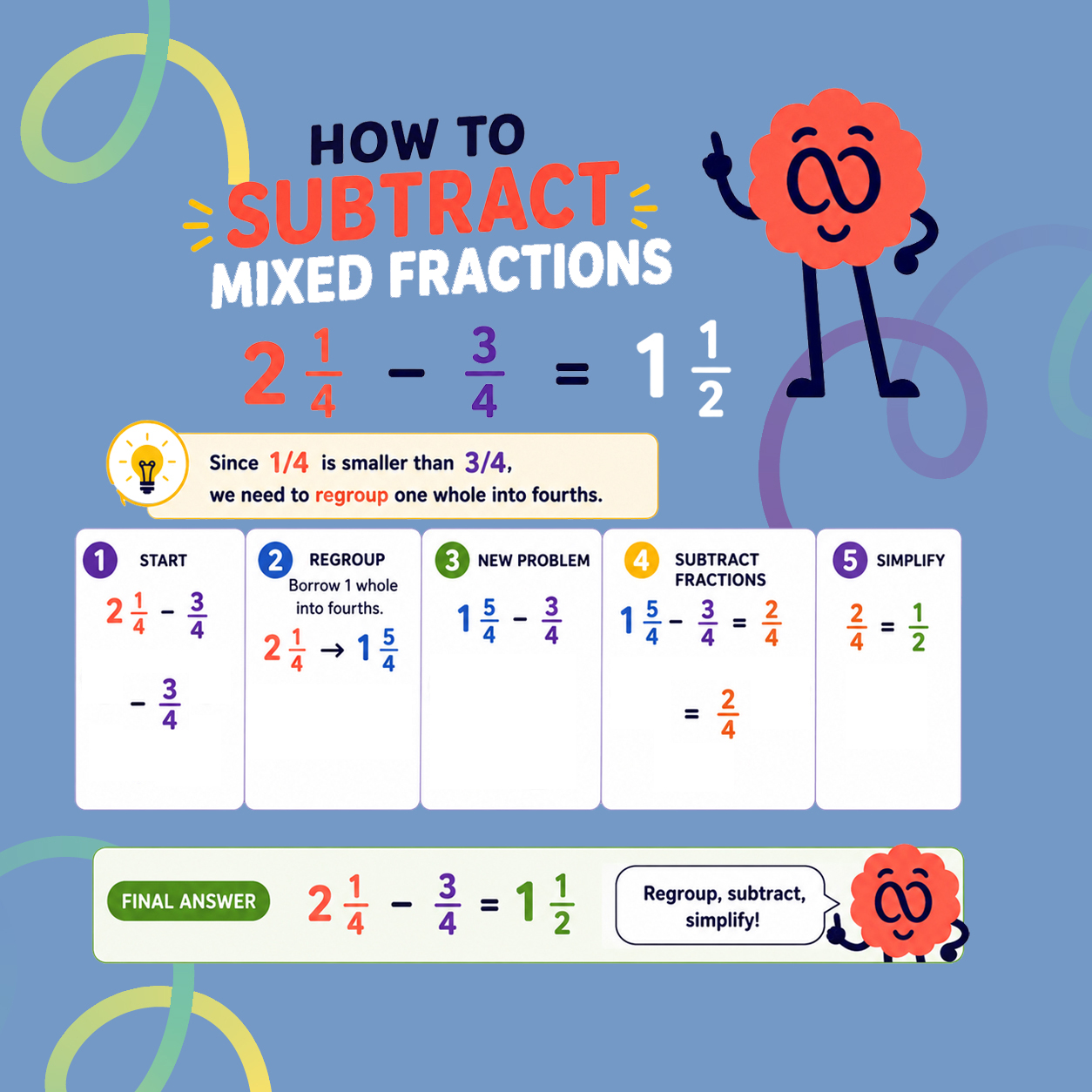
2¼ − 3/4
At first glance, it looks simple.
But here's the problem.
"Since 1/4 is smaller than 3/4, we need to regroup one whole into fourths before subtracting."
This is where you need to “borrow” or regroup.
Many adults remember learning borrowing with whole numbers. Fraction regrouping works in a similar way.
Take one whole from the number 2.
Now:
2¼ becomes:
1 + 5/4
The problem becomes:
1 + 5/4 − 3/4
Now subtract the fractions:
5/4 − 3/4 = 2/4
Simplify:
2/4 = 1/2
Final answer:
1½
This is usually the hardest part of learning how to subtract fractions in Grade 5.
Most people understand the calculation itself. What causes confusion is why you need to borrow in the first place.
A helpful explanation is:
"We're turning one whole into fraction pieces so we have enough parts to subtract."
If you’re still getting comfortable with mixed numbers, this is a good point to review Improper Fractions and Mixed Numbers.
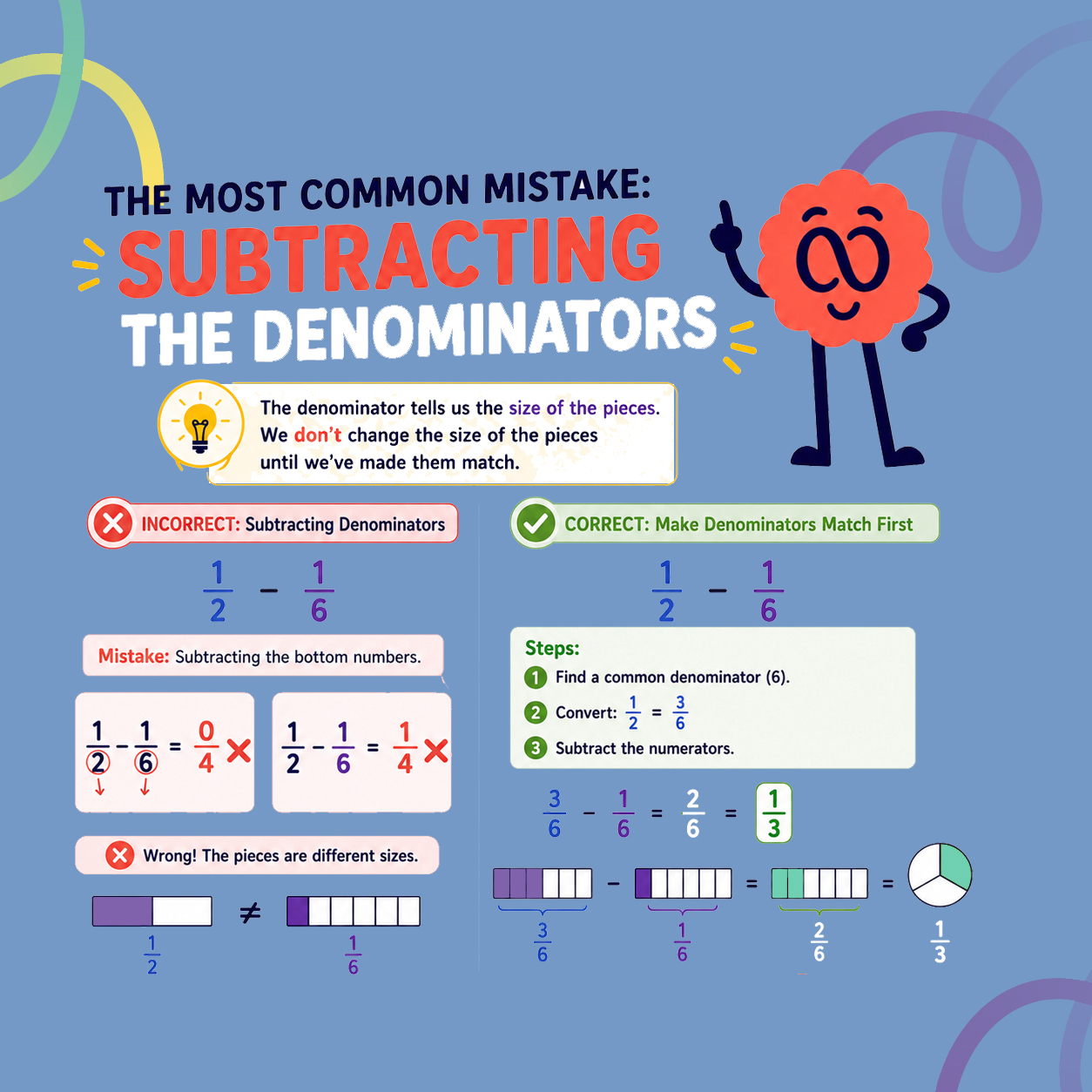
The Most Common Mistake: Subtracting the Denominators
When first learning how to subtract fractions, it’s easy to make the same mistake that comes up when adding fractions.
They subtract the denominators.
For example:
1/2 − 1/6
For example, someone might write:
0/4 ❌
or
1/4 ❌
It usually happens because they're treating fractions like two separate numbers instead of one value.
A helpful way to think about it:
"The denominator tells us the size of the pieces. We don't change the size of the pieces until we've made them match."
Once you understand that idea, it’s easy to stop making the mistake of subtracting denominators.
How Is Subtracting Fractions Different from Adding?
A common question is whether subtracting fractions requires a completely different method.
The answer is no.
In fact, how to subtract fractions is almost identical to addition.
Both methods require:
- A common denominator
- Equivalent fractions
- Working with numerators and denominators
- Simplifying fractions
The only difference is what happens in the middle step.
With addition:
3/6 + 1/6 = 4/6
With subtraction:
3/6 − 1/6 = 2/6
Practice How to Subtract Fractions at Home
One of the easiest ways to practice how to subtract fractions is by using everyday situations.
1. Measuring Cups
Imagine you have:
3/4 cup of milk
Then you use:
1/4 cup
Ask:
"How much is left?"
You can physically see the subtraction happening.
2. Pizza Slices
A pizza has 8 slices.
You eat 3 slices.
Ask:
"What fraction of the pizza is left?"
This helps connect fractions to real objects rather than numbers on a page.
3. Time on a Clock
Start at 45 minutes.
Take away 15 minutes.
Ask:
"What fraction of an hour is left?"
Simple activities like these help you practice subtracting fractions without feeling like you’re doing extra schoolwork.
Quick Check: 3 Questions to Test Understanding
A quick way to check your understanding of how to subtract fractions is to explain your thinking out loud.
Try these questions.
Question 1
What is:
3/4 − 1/4?
Question 2
Why do we need a common denominator for:
1/2 − 1/6?
Question 3
If you have 2½ pizzas and eat 3/4 of a pizza, what would you do first?
Listen carefully to the explanation.
If you can explain why you’re taking a step, not just what you’re doing, you’re building real understanding.
Key Takeaways
- Learning how to subtract fractions becomes easier when you understand denominators first.
- When denominators match, simply subtract the numerators.
- When denominators are different, find a common denominator before subtracting.
- The most common mistake is subtracting the denominators.
- Borrowing or regrouping is often the hardest part of how to subtract mixed fractions.
- Real-world examples make subtracting fractions easier to understand.
- The method for how to subtract fractions is very similar to addition.
Frequently Asked Questions
How to subtract fractions step by step?
To learn how to subtract fractions, follow three simple steps:
- Make the denominators equal.
- Subtract the numerators.
- Simplify the answer if possible.
What is the formula for subtracting fractions?
There isn't a separate formula. Learning how to subtract fractions uses the same process every time: find a common denominator, subtract the numerators and simplify.
How to subtract fractions with different denominators?
When learning how to subtract fractions with different denominators, the first step is finding a common denominator. Once both fractions use the same denominator, subtract the numerators and simplify.
How can I add 1/3 and 1/2?
That's an addition problem rather than a subtraction problem. See our guide on How to Add Fractions for a full step-by-step example.
Once you feel confident with both addition and subtraction, the next step is learning Adding and Subtracting Fractions Together, where both skills are used in the same problem.
Subtraction with fractions is a common sticking point in Grade 4 and Grade 5. Our tutors pinpoint exactly where you’re getting stuck and explain fractions in a way that makes sense.
Book a free assessment today and explore our Grade 4 and Grade 5 math programs.