
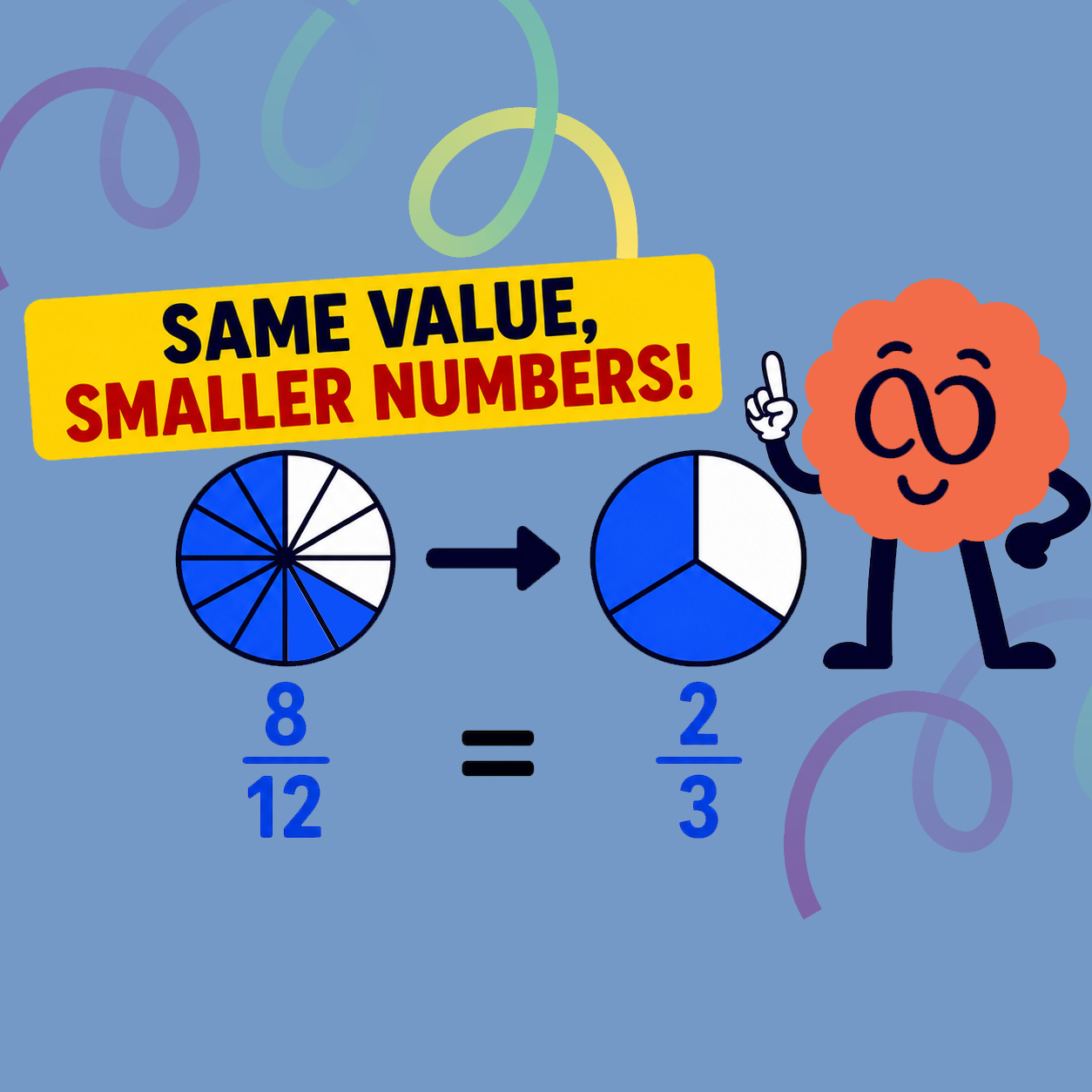
Learning how to simplify fractions can feel like a chore at first, especially when the numbers get big. Once you know the steps, how to simplify fractions becomes one of the easiest fraction skills there is. It’s really just finding a smaller, equal version of the same fraction.
If you haven’t worked with greatest common factors before, start with our What Is the Greatest Common Factor? guide. Learning how to simplify fractions leans on that same idea.
How to Simplify Fractions: The 3-Step Method
When people ask how to simplify fractions step by step, this is the method worth learning first.
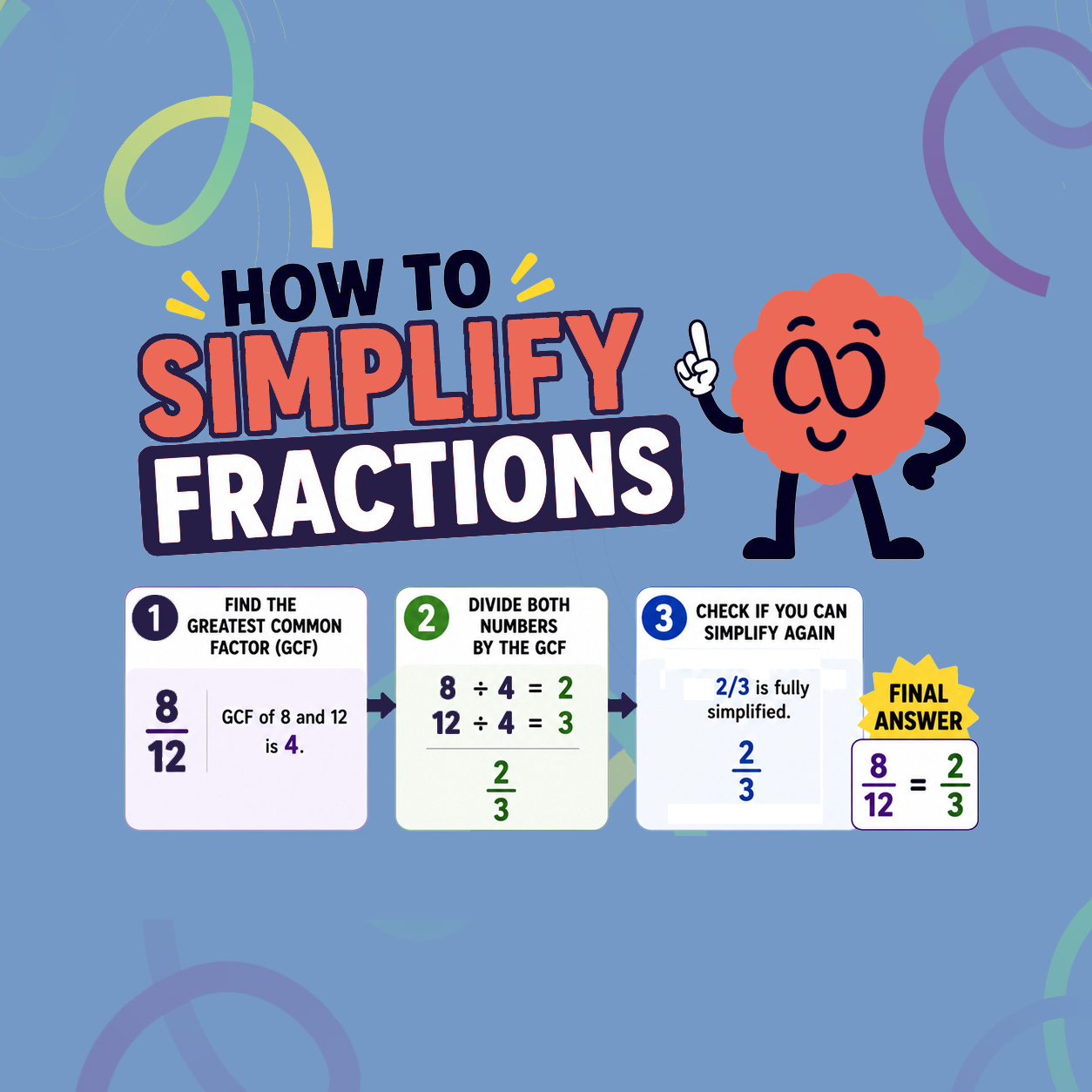
Step 1: Find the Greatest Common Factor
Let’s work through a simple example:
8/12
Find the greatest common factor of 8 and 12. That number is 4.
Step 2: Divide Both Numbers by the GCF
Divide the numerator and denominator by 4:
8 ÷ 4 = 2
12 ÷ 4 = 3
So 8/12 simplifies to 2/3.
Step 3: Check If You Can Simplify Again
Look at your new fraction. Ask yourself if there’s still a number, other than 1, that divides evenly into both the numerator and denominator.
2 and 3 only share the number 1, so 2/3 is fully simplified.
Final answer:
8/12 = 2/3
A common question is, “What is the formula to simplify fractions?”
Here’s the thing. There isn’t a separate formula to memorize. Learning how to simplify fractions always comes down to finding a shared factor and dividing by it.
How to Simplify Fractions with Bigger Numbers
Learning how to simplify fractions with bigger numbers is where things start to feel less obvious.
How Do You Simplify 36/48?
Let’s look at a real example.
List a few factors of each number:
36: 1, 2, 3, 4, 6, 9, 12, 18, 36
48: 1, 2, 3, 4, 6, 8, 12, 16, 24, 48
The largest shared factor is 12.
Divide both numbers by 12:
36 ÷ 12 = 3
48 ÷ 12 = 4
Final answer:
36/48 = 3/4
This is often the moment when people ask, “Do I really have to list out all the factors every time?”
Not always. In real life, it’s usually faster to start dividing by small numbers like 2, 3 or 5 and just keep going until nothing else divides evenly. You’ll land on the same answer either way.
How to Reduce Fractions Without Finding the GCF First
Some people prefer learning how to reduce fractions one small step at a time instead of hunting for the biggest shared factor right away.
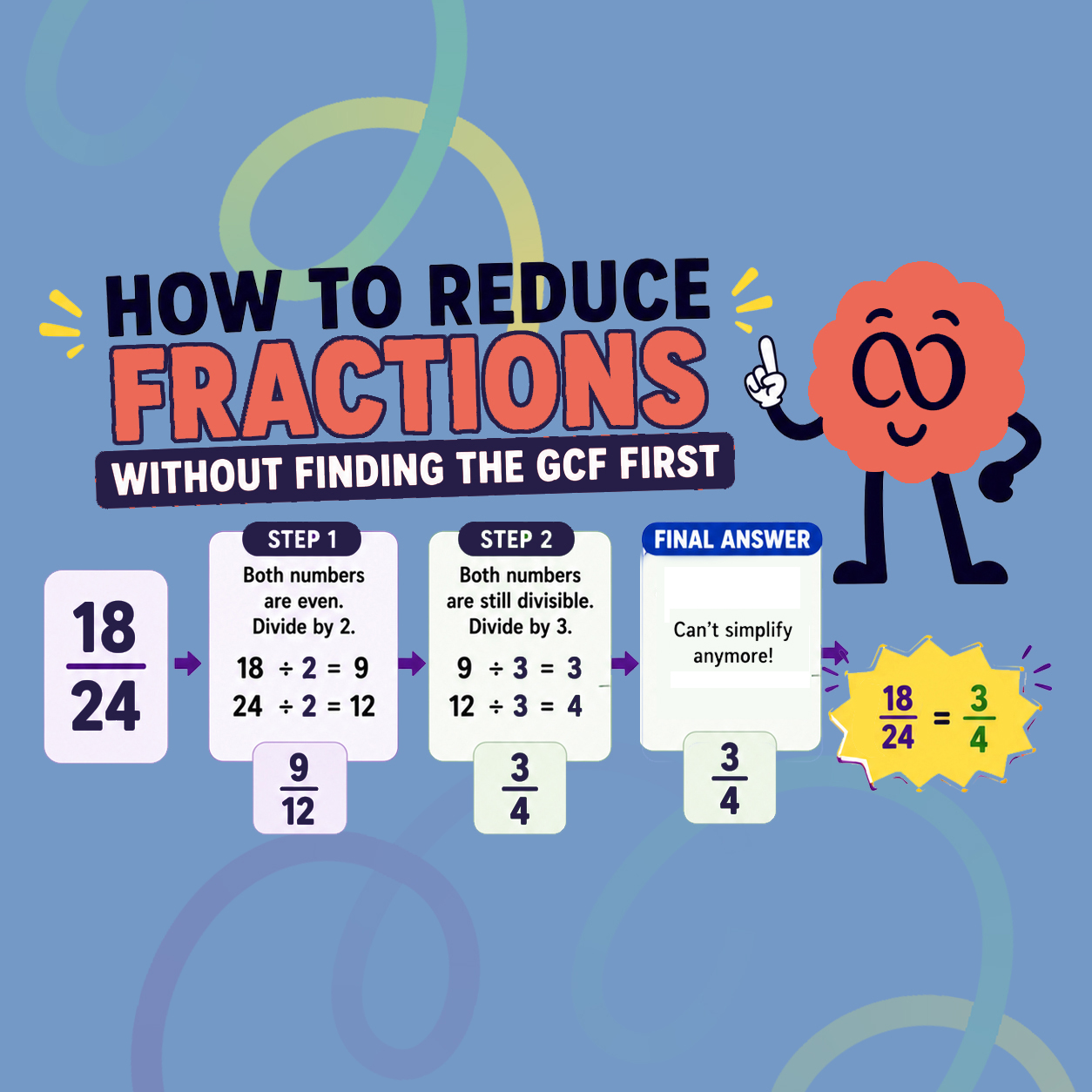
Take 18/24 as an example.
Both numbers are even, so divide by 2:
18 ÷ 2 = 9
24 ÷ 2 = 12
That gives you 9/12. Both numbers can still be divided, this time by 3:
9 ÷ 3 = 3
12 ÷ 3 = 4
Final answer:
18/24 = 3/4
This slower approach takes a couple of extra steps, but it works well for anyone who finds GCFs tricky.
The Most Common Mistake: Only Dividing One Number
When first learning how to simplify fractions, it’s easy to divide just the numerator or just the denominator instead of both.
For example, someone simplifying 8/12 might write:
2/12 ❌
That’s wrong because only the top number was divided. The bottom number has to shrink by the same factor too.
A helpful way to think about it:
“Whatever you do to the top, you have to do to the bottom. Otherwise the fraction changes value instead of staying equal.”
Once that idea sticks, this mistake mostly disappears.
Is Simplifying Fractions the Same as Reducing Fractions?
A common question is whether simplifying fractions and reducing fractions mean two different things.
They don’t. These are just two names for the same process.
Whether your teacher says “simplify” or “reduce,” the steps are identical. Find a shared factor, divide both numbers by it and check if you can do it again.
Practice How to Simplify Fractions at Home
One of the easiest ways to practice how to simplify fractions is to use everyday numbers.
1. Splitting a Recipe
A recipe calls for 6/8 cup of flour.
Ask: “What’s the simplest way to write that amount?”
6/8 simplifies to 3/4, which is easier to measure and remember.
These are called equivalent fractions because they represent the same amount.
2. Counting Money
Say you have 10 dimes out of 100 dimes saved in a jar.
Ask: “What fraction of the jar is that, in its simplest form?”
10/100 simplifies down to 1/10.
3. Sharing Time
If a 60-minute show has 20 minutes of commercials, ask:
“What fraction of the show is commercials, simplified?”
20/60 reduces to 1/3.
Quick Check: 3 Questions to Test Understanding
A quick way to check your understanding of how to simplify fractions is to have them explain their thinking out loud.
Try these questions.
Question 1
What is 8/12 in its simplest form?
Question 2
Why do you have to divide both the numerator and denominator by the same number?
Question 3
How do you know when a fraction can’t be simplified any further?
Listen for the explanation, not just the final answer. If you can explain why a fraction can or can’t be simplified, that’s real understanding.
Key Takeaways
• Learning how to simplify fractions means finding a smaller, equal version of the same fraction.
• Find a shared factor, then divide the numerator and denominator by that number.
• A fraction is fully simplified once the only shared factor left is 1.
• Dividing by small numbers repeatedly works just as well as finding the GCF right away.
• The most common mistake is dividing only one number instead of both.
• Simplifying fractions and reducing fractions are two names for the exact same process.
Frequently Asked Questions
How to simplify fractions step by step?
To simplify a fraction, find a number that divides evenly into both the numerator and denominator, then divide both by that number. Repeat until no shared factor other than 1 remains.
What is the formula to simplify fractions?
There isn’t a separate formula. Learning how to simplify fractions always uses the same process: find a common factor, divide by it and check if you can simplify again.
How to reduce fractions without a calculator?
Start by dividing both numbers by small factors like 2, 3 or 5. Keep dividing until neither number can be divided evenly anymore.
Is simplifying fractions the same as reducing fractions?
Yes. Both terms describe the exact same process of dividing the numerator and denominator by a shared factor.
What if a fraction is already fully simplified?
If the only number that divides evenly into both the numerator and denominator is 1, the fraction can’t be simplified any further.
Why do we simplify fractions?
Knowing how to simplify fractions pays off because the results are easier to compare, add and picture. They also match the form most teachers expect on homework and tests.
Once you feel confident in simplifying fractions, you'll use this skill in many other fraction topics, including adding fractions, subtracting fractions, multiplying fractions, and dividing fractions.The next step is learning how to compare fractions. Simplified fractions are often easier to compare because they use smaller numbers and reveal the value of each fraction more clearly.
Simplifying fractions is a common sticking point in Grade 4 and Grade 5. Our tutors pinpoint exactly where you are getting stuck and explain fractions in a way that makes sense.
Book a free assessment today and explore our Grade 4 and Grade 5 math programs.