
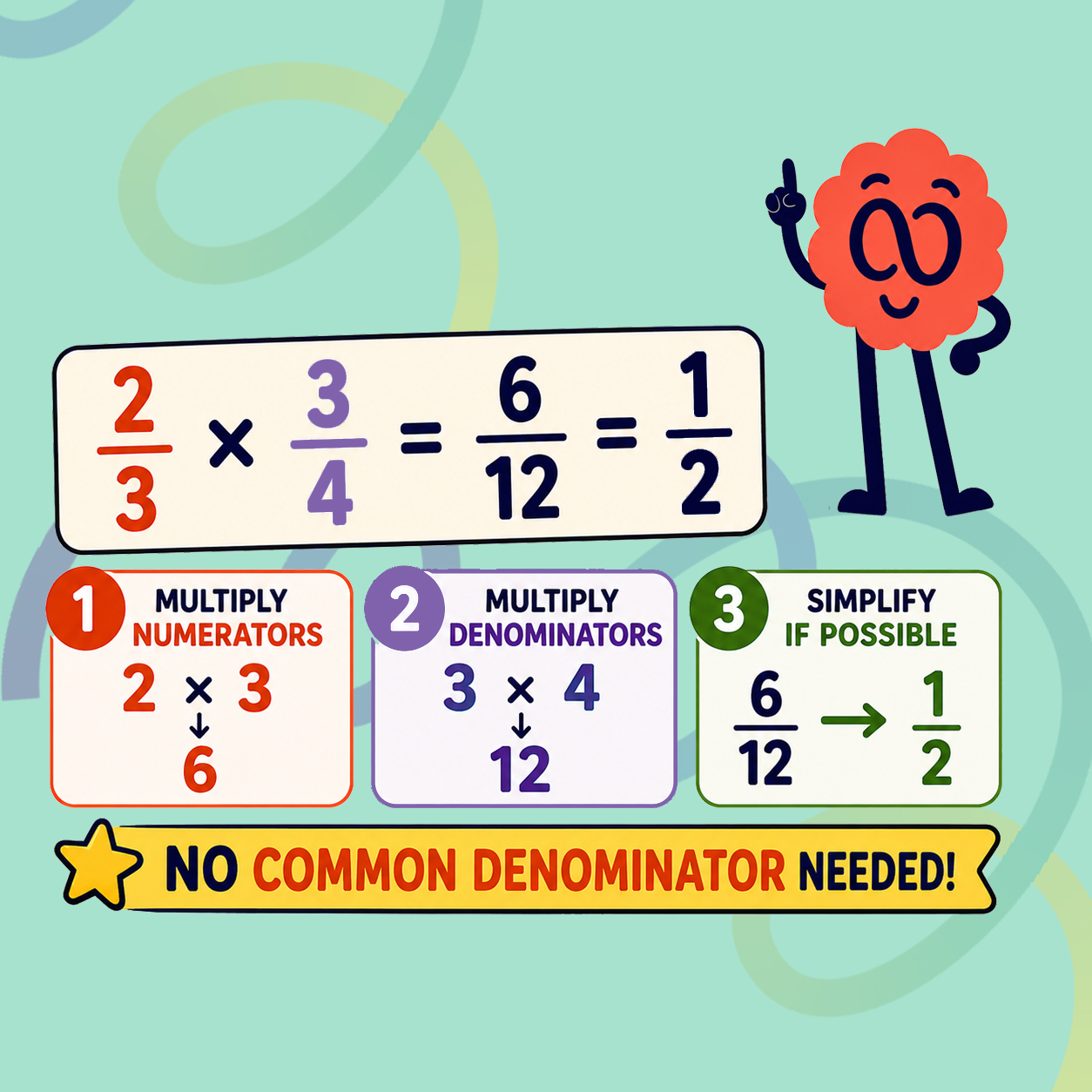
Learning how to multiply fractions is often easier than people expect. To multiply fractions, multiply the numerators together, multiply the denominators together, and simplify the result if possible. Unlike addition and subtraction, you do not need a common denominator when multiplying fractions.
That last part surprises a lot of people. After spending so much time finding common denominators for addition and subtraction, it can feel strange to skip that step. But that's exactly what makes fraction multiplication simpler.
Whether you're helping a child with homework or brushing up on your own math skills, understanding how to multiply fractions starts with one simple rule.
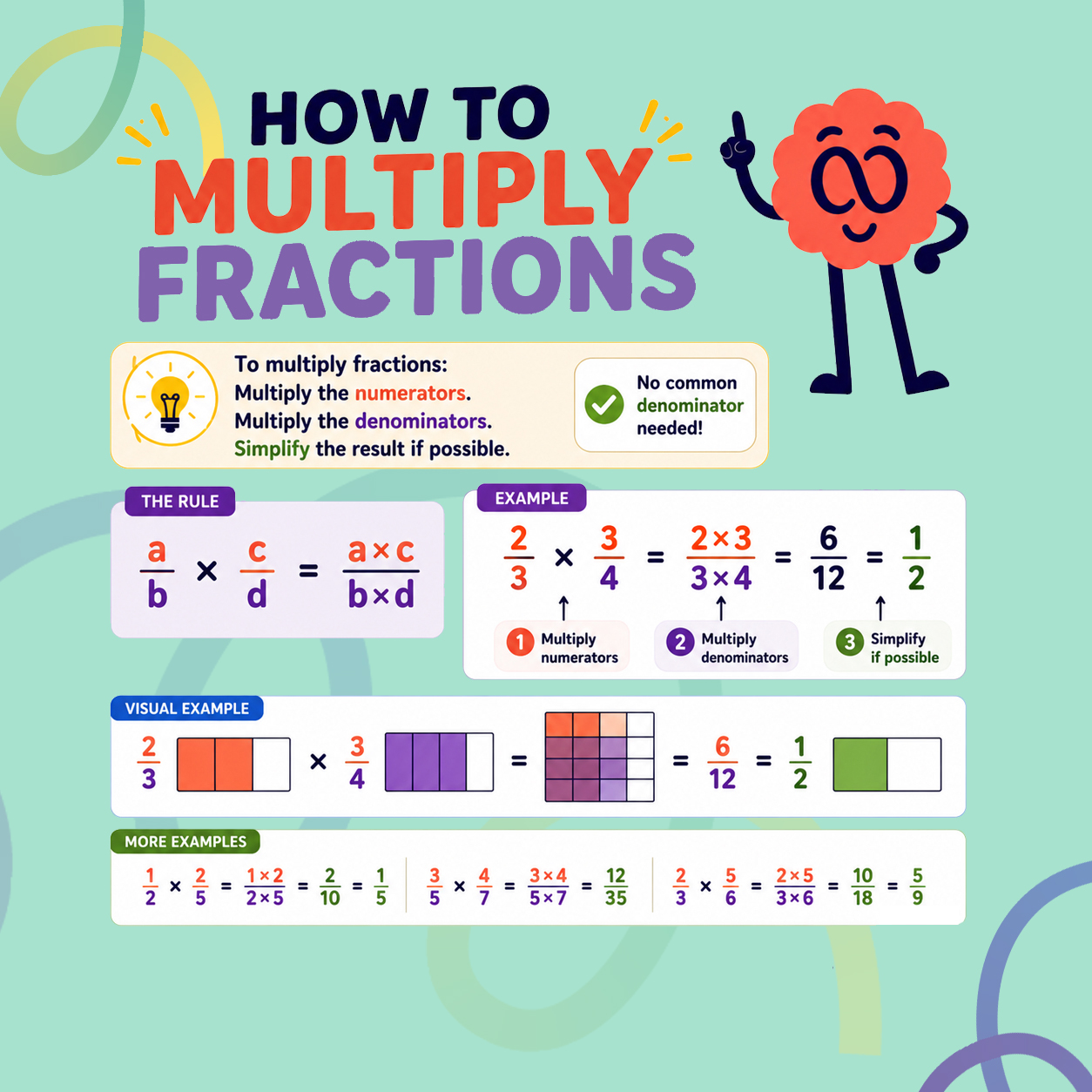
How to Multiply Fractions: The 3-Step Method
If you're wondering how to multiply fractions step by step, this is the process you'll use every time.
Let's start with: 1/2 × 3/4
Step 1: Multiply the Numerators
Before learning how to multiply fractions, it's important to understand what a fraction represents. If you're new to fractions, see What Is a Fraction? for a simple introduction.
The numerator is the top number in a fraction.
1 × 3 = 3
If you need a refresher on numerators and denominators, see What Is a Numerator and Denominator?
Step 2: Multiply the Denominators
Now multiply the bottom numbers:
2 × 4 = 8
Your answer becomes: 3/8
Step 3: Simplify the Result
In this example, 3/8 is already in its simplest form.
Final answer:
1/2 × 3/4 = 3/8
If you need extra practice with this step, check out How to Simplify Fractions for more help.
The good thing about how to multiply fractions is that the same three steps work for easy and difficult problems alike.
Do You Need the Same Denominator to Multiply Fractions?
This is one of the most common questions people ask.
The answer is no.
When learning how to multiply fractions, you do not need common denominators.
For example:
1/2 × 2/3
You can multiply straight away:
1 × 2 = 2
2 × 3 = 6
Result: 2/6
Simplify: 1/3
Many people make the mistake of looking for a common denominator because they're thinking about addition or subtraction. That's completely understandable.
However, multiplication works differently.
When adding fractions, the pieces must be the same size before you combine them. When multiplying fractions, you're finding a fraction of another fraction, so matching denominators isn't necessary.
If you've recently learned fraction addition or subtraction, this difference can take a little time to get used to.
Why Does Multiplying Fractions Work?
Understanding why the method works can make how to multiply fractions easier to remember.
At first, multiplying the top numbers and bottom numbers can seem random.
Why does it work?
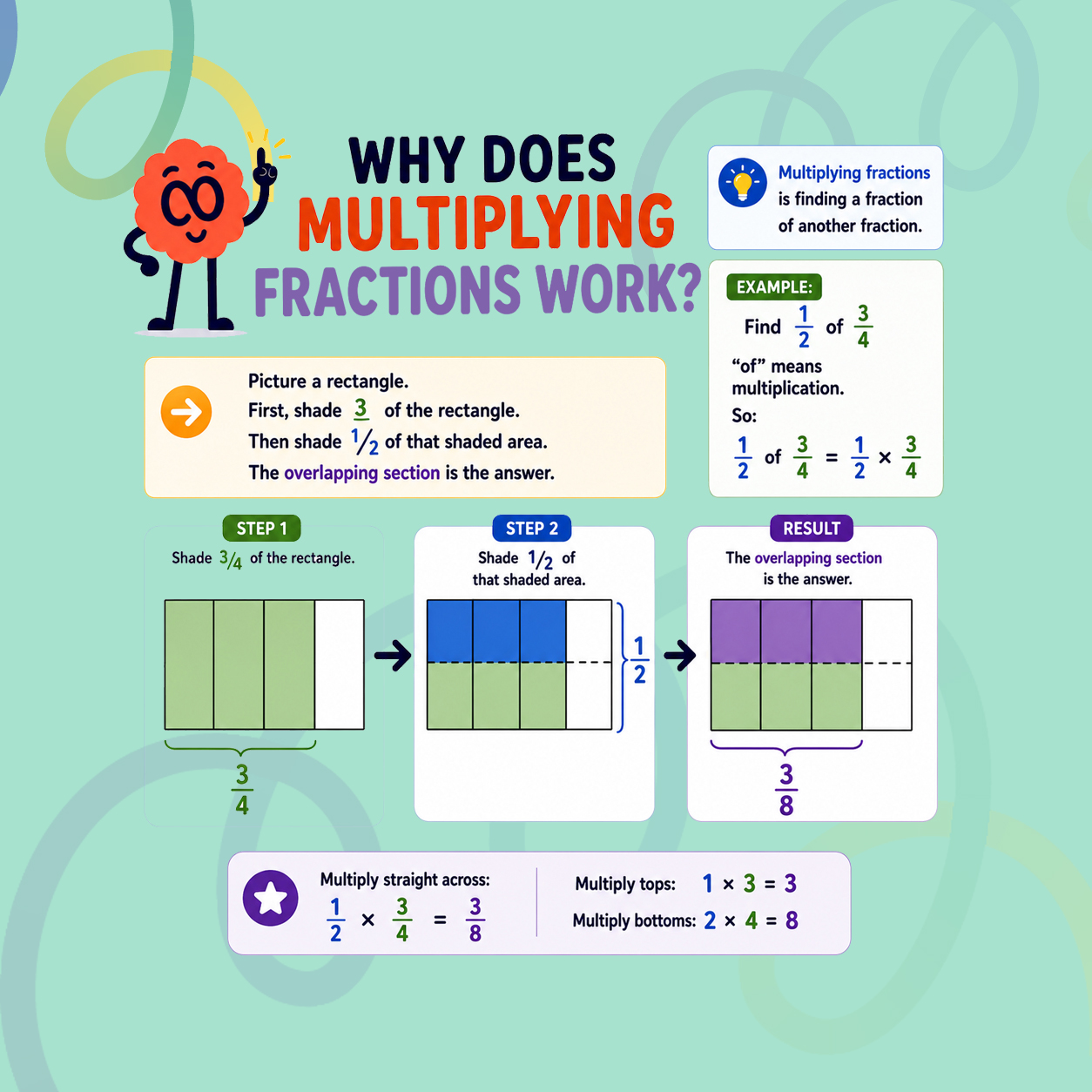
One way to think about it is as a fraction of a fraction.
Imagine you want to find:
1/2 of 3/4
The word " of " in math usually means multiplication.
So: 1/2 of 3/4
Becomes: 1/2 × 3/4
Picture a rectangle.
First, shade 3/4 of the rectangle.
Then shade 1/2 of that shaded area.
The overlapping section represents the answer.
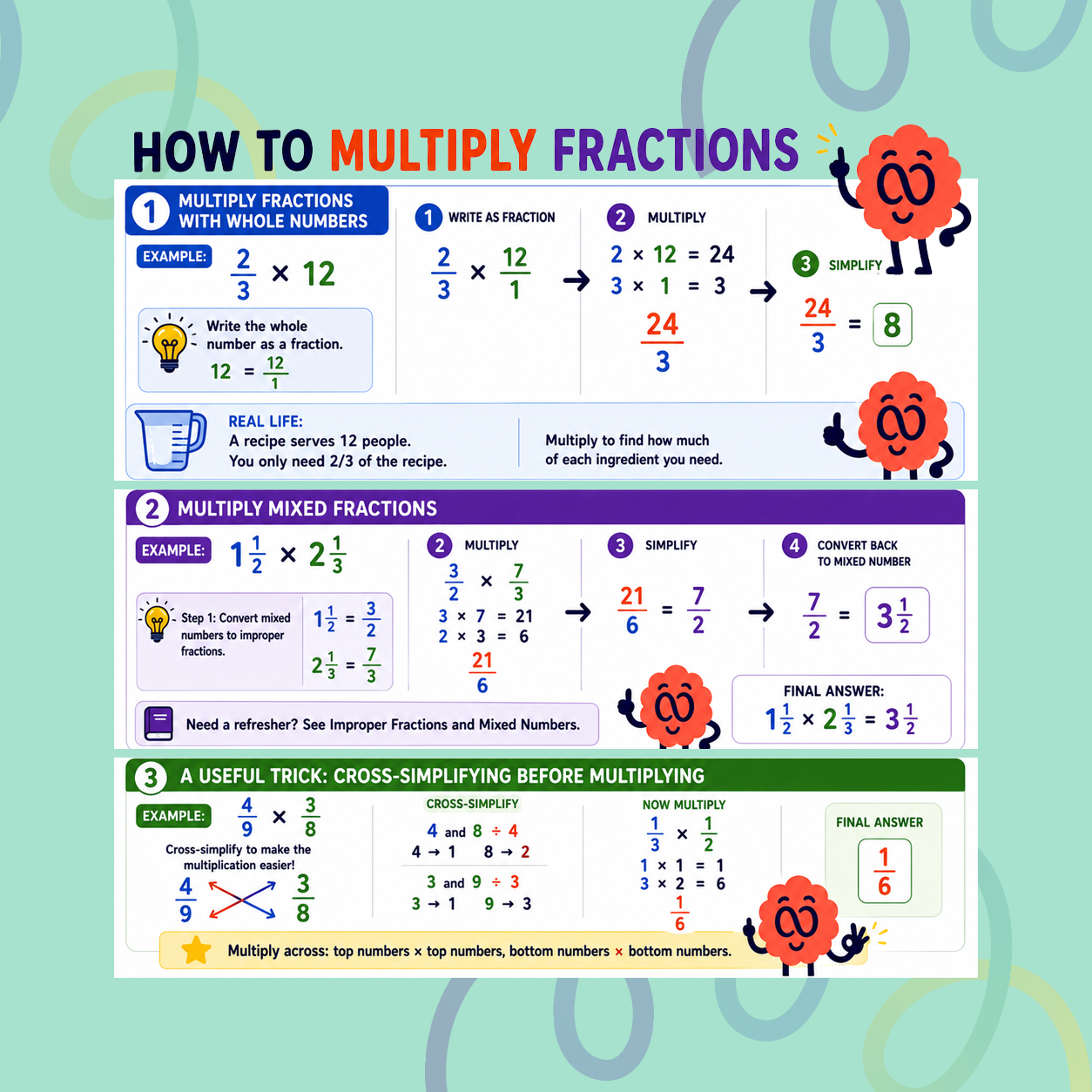
How to Multiply Fractions with Whole Numbers
Learning how to multiply fractions with whole numbers can feel a little different at first because one number isn't written as a fraction.
Fortunately, the process is still straightforward.
Let's solve: 2/3 × 12
The easiest method is to write the whole number as a fraction.
12 becomes: 12/1
Now multiply: 2/3 × 12/1
Numerators: 2 × 12 = 24
Denominators: 3 × 1 = 3
Result: 24/3
Simplify: 8
Final answer: 2/3 × 12 = 8
This type of problem appears often in real life.
Imagine a recipe serves 12 people, but you only need 2/3 of the recipe. Multiplying helps you figure out how much of each ingredient you'll need.
How to Multiply Mixed Fractions
Learning how to multiply mixed fractions adds one extra step, but the overall process stays the same.
Let's look at: 1½ × 2⅓
Before multiplying, convert each mixed number into an improper fraction.
1½ = 3/2
2⅓ = 7/3
Now multiply: 3/2 × 7/3
Numerators: 3 × 7 = 21
Denominators: 2 × 3 = 6
Result: 21/6
Simplify: 7/2
Convert back to a mixed number: 3½
Final answer: 1½ × 2⅓ = 3½
If mixed numbers still feel unfamiliar, see Improper Fractions and Mixed Numbers before tackling more examples.
A Useful Trick: Cross-Simplifying Before Multiplying
As the numbers get bigger, multiplication can become messy.Cross-simplifying is a helpful shortcut for anyone learning how to multiply fractions with larger numbers.
Let's solve: 4/9 × 3/8
Before multiplying, look for numbers that can be simplified diagonally.
4 and 8 can both be divided by 4:
4 → 1
8 → 2
3 and 9 can both be divided by 3:
3 → 1
9 → 3
Now the problem becomes: 1/3 × 1/2
Multiply:
1 × 1 = 1
3 × 2 = 6
Answer: 1/6
Cross-simplifying isn't required, but it often makes calculations faster and reduces mistakes.
If your child is still learning factors, reviewing the Greatest Common Factor can make this step much easier.
Common Mistakes When Multiplying Fractions
Even when students know how to multiply fractions, a few mistakes appear again and again.
Looking for a Common Denominator
This is probably the most common error.
Students spend so much time finding common denominators for addition and subtraction that they assume multiplication works the same way.
It doesn't.
When multiplying fractions, you can multiply immediately.
Forgetting to Simplify
A correct answer isn't always a complete answer.
For example: 2/6
should be simplified to: 1/3
Small simplification mistakes can cost points on assignments and tests.
Multiplying the Wrong Numbers
Sometimes students multiply the numerator from one fraction by the denominator from another.
A quick reminder helps:-
Top times top.
Bottom times bottom.
Mixing Up Addition Rules and Multiplication Rules
A student who recently learned addition may accidentally try to use addition strategies while multiplying.
That's normal.
Math skills build on one another and it takes practice to know which rule belongs to which operation.
Real-World Examples of Multiplying Fractions
One of the best ways to learn how to multiply fractions is to see how the skill is used in everyday situations.
Cooking and Baking
A recipe calls for: 3/4 cup of milk
You only want to make half the recipe.
Calculate: 1/2 × 3/4
Answer: 3/8 cup
Home Improvement Projects
Suppose a board is 4 feet long and you need 3/4 of it.
Calculate: 3/4 × 4
Answer: 3 feet
Shopping Discounts
Imagine a store offers 1/2 off an item that is already marked down to 3/4 of its original price.
Fraction multiplication helps calculate the final discount.
These examples show that multiplying fractions isn't just a school skill. It appears in everyday situations more often than many people realize.
Quick Practice Questions
Try these problems before checking the answers.
1. 1/3 × 2/5
Answer: 2/15
2. 2/7 × 3/4
Answer: 6/28 = 3/14
3. 3/5 × 10
Answer: 6
4. 1½ × 2
Answer: 3
5. 2/3 × 9
Answer: 6
Key Takeaways
- Learning how to multiply fractions starts with multiplying the numerators and denominators.
- Unlike addition and subtraction, multiplying fractions does not require a common denominator.
- The word " of " usually means multiplication in fraction problems.
- Whole numbers can be written as fractions with a denominator of 1.
- To learn how to multiply mixed fractions, convert mixed numbers to improper fractions first.
- Cross-simplifying can make larger calculations much easier.
- Understanding why fraction multiplication works is just as important as memorizing the rule.
Frequently Asked Questions
What is the rule for multiplying fractions?
To learn how to multiply fractions, multiply the numerators together, multiply the denominators together, and simplify the answer if possible.
How to multiply fractions step by step?
Follow three steps:
- Multiply the numerators.
- Multiply the denominators.
- Simplify the result.
How do I multiply a fraction with different denominators?
You do not need common denominators when multiplying fractions. Simply multiply the numerators and denominators directly.
How can I multiply mixed fractions?
Convert each mixed number into an improper fraction, multiply, simplify, and convert back to a mixed number if needed.
Which one is bigger, 3/4 or 1/2?
3/4 is bigger because it represents three parts out of four equal parts, while 1/2 represents one part out of two equal parts.
As students become more comfortable with multiplication, the next skill to learn is How to Divide Fractions, where many of the same ideas continue to appear.
Multiplying fractions is an important skill that shows up in many areas of math. If fraction multiplication is still causing frustration, the right support can make a big difference.
Our tutors help students understand the reasoning behind the steps, not just memorize rules. That means fewer mistakes, stronger problem-solving skills, and more confidence when new math topics appear.
Book a free assessment today and explore our Grade 4 and Grade 5 math programs.