
Learning how to divide fractions can feel a little intimidating at first. Most people get comfortable multiplying fractions, then division shows up and the rules suddenly feel different. That’s completely normal. The good news is that how to divide fractions follows the same three steps every single time, so once those steps click, the rest gets a lot easier.
If you’re not yet comfortable multiplying fractions, start with our How to Multiply Fractions guide. Dividing fractions borrows a lot from that same process.
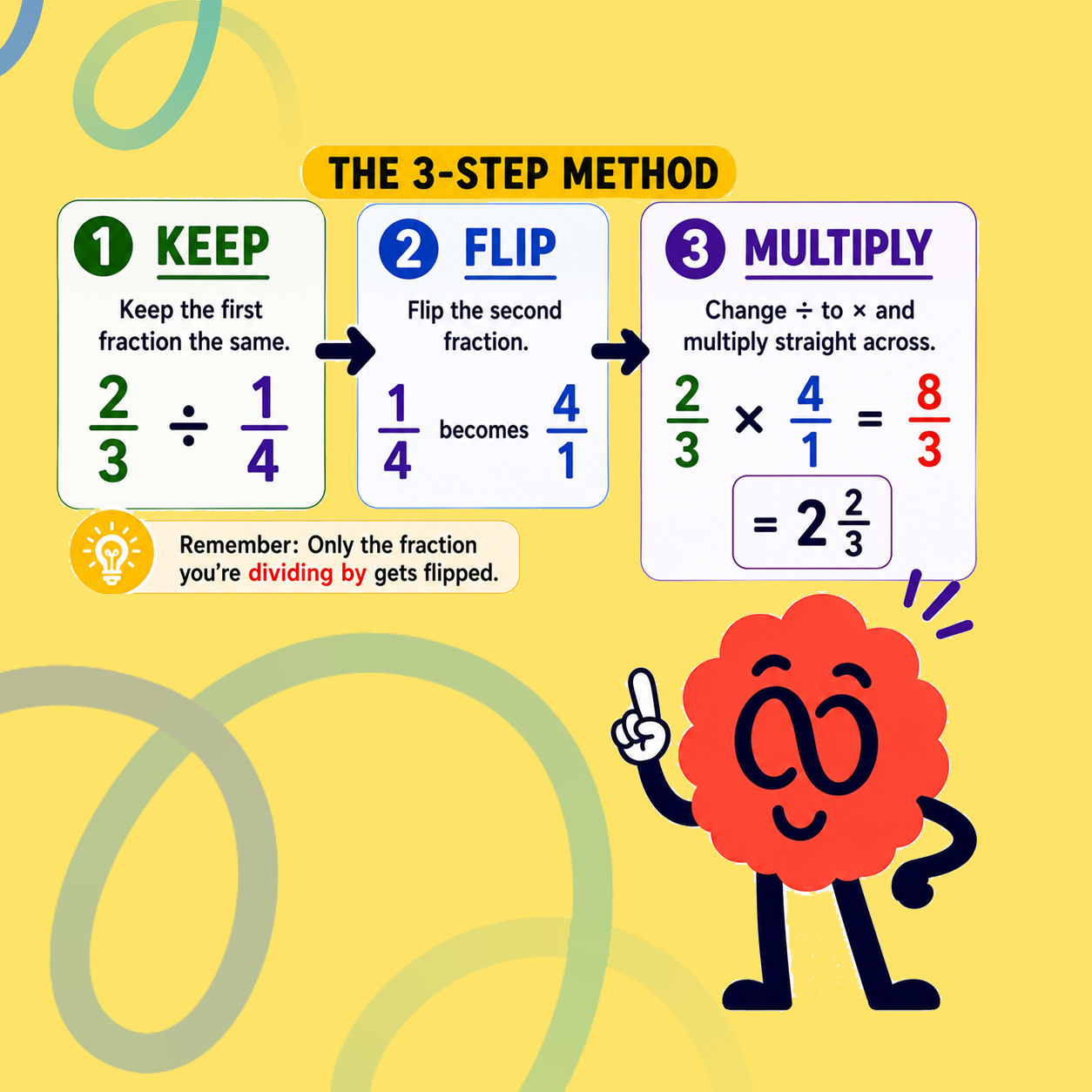
How to Divide Fractions: The 3-Step Method
When people ask how to divide fractions step by step, this is the method worth learning first.
Before you start, make sure you’re solid on numerators and denominators. If the top and bottom numbers still confuse you, revisit Parts of a Fraction before moving on.
Step 1: Keep the First Fraction the Same
Let’s work through a simple example:
2/3 ÷ 1/4
The first fraction never changes. It stays exactly as it is.
Step 2: Flip the Second Fraction
Now flip, or find the reciprocal of, the second fraction:
1/4 becomes 4/1
This flipped version is called the reciprocal.
Step 3: Multiply the Fractions
Change the division sign to multiplication, then multiply straight across:
2/3 × 4/1 = 8/3
Simplify the fraction:
8/3 = 2⅔
Final answer:
2/3 ÷ 1/4 = 2⅔
A common question is, “What is the formula for dividing fractions?”
Here’s the thing. There isn’t a separate formula to memorize. Learning how to divide fractions always comes down to the same three steps: keep, change, flip.
How to Divide Fractions with Whole Numbers
Learning how to divide fractions with whole numbers is where a lot of people start to feel unsure.
Let’s look at a simple example.
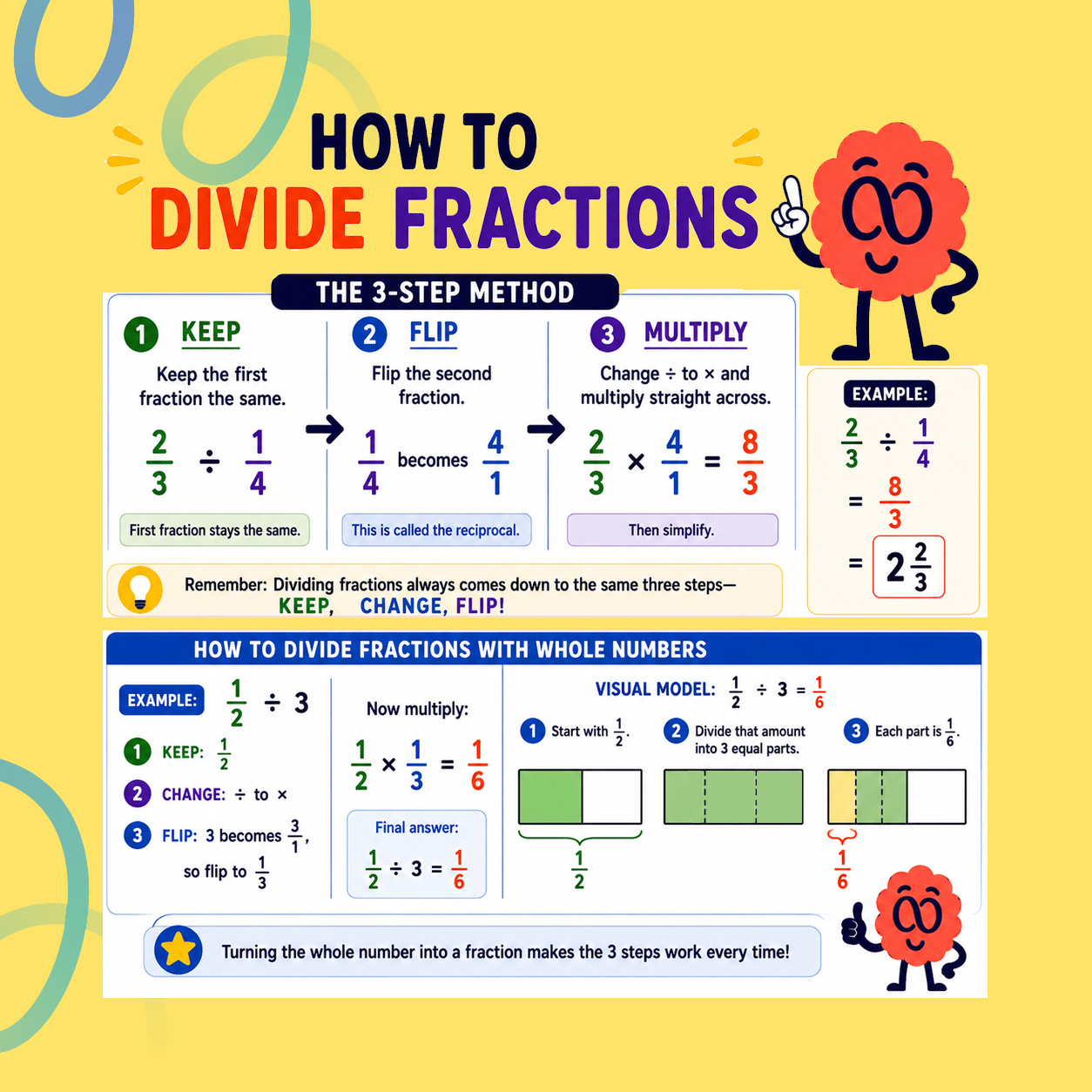
How Do You Solve 1/2 ÷ 3?
The first step is turning the whole number into a fraction.
3 becomes 3/1
Now keep, change, flip:
Keep: 1/2
Change ÷ to ×
Flip: 3/1 becomes 1/3
Multiply the fractions:
1/2 × 1/3 = 1/6
Final answer:
1/2 ÷ 3 = 1/6
This is often the moment when people ask:
“Why do we flip the second fraction?”
A simple explanation is:
“Dividing by a number is the same as multiplying by its reciprocal.”
Think about it this way. If you have 3 chocolate bars and you want to know how many half-bars that makes, you multiply by 2 instead of dividing by 1/2. Multiplying by the reciprocal gets you to the same answer faster.
That’s why flipping the second fraction works.
How to divide fractions with whole numbers is one of the more commonly searched fraction topics because turning a whole number into a fraction feels like an extra, unfamiliar step. The good news is that once you see 3 as 3/1, the rest of the problem works exactly like any other fraction division.
How to Divide Mixed Fractions
Another challenge shows up when learning how to divide mixed fractions.
Take this example:
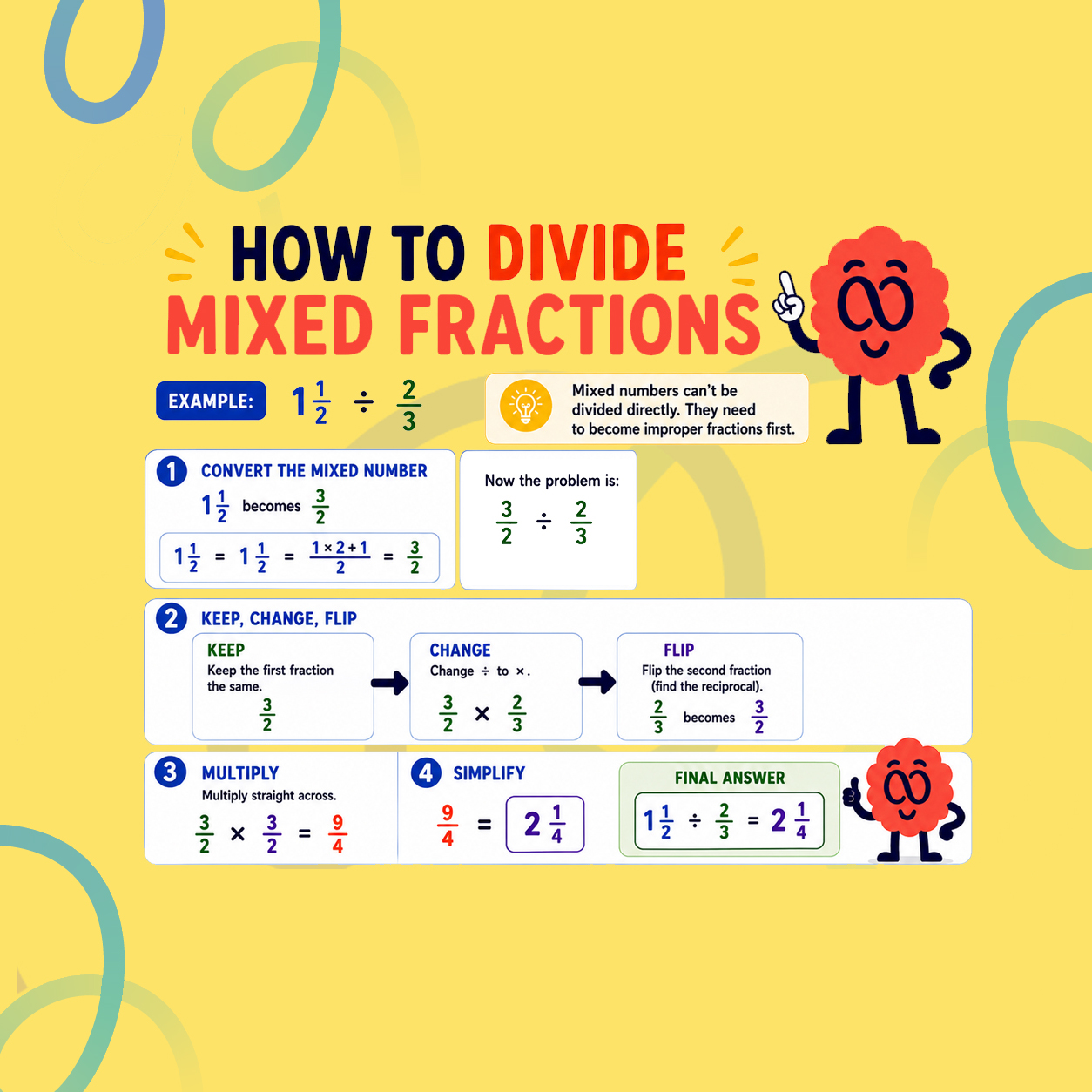
1½ ÷ 2/3
At first glance, it looks simple.
But here’s the problem.
“Mixed numbers can’t be divided directly. They need to become improper fractions first.”
This is where converting comes in.
If you’re still getting comfortable with mixed numbers, this is a good point to review Improper Fractions and Mixed Numbers.
Convert the mixed number:
1½ becomes 3/2
The problem becomes:
3/2 ÷ 2/3
Now keep, change, flip:
Keep: 3/2
Change ÷ to ×
Flip: 2/3 becomes 3/2
Multiply:
3/2 × 3/2 = 9/4
Simplify:
9/4 = 2¼
Final answer:
1½ ÷ 2/3 = 2¼
This is usually the hardest part of learning how to divide fractions in Grade 5.
Most people understand the multiplication step just fine. What trips them up is forgetting to convert the mixed number before flipping anything.
A helpful way to think about it:
“We turn the mixed number into a single fraction first so the keep-change-flip method actually works.”
If you need extra practice simplifying your final answer, see How to Simplify Fractions.
The Most Common Mistake: Flipping the Wrong Fraction
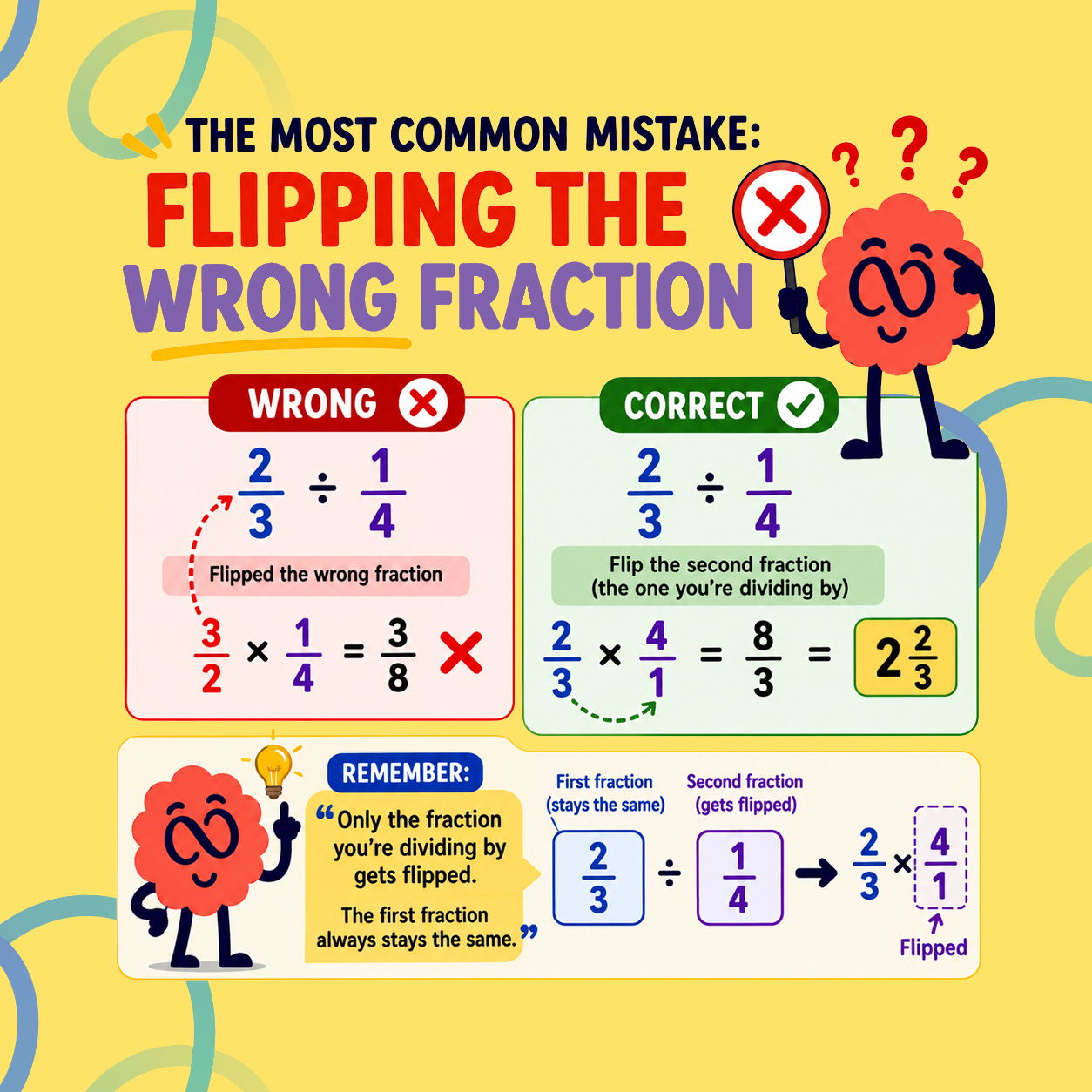
When first learning how to divide fractions, it’s easy to flip the wrong one.
They flip the first fraction instead of the second.
For example: 2/3 ÷ 1/4
Someone might write:
3/2 × 1/4 = 3/8 ❌
It usually happens because they’re not sure which fraction is supposed to change.
A helpful way to think about it:
“Only the fraction you’re dividing by gets flipped. The first fraction always stays exactly as it is.”
Once that order clicks, this mistake mostly disappears.
How Is Dividing Fractions Different from Multiplying?
A common question is whether dividing fractions needs a totally different method from multiplying.
The answer is no.
In fact, how to divide fractions is almost identical to multiplication, with one extra step tacked onto the front.
Both methods require:
• A clear numerator and denominator
• Multiplying straight across
• Simplifying the final fraction
The only real difference is what happens before you multiply.
With multiplication: 2/3 × 1/4 = 2/12 = 1/6
With division: 2/3 ÷ 1/4 = 2/3 × 4/1 = 8/3
Practice How to Divide Fractions at Home
One of the easiest ways to practice how to divide fractions is to use situations you already understand.
1. Sharing Snacks
Imagine you have:
1/2 a pizza
You want to split it into pieces that are each:
1/8 of the whole pizza
Ask: “How many slices does that make?”
You can count it out and check the math.
2. Measuring Cups
A recipe needs:
3/4 cup of flour
But your scoop only holds:
1/4 cup
Ask: “How many scoops will you need?”
This turns an abstract division problem into something your hands can actually do.
3. Splitting Allowance
Say you have 5 dollars and want to split it into quarter-dollar portions for different savings jars.
Ask: “How many jars can you fill?”
Real numbers like this make fraction division feel useful instead of random.
Quick Check: 3 Questions to Test Understanding
A quick way to check your understanding of how to divide fractions is to explain your thinking out loud.
Try these questions.
Question 1
What is 2/3 ÷ 1/4?
Question 2
Why do we flip the second fraction when dividing fractions?
Question 3
If you have 1½ pies and want to divide them into 1/3-size slices, what would you do first?
Listen for the explanation, not just the answer. If you can explain why a step happens and not just what to do, that’s real understanding.
Key Takeaways
• Learning how to divide fractions gets easier once you’re comfortable with keep, change, flip.
• Keep the first fraction the same, flip the second, then multiply.
• Whole numbers can be divided as fractions once you write them as a fraction over 1.
• Mixed numbers need to become improper fractions before you divide.
• The most common mistake is flipping the first fraction instead of the second.
• Real-world examples make dividing fractions click faster than worksheets alone.
• The method for how to divide fractions is almost identical to multiplying fractions, just with one extra step.
Frequently Asked Questions
How to divide fractions step by step?
To divide fractions, follow three steps. Keep the first fraction the same, change the division sign to multiplication, and flip the second fraction. Then multiply straight across and simplify.
What is the formula for dividing fractions?
There isn’t a separate formula. Learning how to divide fractions always uses the same keep-change-flip process: keep the first fraction, flip the second, then multiply.
How to divide fractions with whole numbers?
Write the whole number as a fraction over 1, then use keep-change-flip like any other fraction division problem.
How to divide mixed fractions?
Convert each mixed number into an improper fraction first. Then keep the first fraction, flip the second, multiply, and simplify your answer.
Do you need a common denominator to divide fractions?
No. Common denominators matter for adding and subtracting fractions, not for dividing them. Division uses keep, change, flip instead.
Why does flipping the second fraction work?
Dividing by a fraction gives the same answer as multiplying by its reciprocal. Flipping the second fraction turns the problem into multiplication, which is easier to calculate.
Once you feel confident with how to divide fractions, the next step is applying that skill to real Fraction Word Problems, where dividing fractions shows up in everyday questions about sharing, cooking and measuring.
Fraction division is a common sticking point in Grade 4 and Grade 5. Our tutors pinpoint exactly where you are getting stuck and explain fractions in a way that actually makes sense.
Book a free assessment today and explore our Grade 4 and Grade 5 math programs