
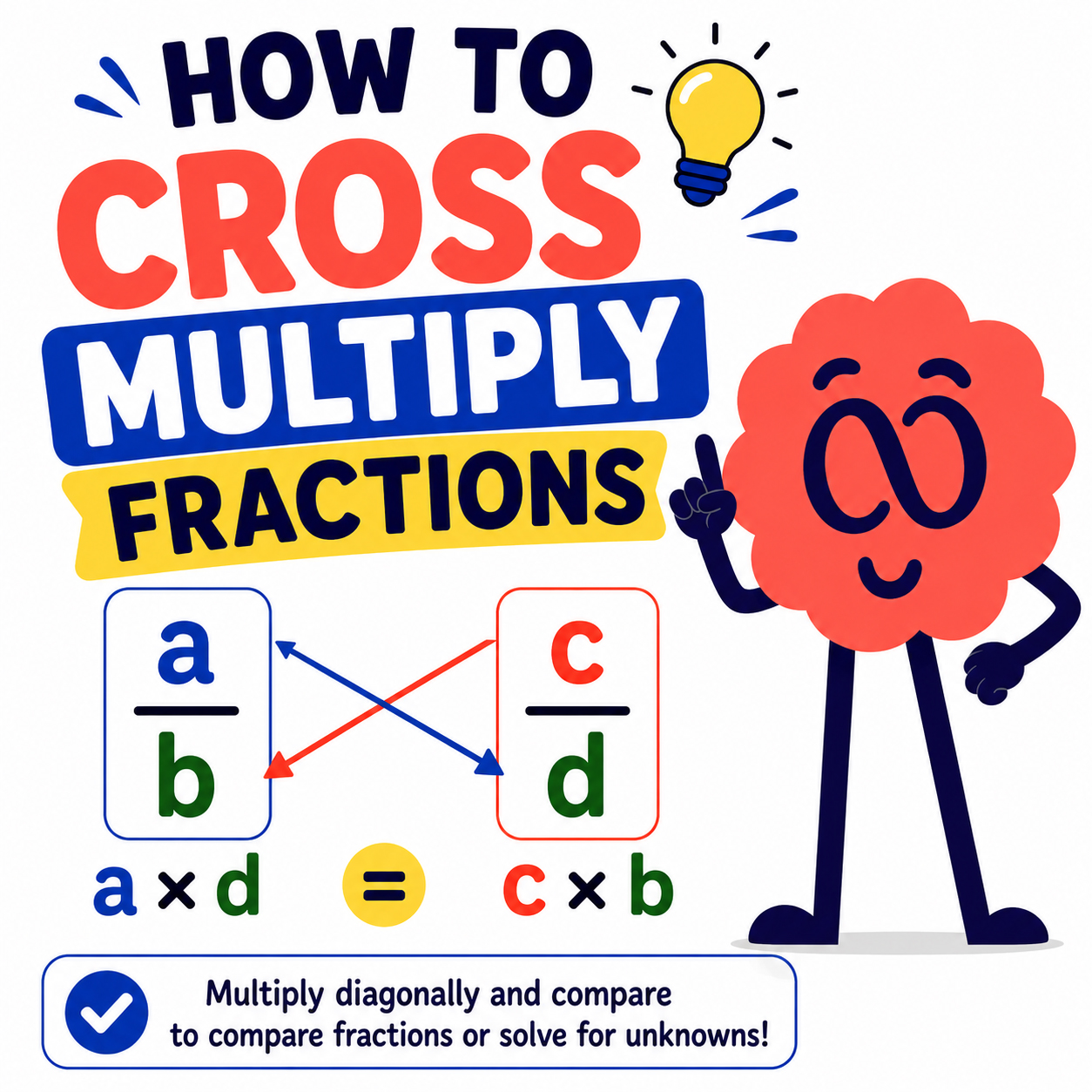
To cross multiply fractions, multiply the numerator of the first fraction by the denominator of the second. Then multiply the numerator of the second fraction by the denominator of the first. Use this to compare two fractions or to solve for an unknown number when two fractions equal each other. Don't use cross multiplication to add, subtract, multiply, or divide fractions directly. It only works when you compare two fractions or set them equal to each other.
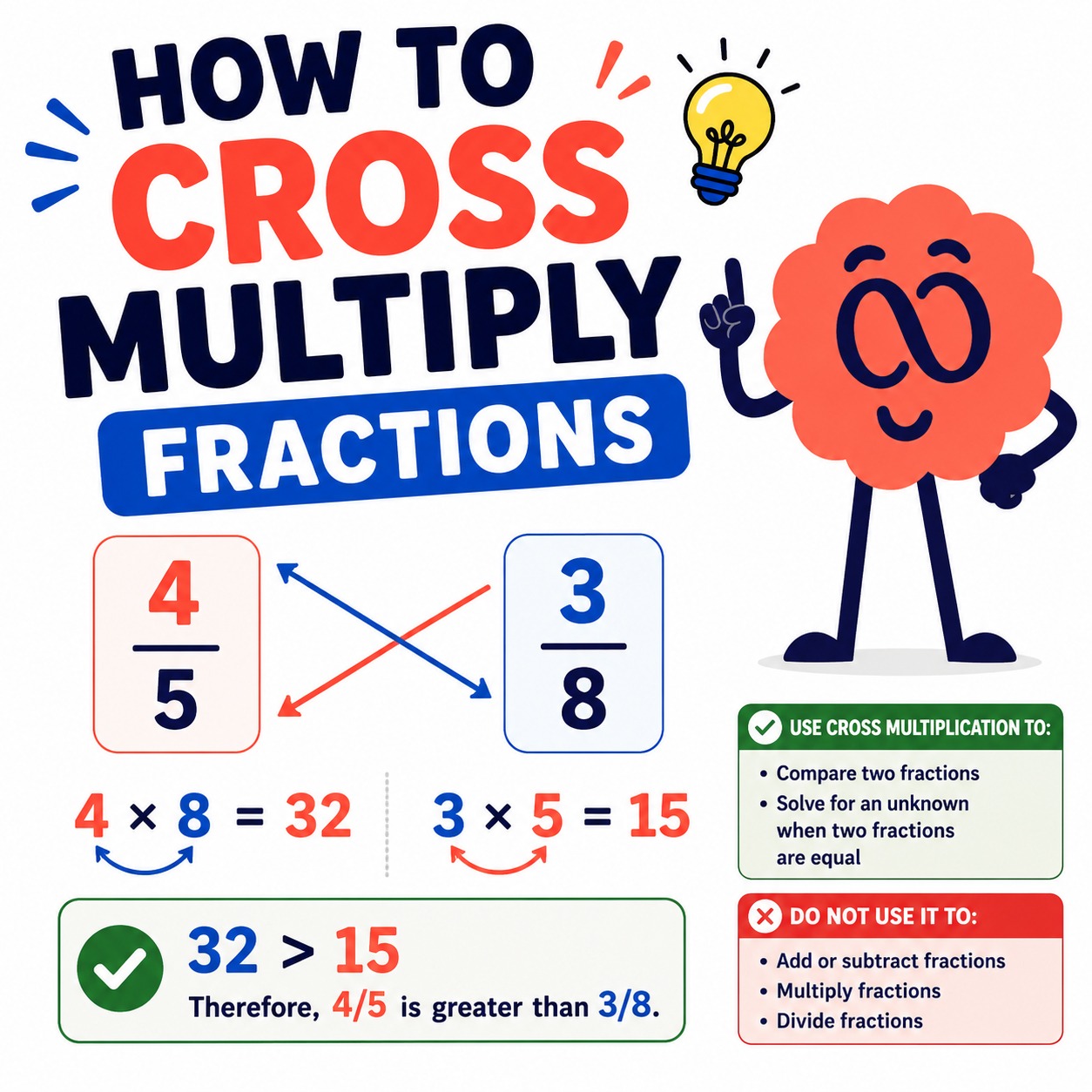
Take 4/5 and 3/8. Multiply 4 by 8 to get 32. Multiply 3 by 5 to get 15. Since 32 is bigger than 15, 4/5 is the larger fraction. That's the entire mechanic behind how to cross multiply fractions. The harder part, and the part most guides skip, is knowing exactly when this shortcut applies and when it doesn't.
When Do You Cross Multiply Fractions? When You SHOULD
Cross multiplication is the right tool in three specific situations.
• Comparing two fractions to see which one is bigger
• Solving for a missing number in a pair of equivalent fractions, like 4/5 = x/20
• Checking whether two fractions are equal to each other
All three involve setting two fractions side by side, either as a comparison or as an equation. For a refresher on what makes two fractions equal, see our guide on equivalent fractions.
When You Should NOT Cross Multiply Fractions
This is the part that trips people up most. Cross multiplication does not work for adding, subtracting, multiplying, or dividing fractions directly.
If you're adding fractions, the correct method is finding a common denominator first, not cross multiplying the numbers. Our guide on how to add fractions walks through that process step by step.
If you're multiplying fractions, the correct method is multiplying straight across, numerator by numerator and denominator by denominator, with no cross step involved at all. Our guide on how to multiply fractions covers that method.
Mixing up these rules causes some of the most common careless errors in fraction work. Cross multiplication looks similar enough to regular multiplication that it's easy to reach for the wrong tool by habit when you cross multiply fractions without thinking it through.
How to Cross Multiply Fractions to Compare Them
Cross multiplication works well when two fractions don't share a denominator, since it skips the step of finding one. For more on that underlying skill, see our guide on comparing fractions.
Take 5/7 and 4/6. Multiply 5 by 6 to get 30. Multiply 4 by 7 to get 28. Since 30 is bigger than 28, 5/7 is the larger fraction. Notice how the cross products line up: the first cross product (5 × 6) matches 5/7, and the second (4 × 7) matches 4/6.
How to Cross Multiply Fractions to Solve for an Unknown
Cross multiplication also works when one fraction has a missing number and you set the two fractions equal to each other.
Take 4/5 = x/20. Cross multiply: 4 × 20 = 5 × x, which gives 80 = 5x. Divide both sides by 5, and x = 16. So 4/5 is equivalent to 16/20.

Cross Multiplication in Real Life
Cross multiplication shows up anytime you compare or scale two ratios. Scaling a recipe is a common example. If a recipe calls for 3/4 cup of flour for 6 servings, cross multiplication finds how much flour you need for 10 servings by setting 3/4 over 6 equal to x over 10.
Comparing prices works the same way. If one store sells 5 apples for $4 and another sells 8 apples for $6, cross multiplying the two rates shows which deal is actually better.
When Does My Child Learn How to Cross Multiply Fractions?
Cross multiplication builds directly on equivalent fractions and comparing fractions, both of which kids learn in Grades 3 through 5. Students typically formalize the technique around Grade 5 to Grade 6, and they use it heavily again once pre-algebra introduces solving proportions.
Common Mistakes When You Cross Multiply Fractions
A few habits tend to cause errors when learning how to cross multiply fractions.
• Using cross multiplication to add or subtract fractions instead of finding a common denominator
• Using cross multiplication to multiply fractions instead of multiplying straight across
• Crossing the wrong pair of numbers, multiplying a numerator by its own denominator instead of the other fraction's
• Forgetting which cross product belongs to which original fraction when comparing two fractions
Key Takeaways
• Cross multiply by multiplying each numerator by the other fraction's denominator.
• Use it to compare fractions, solve for an unknown, or check if two fractions are equal.
• Never use it to add, subtract, multiply, or divide fractions directly.
• The cross product that's bigger belongs to the bigger fraction when comparing.
• This skill builds on equivalent fractions and comparing fractions, and it resurfaces again in pre-algebra.
Frequently Asked Questions
How do you cross multiply fractions?
Multiply the numerator of the first fraction by the denominator of the second. Then multiply the numerator of the second fraction by the denominator of the first. Compare the two results, or set them equal to each other if you're solving for an unknown. That's the full process for how to cross multiply fractions.
When do you cross multiply fractions?
Cross multiply fractions to compare two fractions, solve for a missing number in equivalent fractions, or check whether two fractions are equal. Don't use it for adding, subtracting, multiplying, or dividing fractions.
Can you cross multiply when adding fractions?
No. Adding fractions requires a common denominator, not cross multiplication. Cross multiplying numbers meant for addition will produce the wrong answer.
How do you use cross multiplication to compare fractions?
Multiply the numerator of each fraction by the other fraction's denominator. Whichever cross product is larger tells you which original fraction is larger.
Does cross multiplication work for three fractions at once?
No. Cross multiplication only works on two fractions at a time. Comparing three or more fractions usually calls for converting them all to a common denominator instead.
Cross multiplication is a genuinely useful shortcut, but only for the right job. Mixing it up with the rules for adding or multiplying fractions causes some of the most common careless errors.
If your child needs help sorting out when do you cross multiply fractions versus when to use another method, our tutors can help build that clarity.
Book a free assessment today and explore our Grade 5 math program.