
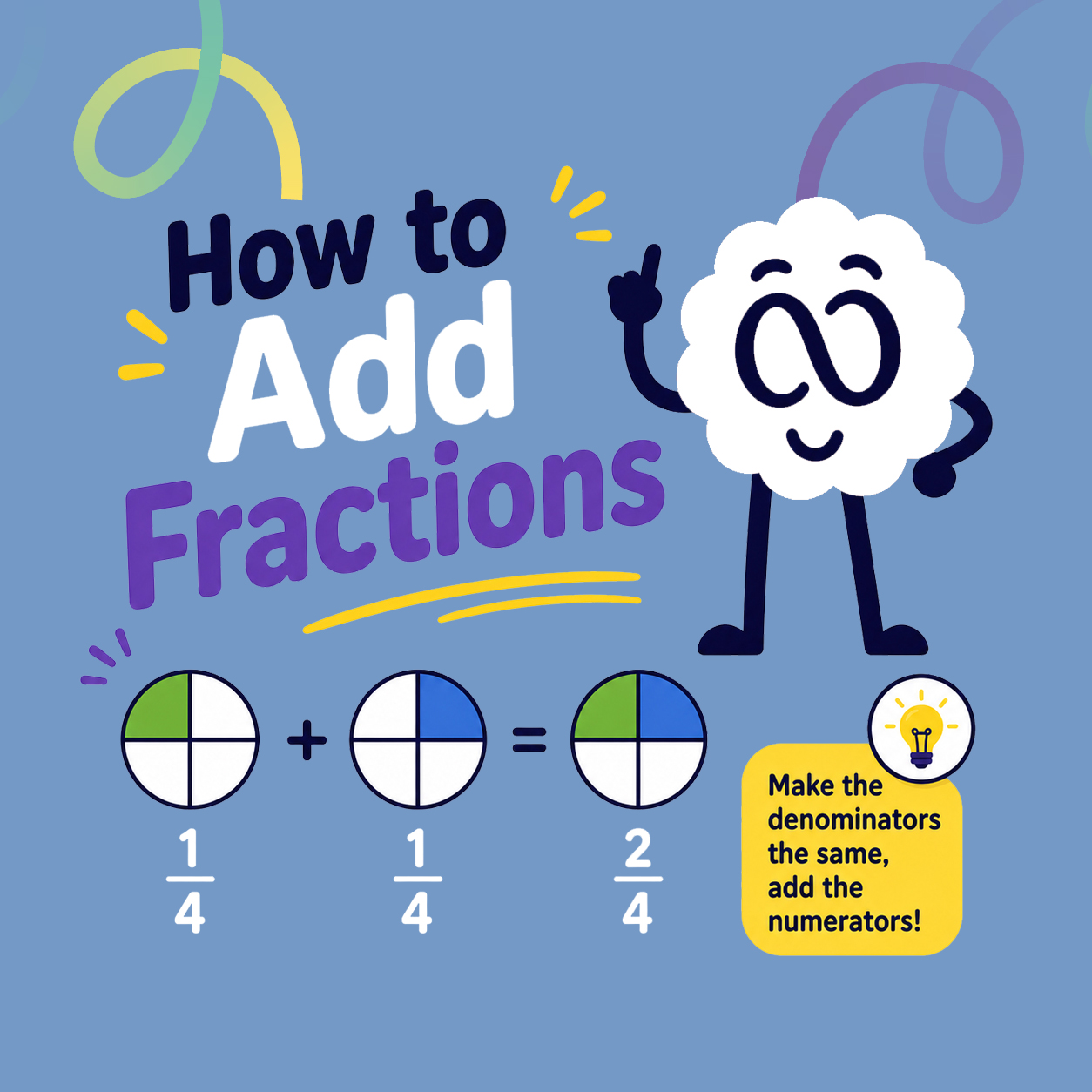
If you’re trying to figure out how to add fractions, you’re definitely not alone. Fractions can feel confusing at first. The good news is that one small idea usually causes most of the confusion and once that clicks, everything gets much easier: make the denominators the same, add the numerators, and simplify if needed.
Most people don’t struggle because they’re bad at math. They usually get stuck because nobody has explained why those steps matter. Once you understand why those steps matter, how to add fractions becomes much easier and far less intimidating.

How to add fractions: The 3-Step Method
When people ask how to add fractions, this is the method worth learning first.
Step 1: Make Sure the Denominators Match
The denominator is the bottom number in a fraction. For a refresher, see our guide to Parts of a Fraction.
For example:
1/4 + 1/4
Both fractions already have the same denominator, so there's nothing to change.
Step 2: Add the Numerators
Add the top numbers:
1 + 1 = 2
So:
1/4 + 1/4 = 2/4
Step 3: Simplify the Fraction
The fraction 2/4 can be simplified to 1/2.
For a full walkthrough, see our guide on How to Simplify Fractions.
So the final answer becomes:
1/4 + 1/4 = 1/2
This example shows that adding fractions can be quite simple when the denominators are the same.
How to add fractions with Different Denominators
The part that usually causes frustration is learning how to add fractions with different denominators.
How Can I Add 1/3 and 1/2?
Start by finding a denominator both fractions can share.
The denominators are:
- 3
- 2
A common denominator is 6.
Convert each fraction:
1/3 = 2/6
1/2 = 3/6
Now add the numerators:
2 + 3 = 5
Result:
5/6
So:
1/3 + 1/2 = 5/6
This is the point where many people get stuck. Before you can add fractions, the pieces need to be the same size. That’s why we find a common denominator first.
One way to explain it is with money. Adding 1/3 and 1/2 straight away is a bit like trying to add dollars and euros without converting them first. Once everything is in the same “units,” the math becomes much simpler.
For more examples, see Adding Fractions with Unlike Denominators for additional practice.
How to Find a Common Denominator
Finding a common denominator is something many people worry about at first.
In reality, there are two simple methods.
Method 1: Multiply the Denominators
For 1/3 + 1/2:
3 × 2 = 6
This gives you a denominator both fractions can use.
For most Grade 4 students, this method is completely fine.
Method 2: Find the Least Common Multiple
In Grade 5, students start learning about the Least Common Multiple, often shortened to LCM.
For example:
4 and 6 share a least common multiple of 12.
Using the smallest possible common denominator keeps calculations easier.
If you’re ready for this approach, see our guide on What Is LCM?.
You can also learn more about the idea behind common denominators in What Is a Common Denominator?
The Step Where Most Kids Go Wrong
If there's one mistake that causes the most frustration when learning how to add fractions, it's this:
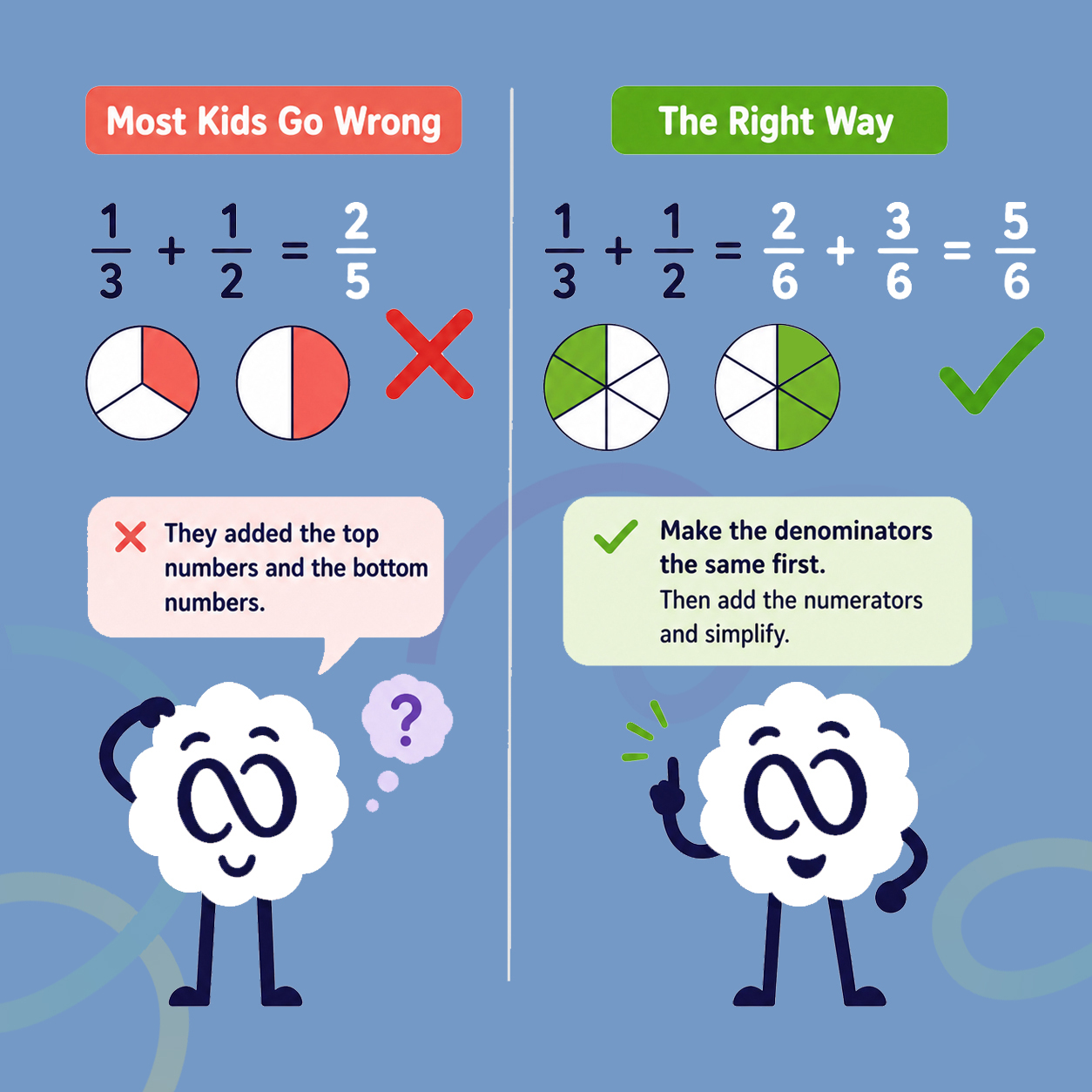
The most common mistake is trying to add the denominators.
For example:
1/3 + 1/2
For example, someone might write:
2/5 ❌
It seems logical from their perspective. They added the top numbers and then added the bottom numbers.
But here's the problem.
The denominator tells us the size of the pieces. If we change it without making equivalent fractions first, we're no longer talking about the same-sized parts.
A helpful way to think about it:
"The bottom numbers tell us how big the pieces are. We need the pieces to be the same size before we can put them together."
That explanation is usually more effective than introducing complicated rules.
Show:
❌ 1/3 + 1/2 = 2/5
✅ 1/3 + 1/2 = 2/6 + 3/6 = 5/6
Many people need to see both examples side by side before the idea clicks.
Adding Mixed Fractions: What Comes Next?
As you become more confident with adding fractions, you’ll also begin working with mixed numbers and eventually learn how to subtract fractions .
A mixed fraction contains a whole number and a fraction.
For example:
2½ + 1½
The easiest way to solve this is to add the whole numbers first:
2 + 1 = 3
Then add the fractions:
½ + ½ = 1
Final answer:
4
The good news is that mixed fractions aren’t a completely new skill. They build on ideas you’ve already practiced with fractions.
Taking time to get comfortable with the basics now can make the next step feel much easier.
How to Add Fractions at Home: 3 Simple Activities
One thing worth noting is that fractions often click better in the kitchen than at a desk.
1. Use Measuring Cups
While baking or cooking, ask questions like:
- What happens if we combine 1/4 cup and 1/4 cup?
- How many 1/4 cups make 1 cup?
You can physically see the fractions being combined.

2. Share Food
Pizza works well, but so do sandwiches, chocolate bars, and fruit slices.
Try asking:
"If you eat 1/4 of the pizza and I eat 2/4, how much have we eaten altogether?"
Real objects make fractions feel less abstract.
3. Use a Clock
A clock is full of fractions.
Ask:
- How much of an hour is 15 minutes?
- What happens if we combine two quarter-hours?
These conversations help you practice adding fractions without feeling like you’re doing math homework.
How to Add Fractions: Quick Check
You don't need a worksheet to check understanding.
Instead, try asking a few casual questions.
Question 1
If we add 1/4 and 1/4, what do we get?
Question 2
Why can't we add the denominators in 1/3 + 1/2?
Question 3
What denominator could both 1/4 and 1/2 use?
If you can explain your thinking, not just give the answer, you’re probably developing genuine understanding.
Key Takeaways
- The more you practice how to add fractions, the more confident you will become.
- When denominators match, simply add the numerators.
- When denominators are different, find a common denominator first.
- The most common mistake is adding the denominators.
- Real-world activities often work better than worksheets.
Frequently Asked Questions
How to add fractions step by step?
To learn how to add fractions, follow these three steps:
- Make the denominators equal.
- Add the numerators.
- Simplify the answer if possible.
How to add 2 fractions with different denominators?
When learning how to add fractions with different denominators, the first step is finding a common denominator.Then rewrite the fractions using that denominator, add the numerators and simplify.
How can I add 1/3 and 1/2?
Convert both fractions to sixths:
1/3 = 2/6
1/2 = 3/6
Then add:
2/6 + 3/6 = 5/6
Why do people struggle with adding fractions?
Most people struggle because they don’t yet understand why denominators must match before fractions can be combined.
Adding fractions is a Grade 4–5 milestone. If you’re struggling with How to Add Fractions, our tutors work through it in a way that actually clicks.
Book a free assessment today and explore our Grade 4 and Grade 5 math programs.