
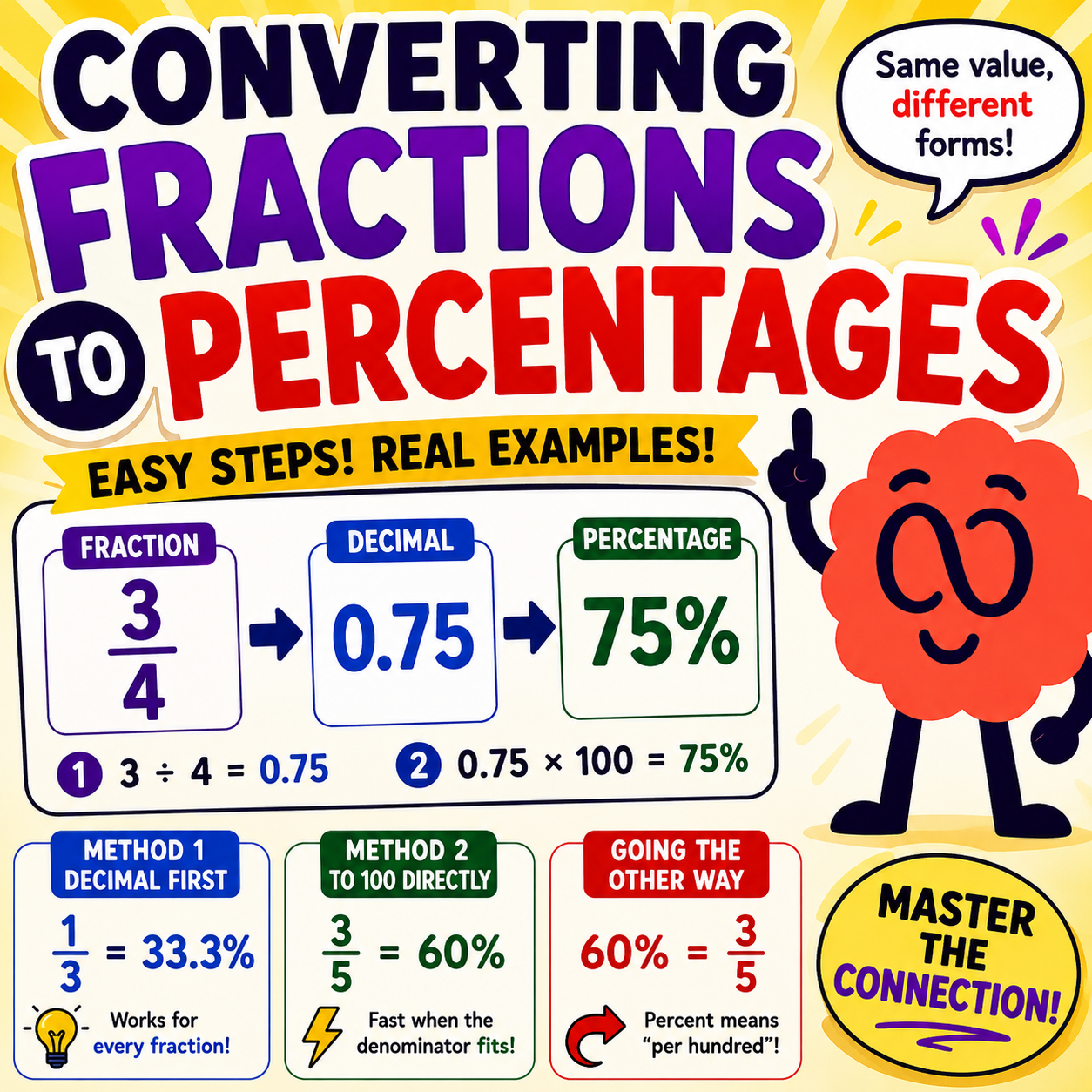
To convert fractions to percentages, divide the numerator by the denominator to get a decimal, then multiply by 100 and add a percent sign. For example, 3/4 = 3 ÷ 4 = 0.75, and 0.75 × 100 = 75%. If the denominator can be easily converted to 100, like 4, 5, 10, 20, 25 or 50, the decimal step can be skipped entirely and the fraction can be converted directly.
Converting fractions to percentages connects three different ways of writing the exact same value. Understanding how to convert fractions to percentages helps students move easily between fractions, decimals, and percentages.
Once the link between fractions, decimals and percentages is clear, all three start to feel like the same idea written three different ways.
Take 3/4.
Divide the numerator by the denominator:
3 ÷ 4 = 0.75
Multiply by 100 and add a percent sign:
0.75 × 100 = 75%
3/4 = 75%
That two-step process, divide then multiply, works for converting any fraction to a percentage, no matter how unfriendly the denominator looks.
Knowing how to convert fractions to percentages reliably starts with this method, since it works for every fraction, which makes it the most reliable option when the denominator doesn’t divide neatly into 100. The decimal step here is exactly the same skill covered in converting fractions to decimals.
Take 1/3.
1 ÷ 3 = 0.333...
0.333... × 100 = 33.3%
1/3 = 33.3%
Notice that the decimal repeats, so the percentage is rounded rather than exact. Writing it as 33.3% or 33⅓% both communicate the same value, just with different levels of precision.
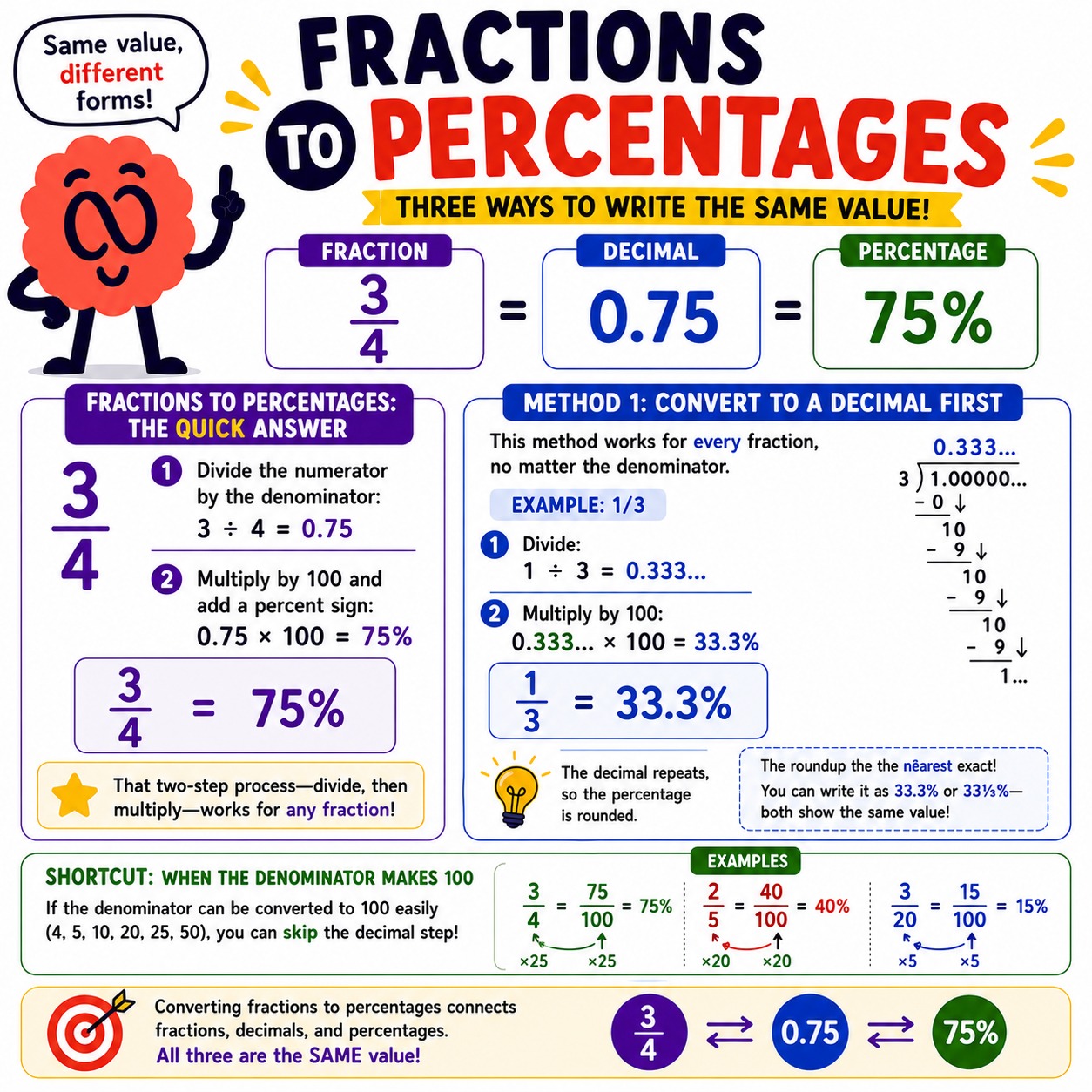
This is one of the fastest fraction to percentage methods when the denominator divides evenly into 100.
Take 3/5.
5 divides into 100 exactly 20 times, so multiply both the numerator and denominator by 20:
3/5 = 60/100
A fraction with a denominator of 100 converts to a percentage instantly, since percent literally means “per hundred.”
60/100 = 60%
This shortcut works cleanly for denominators like 2, 4, 5, 10, 20, 25 and 50, since each one divides evenly into 100. For anything else, like 3, 6 or 7, the decimal method from above is the more reliable path.
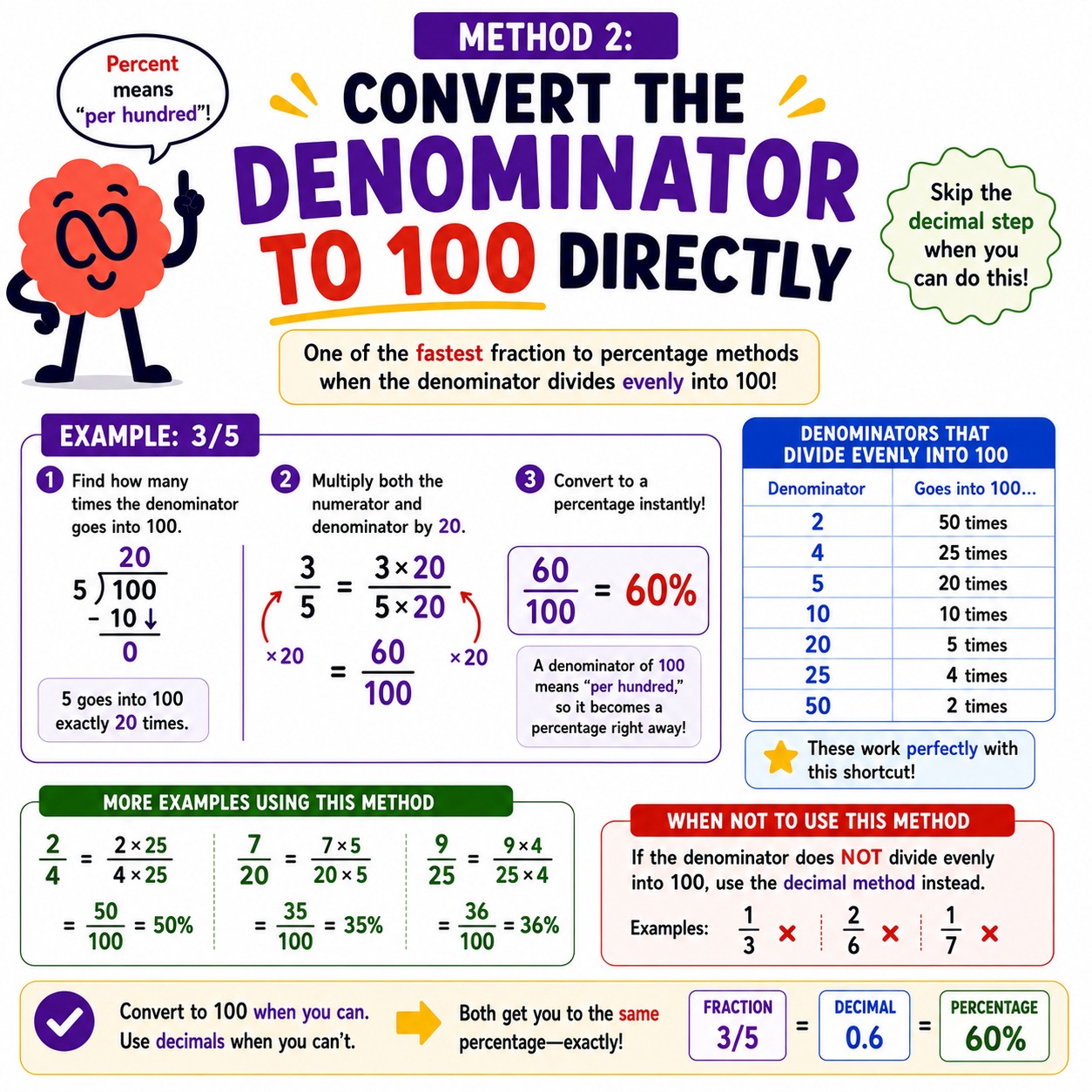
These are the fraction to percentage conversions that come up most often when working with fractions to percentages in everyday situations.
Fraction
Percentage
1/2
50%
1/4
25%
3/4
75%
1/3
33.3%
2/3
66.7%
1/5
20%
1/10
10%
1/8
12.5%
The halves, quarters and tenths are worth memorizing outright. Memorizing these common fraction to percentage conversions can make mental math much faster.
Thirds are worth recognizing even though the decimal repeats, since 33.3% and 66.7% show up constantly in everyday statistics.
Mixed numbers and improper fractions both convert the same way once they’re rewritten as a single fraction or decimal.
Take 1 1/2.
Convert the mixed number to an improper fraction first:
1 1/2 = 3/2
Divide the numerator by the denominator:
3 ÷ 2 = 1.5
Multiply by 100:
1.5 × 100 = 150%
1 1/2 = 150%
A percentage over 100% simply means more than one whole, which makes sense here since 1 1/2 is more than a single whole to begin with.
Converting in the opposite direction uses a similar two-step idea, just in reverse.
Take 60%.
Write the percentage over 100:
60/100
Simplify the result, the same process covered in How to Simplify Fractions:
60/100 = 3/5
60% = 3/5
Since percent already means “per hundred,” writing it as a fraction over 100 is usually the fastest way in, and simplifying afterward turns it into a cleaner fraction to work with. For more worked examples going this direction, see converting decimals to fractions, which covers the same simplifying step in more depth.
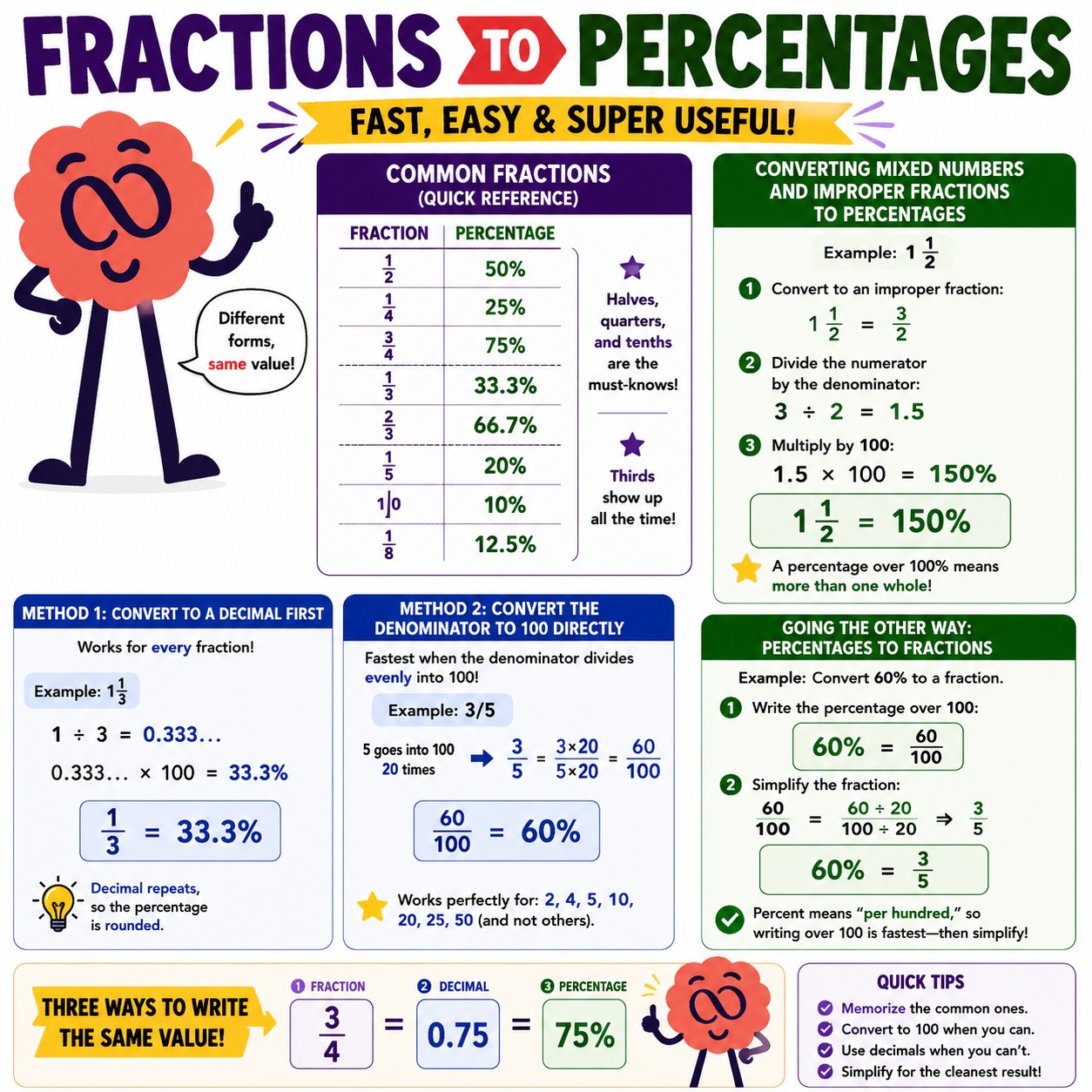
Converting fractions to percentages shows up constantly outside of any classroom.
Knowing how to convert fractions to percentages makes it easier to understand grades, discounts, and statistics.
Test scores are the most familiar example. Getting 18 out of 20 questions right is 18/20, which converts to 90%.
Sales discounts work the same way. A price marked “25% off” is identical to saying the price drops by 1/4.
Statistics in the news rely on this conversion too. A headline reporting that “two-thirds of respondents agreed” is just 2/3 written out as 66.7%, since percentages tend to read more naturally in everyday language than fractions do.
Fractions, decimals and percentages are typically taught as connected representations of the same value starting in Grade 5, with the relationship reinforced again in Grade 6 as students work with ratios and proportional reasoning.
By the time this topic is introduced formally, most students have already seen percentages informally through grades, discounts and sports statistics, which makes the conversion feel less abstract than it might otherwise. For a broader look at where this fits among other skills at that age, see Fractions for 5th Graders.
Here’s the short version of fractions to percentages, in both directions.
• To convert a fraction to a percentage, divide the numerator by the denominator, then multiply by 100.
• If the denominator divides evenly into 100, convert it directly instead of going through a decimal.
• Mixed numbers and improper fractions convert the same way once rewritten as a single fraction or decimal.
• To go from a percentage back to a fraction, write it over 100 and simplify.
• This conversion shows up constantly in test scores, discounts and everyday statistics.
To understand how to convert fractions to percentages, divide the numerator by the denominator to get a decimal, then multiply by 100 and add a percent sign.
3/4 is 75%. Dividing 3 by 4 gives 0.75, and multiplying by 100 gives 75%.
Write the percentage over 100, then simplify the resulting fraction. For example, 60% becomes 60/100, which simplifies to 3/5.
1/3 is approximately 33.3%. The decimal repeats forever, so the percentage is typically rounded to one decimal place.
It depends on the denominator. Fractions with a denominator that divides evenly into 100, like 4, 5, 10, 20, 25 or 50, convert directly. Other denominators need the decimal method first.
Fraction to percentage conversions show up anywhere a value needs to be compared quickly, like grades, discounts, and statistics. Percentages are often easier to compare at a glance than fractions with different denominators.
Converting fractions to percentages helps students see that fractions, decimals, and percentages are simply different ways of showing the same value. If conversions like this are causing confusion, the right support builds that confidence step by step.
Book a free assessment today and explore our Grade 5 math programs.