
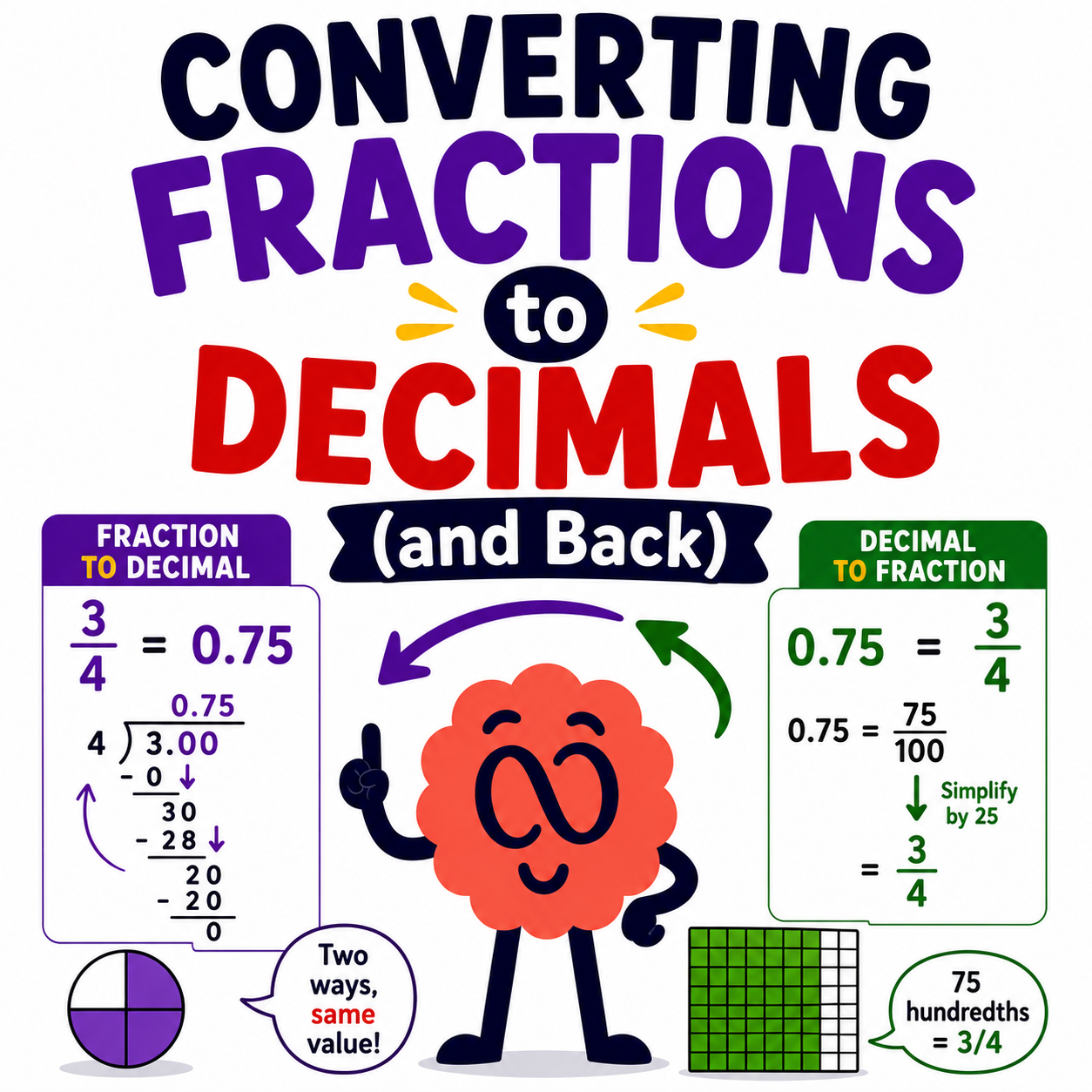
To convert fractions to decimals, divide the numerator by the denominator. For example, 3/4 = 3 ÷ 4 = 0.75. To convert a decimal back to a fraction, write the decimal as a fraction using its place value. 0.75 is 75 hundredths, which is 75/100, simplified down to 3/4. Common fractions like 1/2, 1/4 and 3/4 have fixed decimal equivalents that are worth memorizing.
That’s the short version. The rest of this guide covers both directions of converting fractions to decimals in more detail, plus a quick reference table for the conversions that come up most often.
Fractions and decimals are just two different ways of writing the same value. A fraction like 3/4 and a decimal like 0.75 represent the same value, while fractions such as 3/4, 6/8, and 9/12 are examples of equivalent fractions.
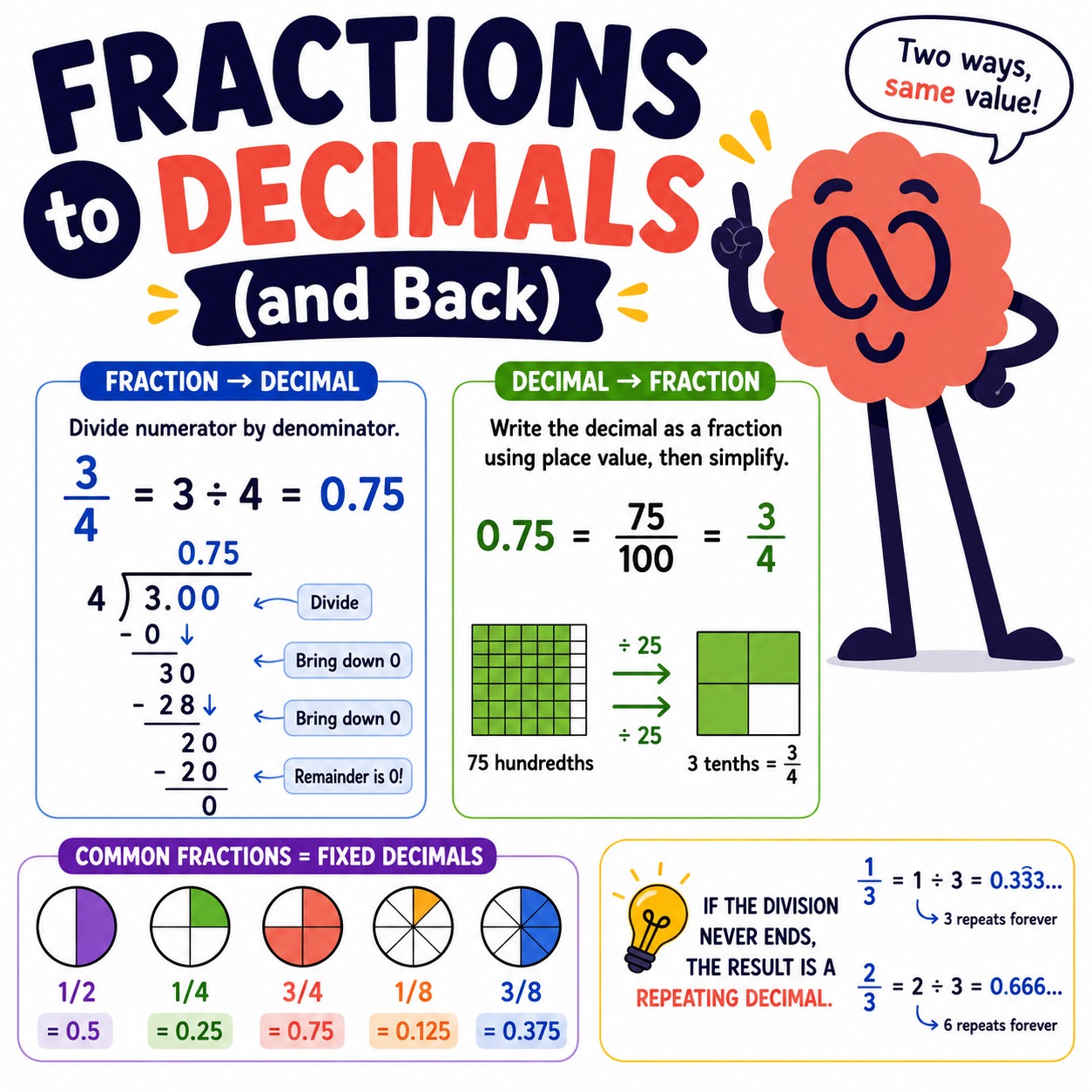
Take 3/4. Divide the numerator by the denominator:
3 ÷ 4 = 0.75
Take 1/3. Divide the numerator by the denominator:
1 ÷ 3 = 0.333...
The first example ends cleanly. The second one doesn’t, which is worth a closer look further down.
Understanding how to convert fractions to decimals becomes much easier once you realize every fraction can be written as a division problem.
The method behind converting fractions to decimals is always the same: divide the top number by the bottom number.
Take 3/8.
3 ÷ 8 = 0.375
Written out as a long division, 3 divided by 8 doesn’t go evenly, so the division continues with decimal places: 3.000 ÷ 8 = 0.375. The division stops once there’s no remainder left.
3/8 = 0.375
Not every division stops so cleanly. When the division never ends, the result is called a repeating decimal, and that case gets its own explanation in a moment.
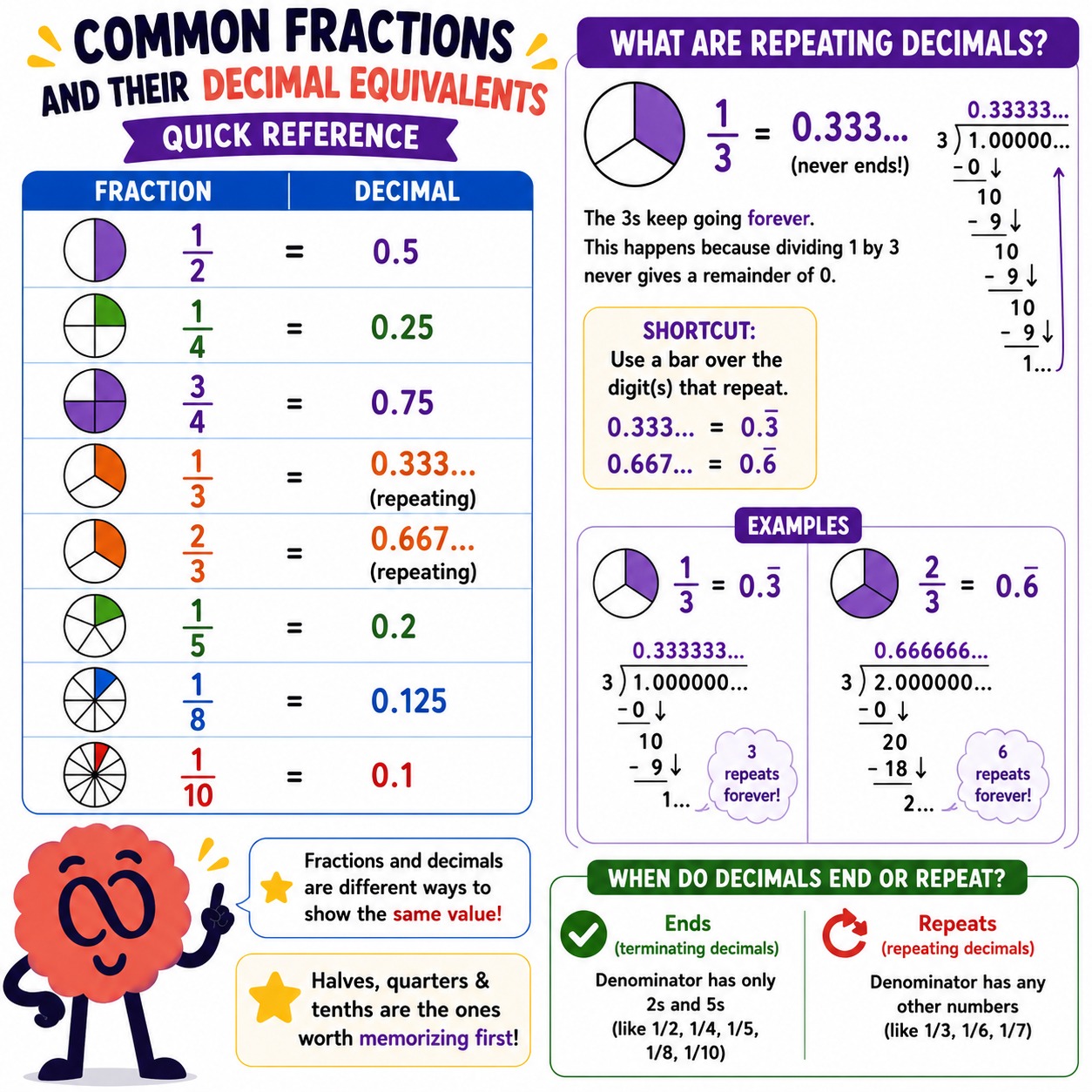
These are the fractions to decimals conversions that show up the most. A few are worth memorizing outright, since they appear constantly in measurements, money and test scores.
Fraction
Decimal
1/2
0.5
1/4
0.25
3/4
0.75
1/3
0.333... (repeating)
2/3
0.667 (repeating)
1/5
0.2
1/8
0.125
1/10
0.1
The halves, quarters and tenths in this table are the ones worth memorizing first. Thirds and eighths come up often enough to recognize, even without memorizing every digit.
1/3 = 0.333... never actually ends. The 3s keep going forever, which is why it’s called a repeating decimal.
This happens because dividing 1 by 3 never produces a remainder of 0. The same leftover keeps showing up at every step, so the same digit keeps getting added.
Rather than writing out an endless string of 3s, repeating decimals are usually written with a bar over the repeating digit or digits, like 0.3 with a line above the 3.
Whether converting fractions to decimals produces a repeat depends on the denominator. Fractions whose denominator only breaks down into 2s and 5s, like 1/2, 1/4, 1/5 or 1/8, convert to decimals that end cleanly. Fractions with any other number in the denominator, like 1/3, 1/6 or 1/7, produce repeating decimals.
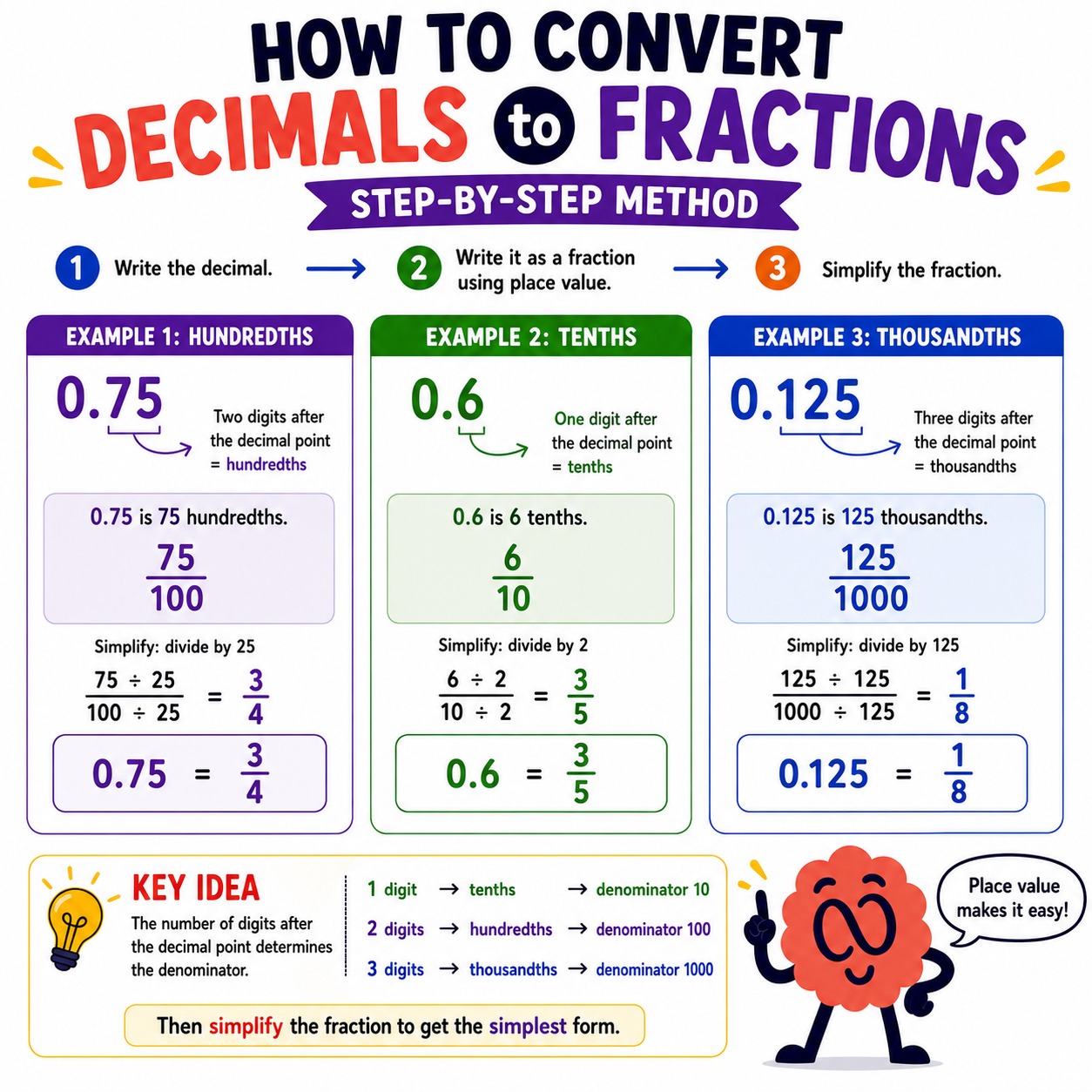
Understanding decimals to fractions starts with place value rather than division. Knowing how to turn decimals into fractions becomes much easier once you understand how decimal places determine the denominator.
Take 0.75.
The digits after the decimal point sit in the hundredths place, so 0.75 is 75 hundredths, or 75/100.
75/100 can be simplified, since both numbers share a factor of 25.
75/100 = 3/4
This example shows how to turn decimals into fractions by using place value and then simplifying the result.
Tenths work the same way, just with one decimal place instead of two. Take 0.6.
0.6 is 6 tenths, or 6/10.
6/10 simplifies to 3/5.
Thousandths follow the identical pattern with three decimal places. Take 0.125.
0.125 is 125 thousandths, or 125/1000.
125/1000 simplifies down to 1/8.
The number of digits after the decimal point determines the denominator: one digit means tenths, two digits means hundredths, and three digits means thousandths. Simplifying the resulting fraction afterward is what turns an awkward fraction like 75/100 into a clean one like 3/4.
Converting fractions to decimals shows up far more often outside a classroom than it might seem.
Money is the clearest example. A quarter is 1/4 of a dollar, which is exactly why it’s worth $0.25.
Measurements work the same way. A tape measure marked at 3/4 of an inch is the same length as 0.75 inches, just written differently depending on the tool.
Test scores follow the identical logic. Getting 3 questions right out of 4 is 3/4, which converts to 0.75, or 75%.
Once the connection between fractions, decimals and percentages clicks in one of these contexts, it tends to carry over to the others.
Converting fractions to decimals (and back) is officially introduced in Grade 5, under the Common Core standard 5.NF.B, which covers using division to find decimal equivalents of fractions.
Repeating decimals specifically are typically a Grade 6 topic, building on the Grade 5 foundation of basic conversions.
Students working through fifth grade fraction skills usually encounter this conversion right alongside simplifying, comparing and operating on fractions, since all of those skills reinforce each other.
Here’s a quick summary of fractions to decimals, and back again.
• To convert a fraction to a decimal, divide the numerator by the denominator.
• To convert a decimal to a fraction, use place value, then simplify the result.
• A handful of common fractions, like 1/2, 1/4 and 3/4, are worth memorizing as decimals outright.
• Repeating decimals happen when a denominator has factors other than 2 and 5.
• The same conversion shows up constantly in money, measurements and test scores.
To understand how to convert fractions to decimals, divide the numerator by the denominator. For example, 3/4 becomes 0.75 because 3 ÷ 4 = 0.75.
3/4 is 0.75. Dividing 3 by 4 gives exactly 0.75 with no remainder.
If you're learning how to turn decimals into fractions, start by writing the decimal using its place value and then simplify the fraction if possible.
1/3 is 0.333..., a repeating decimal. The 3 repeats forever because dividing 1 by 3 never reaches a remainder of 0.
It depends on the denominator. Denominators made up only of 2s and 5s produce decimals that end. Any other factor in the denominator produces a repeating decimal.
Once converting fractions to decimals feels solid, the next logical step is converting fractions to percentages, since percentages are just decimals shifted two places. For more practice specifically going from decimals back to fractions, a deeper look at converting decimals to fractions covers additional worked examples.
Converting fractions to decimals (and back) is a Grade 5 milestone that comes up in tests, real life and every math topic from here on out. If a student is losing marks on conversion questions, the right support closes that gap quickly.
Book a free assessment today and explore our Grade 5 math programs.