
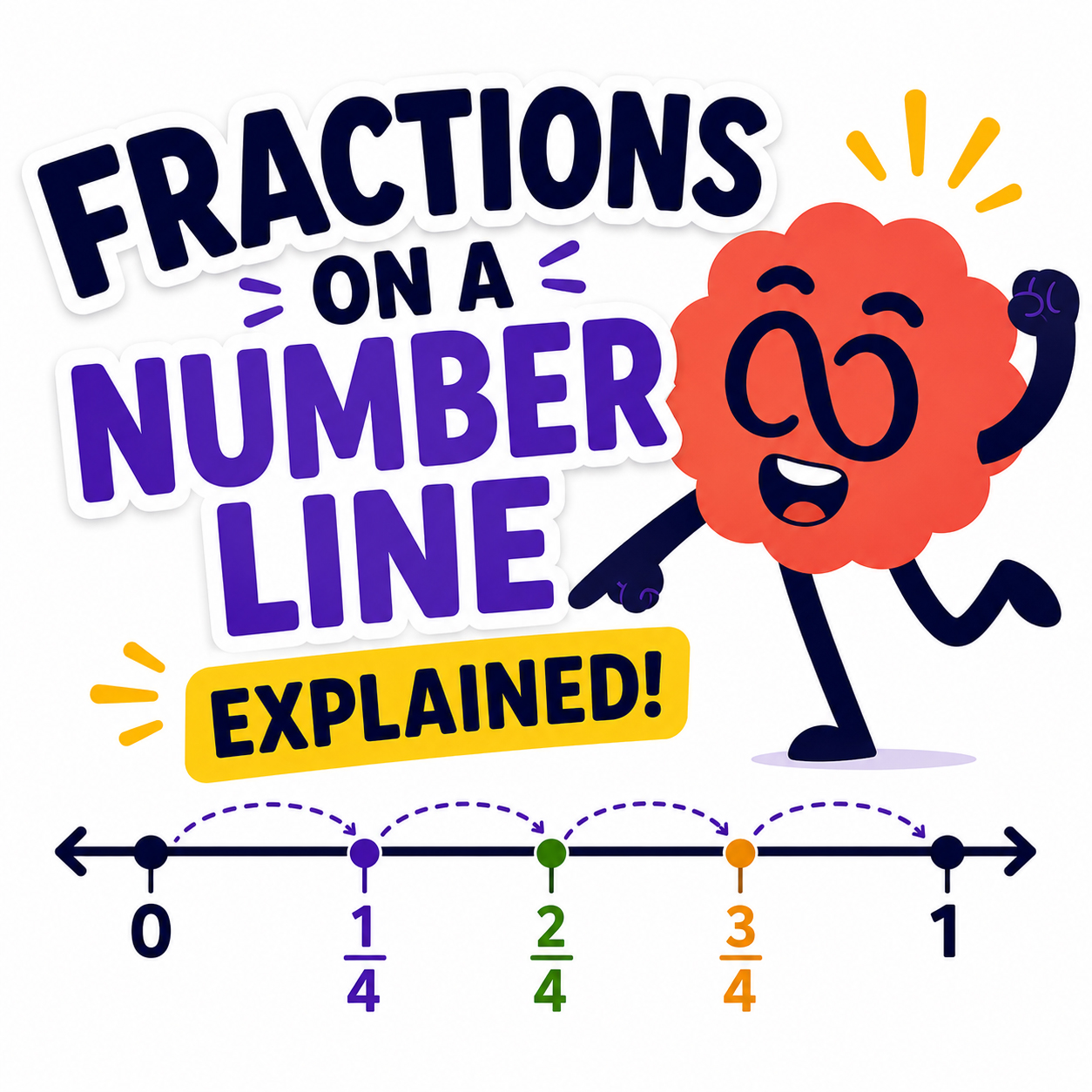
Fractions on a number line can seem a little strange when you first see them.They are usually pretty easy to understand when they're shown as pieces of a pizza or parts of a chocolate bar. You can see exactly what's happening.
A number line feels different.
Instead of looking at pieces, you're looking at points between numbers. That's why fractions on a number line can seem confusing at first.
But after a few examples, most people realize there's nothing tricky about it. A number line simply shows where a fraction belongs. The marks between 0 and 1 represent equal parts, and each fraction has its own spot on the line.
Once you get comfortable reading fractions on a number line, it becomes much easier to compare fractions and understand their value.
Need a refresher before getting started? Check out our guide: What Is a Fraction?
A number line is simply a line that shows numbers in order.
Fractions can be placed on that line just like whole numbers.
For example:
Instead of showing pieces of a shape, a number line shows the actual value of a fraction.
That's why many teachers use number lines when introducing fractions.
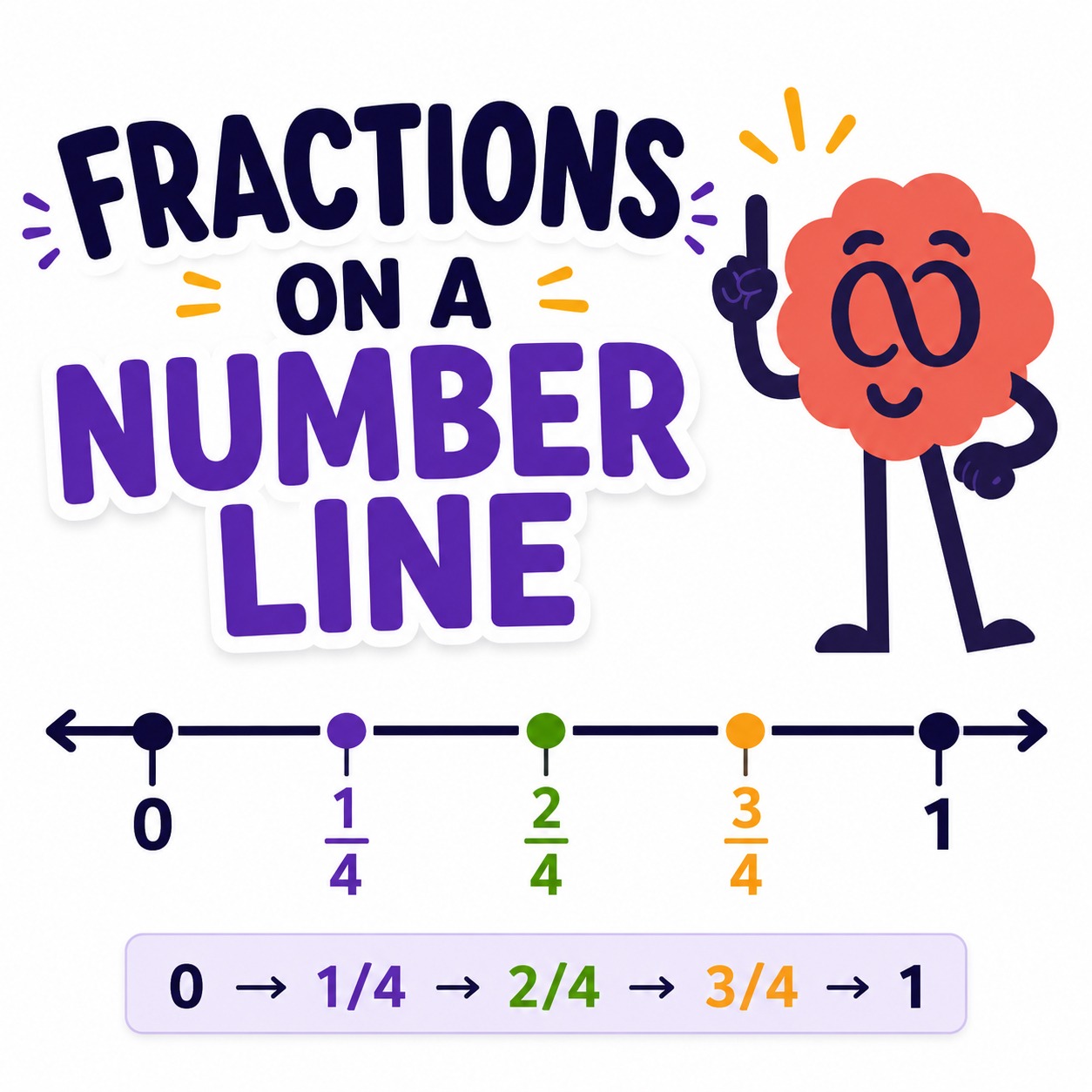
Imagine a number line from 0 to 1.
If you divide the space into 4 equal parts, each section represents 1/4.
The marks would be:
0 → 1/4 → 2/4 → 3/4 → 1
Now you can clearly see where each fraction belongs.
Here's the thing.
Many people think fractions are only pieces of objects.
But fractions are actually numbers.
And numbers belong on a number line.
Once people see fractions this way, several concepts become easier:
That's why fractions on a number line appear so often in Grade 3 and Grade 4 math.
"Why can't I just use a pizza picture?"
You can.
Pizza models are great.
But number lines help you compare fractions much more easily because every fraction has a specific location.
Let's use 3/4 as an example.
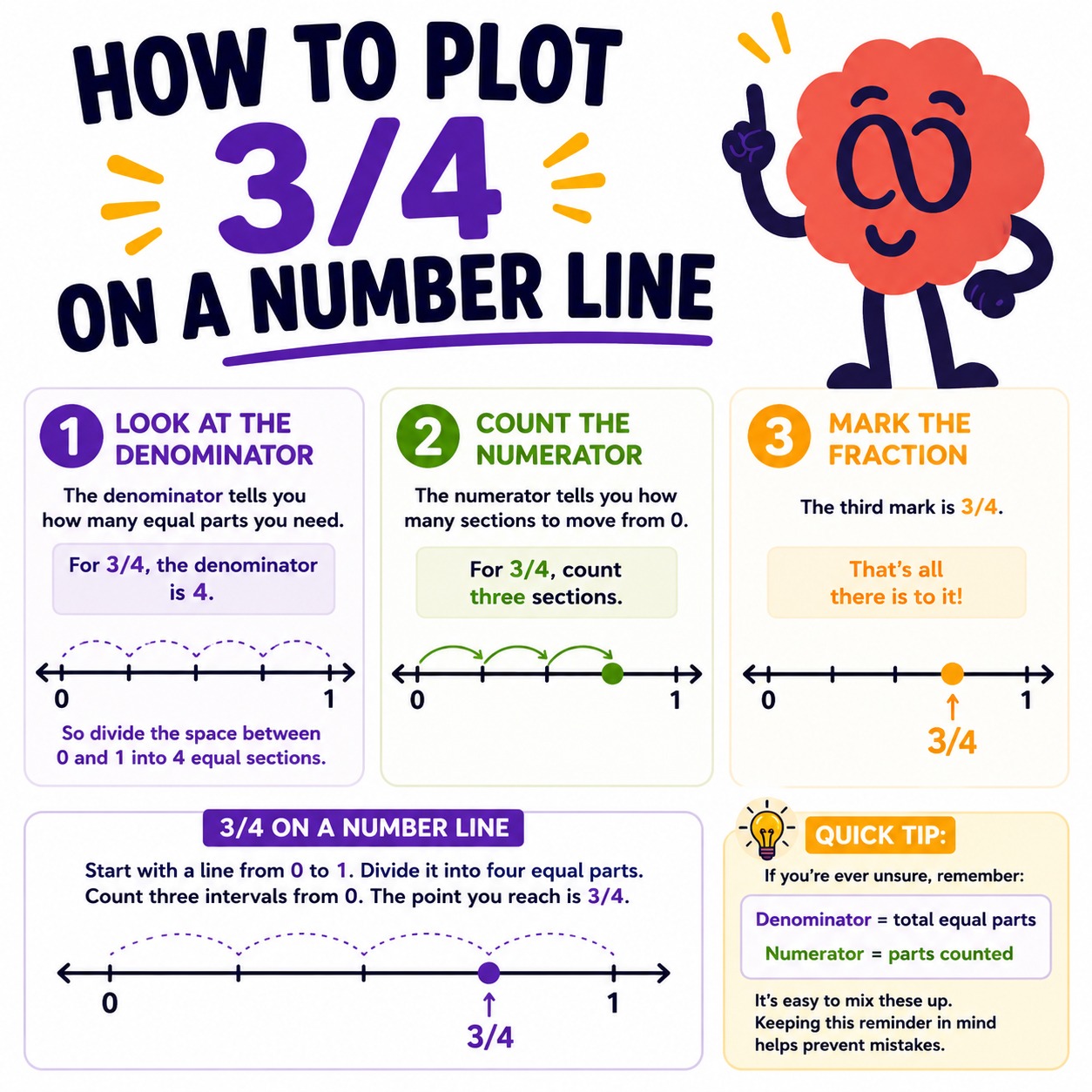
The denominator tells you how many equal parts you need.
For 3/4, the denominator is 4.
So divide the space between 0 and 1 into 4 equal sections.
The numerator tells you how many sections to move from 0.
For 3/4, count three sections.
The third mark is 3/4.
That's all there is to it.
Many people expect a complicated rule. But the process is usually that simple.
This is one of the most common fraction questions in elementary school.
Start with a line from 0 to 1.
Divide it into four equal parts.
Count three intervals from 0.
The point you reach is 3/4.
If you're ever unsure, remember:
It's easy to mix these up.
Keeping this simple reminder in mind helps prevent mistakes.
Many people think fractions only exist between 0 and 1.
But that's not true.
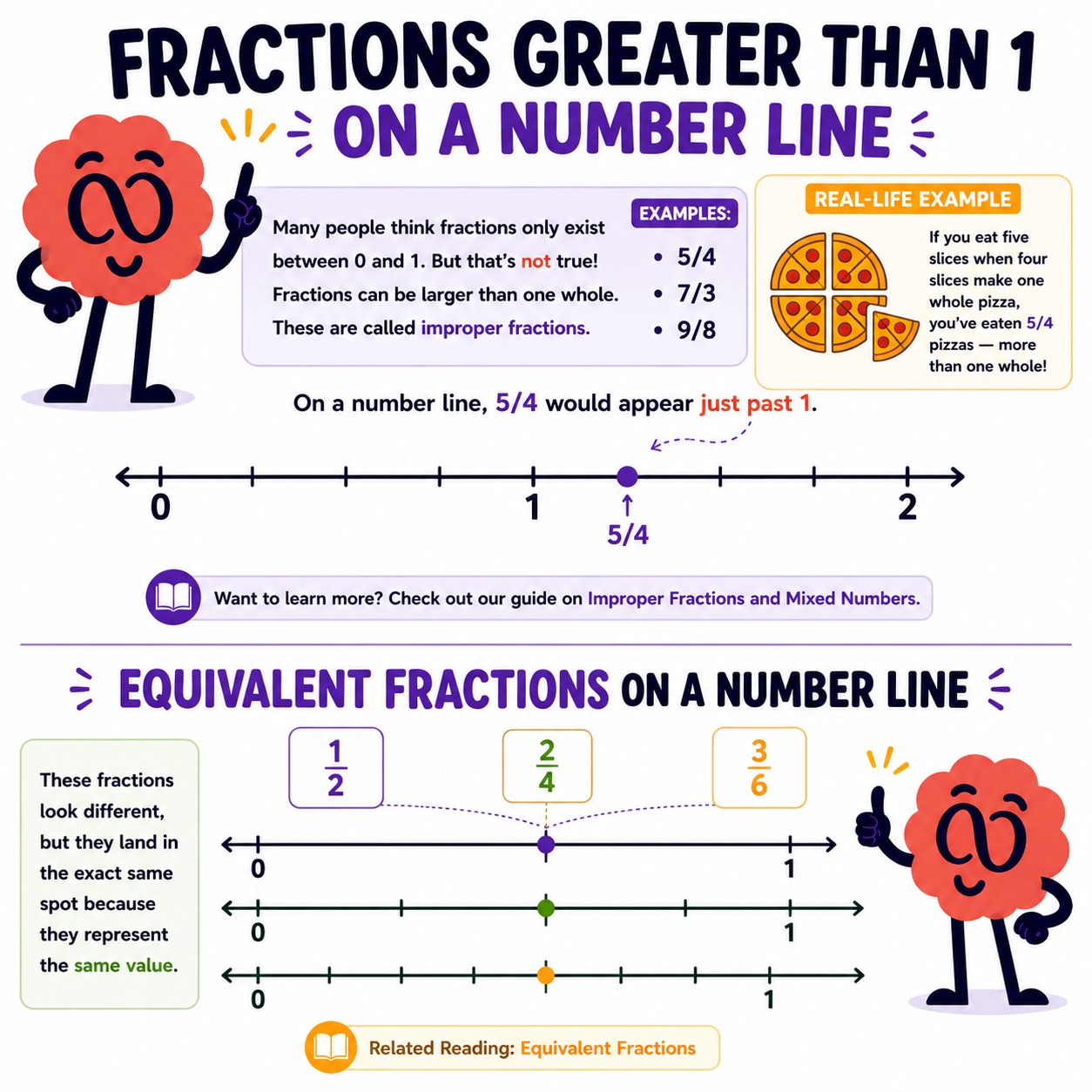
Fractions can be larger than one whole.
These are called improper fractions.
Examples include:
Imagine eating five slices of a pizza when four slices make one whole pizza.
You have eaten 5/4 pizzas.
That's more than one whole.
On a number line, 5/4 would appear just past 1.
If you'd like to learn more about this topic, read our guide on Improper Fractions and Mixed Numbers.
One of the coolest things about fractions on a number line is seeing equivalent fractions.
Take:
They look different.
But when plotted on a number line, they land in exactly the same spot.
That's because they represent the same value.
Many people find equivalent fractions easier to understand after seeing them on a number line.
Related Reading: Equivalent Fractions
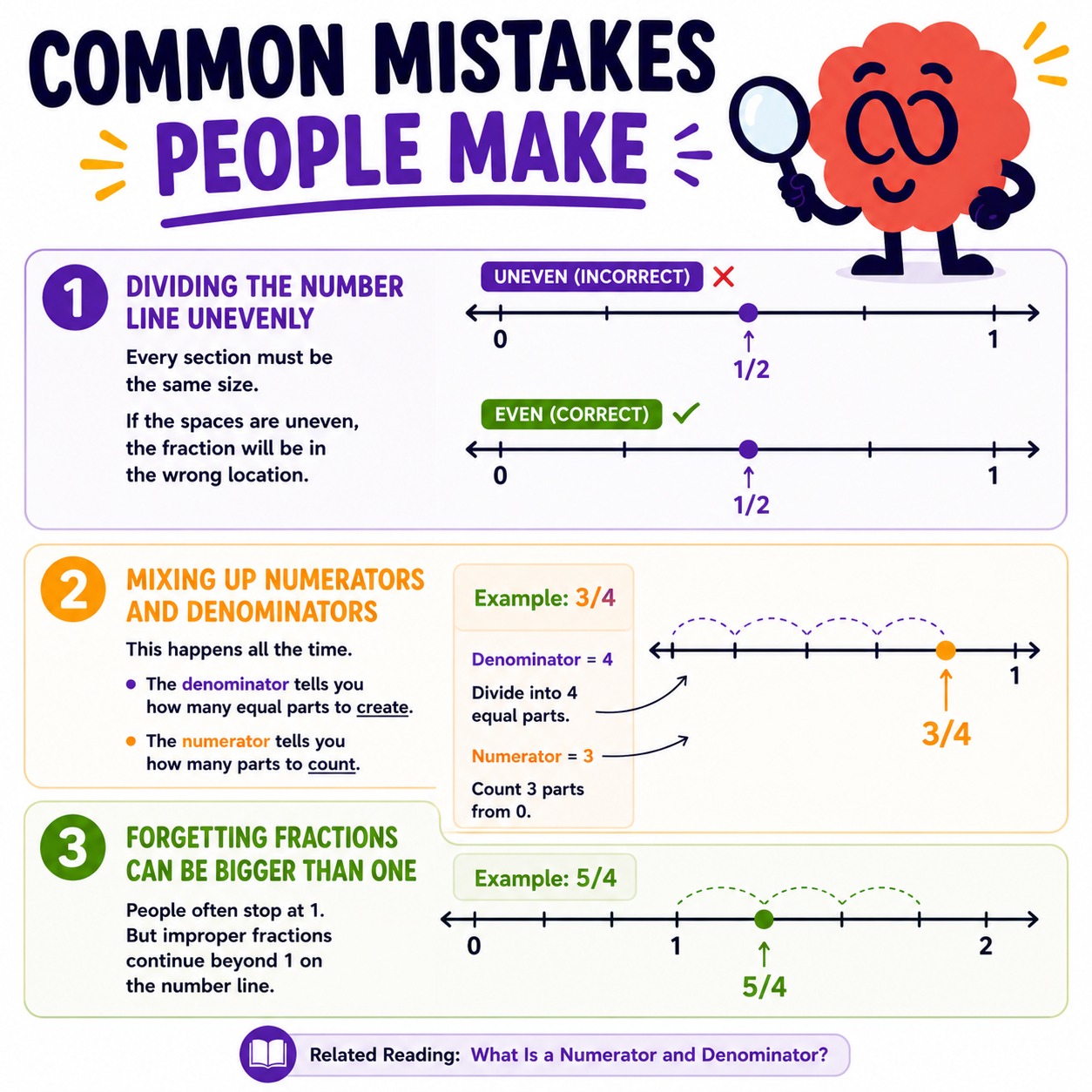
Most people struggle with the same few things.
Every section must be the same size.
If the spaces are uneven, the fraction will be in the wrong location.
This happens all the time.
The denominator tells you how many equal parts to create.
The numerator tells you how many parts to count.
Related Reading: What Is a Numerator and Denominator?
People often stop at 1.
But improper fractions continue beyond 1 on the number line.
Fractions on a number line are often introduced in 3rd grade, giving children their first experience placing fractions between whole numbers.
By the end of Grade 3, learners are usually expected to:
These skills become the foundation for later fraction topics.
You don't need worksheets every day.
Simple questions work surprisingly well.
Try asking:
Even short conversations can help build confidence.
Divide the space into equal parts using the denominator. Then count the number of parts shown by the numerator.
They help learners understand that fractions are numbers with specific positions between whole numbers.
Divide the space from 0 to 1 into four equal parts and count three intervals from 0.
Use equal intervals and place the fraction according to its value.
Yes. Improper fractions such as 5/4 and 7/3 appear beyond 1 on the number line.
Understanding fractions on a number line is one of the biggest milestones in elementary math. Once fractions can be placed accurately on a number line, many other fraction concepts become easier to understand.
If you need extra help with fractions, Brainster's tutors provide step-by-step support that builds confidence and understanding.
Book a free assessment today and explore our Grade 3, Grade 4, and Grade 5 math programs.