
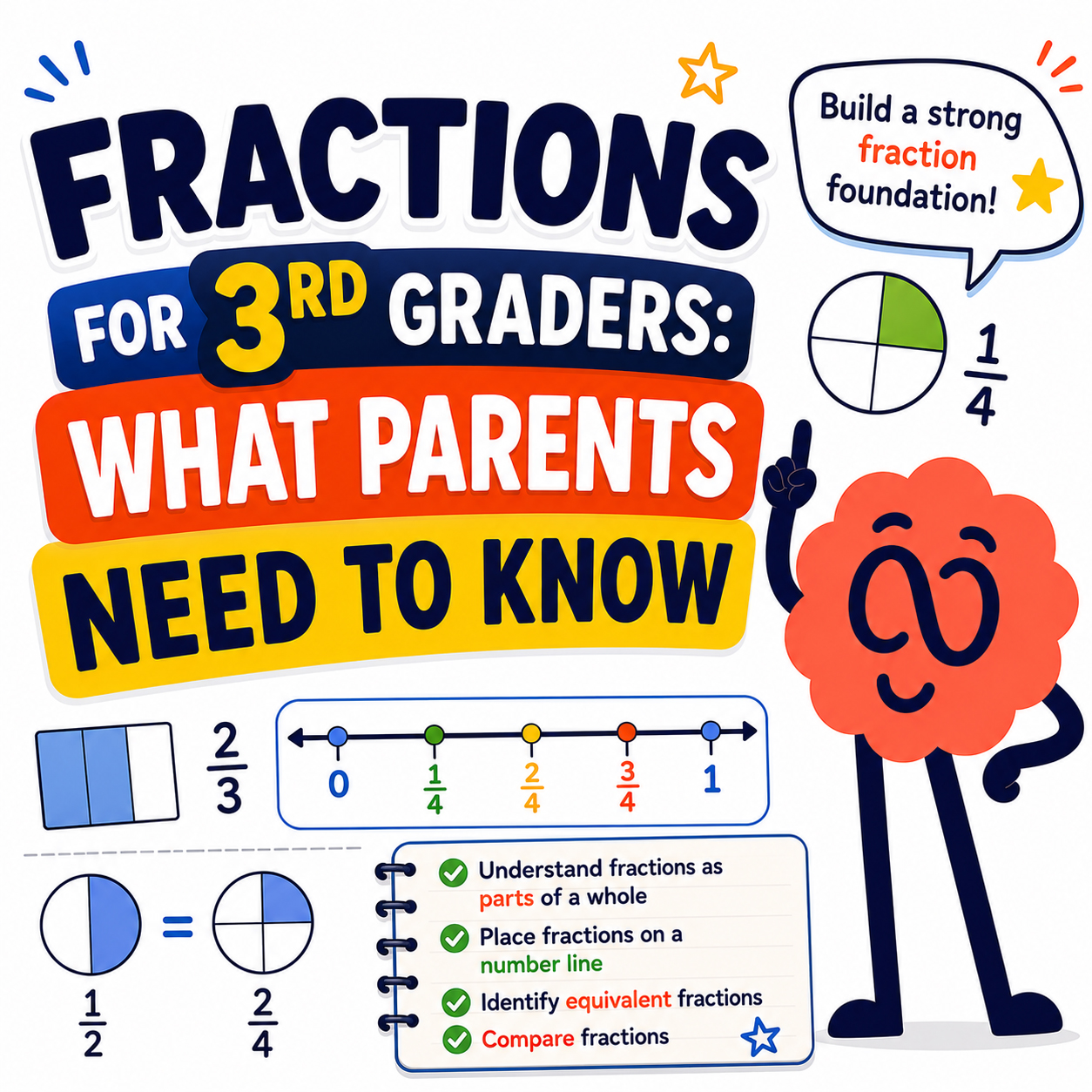
3rd grade fractions focus on understanding fractions as equal parts of a whole, placing fractions on a number line, recognizing simple equivalent fractions, and comparing fractions. These foundational skills help students build confidence with fractions before moving on to addition and subtraction in later grades.
For a broader look at what fractions are before getting into grade-specific skills, check out our What Are Fractions? guide.
The 3rd grade fractions standards fall under Common Core 3.NF (Number and Operations — Fractions). There are four core skills covered at this grade level:
• Understanding a fraction as equal parts of a whole
• Placing fractions on a number line between 0 and 1
• Recognizing simple equivalent fractions such as 1/2 = 2/4
• Comparing fractions with the same numerator or the same denominator
These 3rd grade fractions skills create the foundation for more advanced fraction concepts in later grades.
This is the foundation of 3rd grade fractions. A fraction shows equal parts of a whole. The denominator tells how many equal pieces make up the whole, while the numerator tells how many pieces are being counted.
For example, a pizza cut into 4 equal slices with 1 slice taken shows 1/4. One important rule in 3rd grade fractions is that all parts must be equal. Therefore, students spend time identifying equal parts before writing fractions.
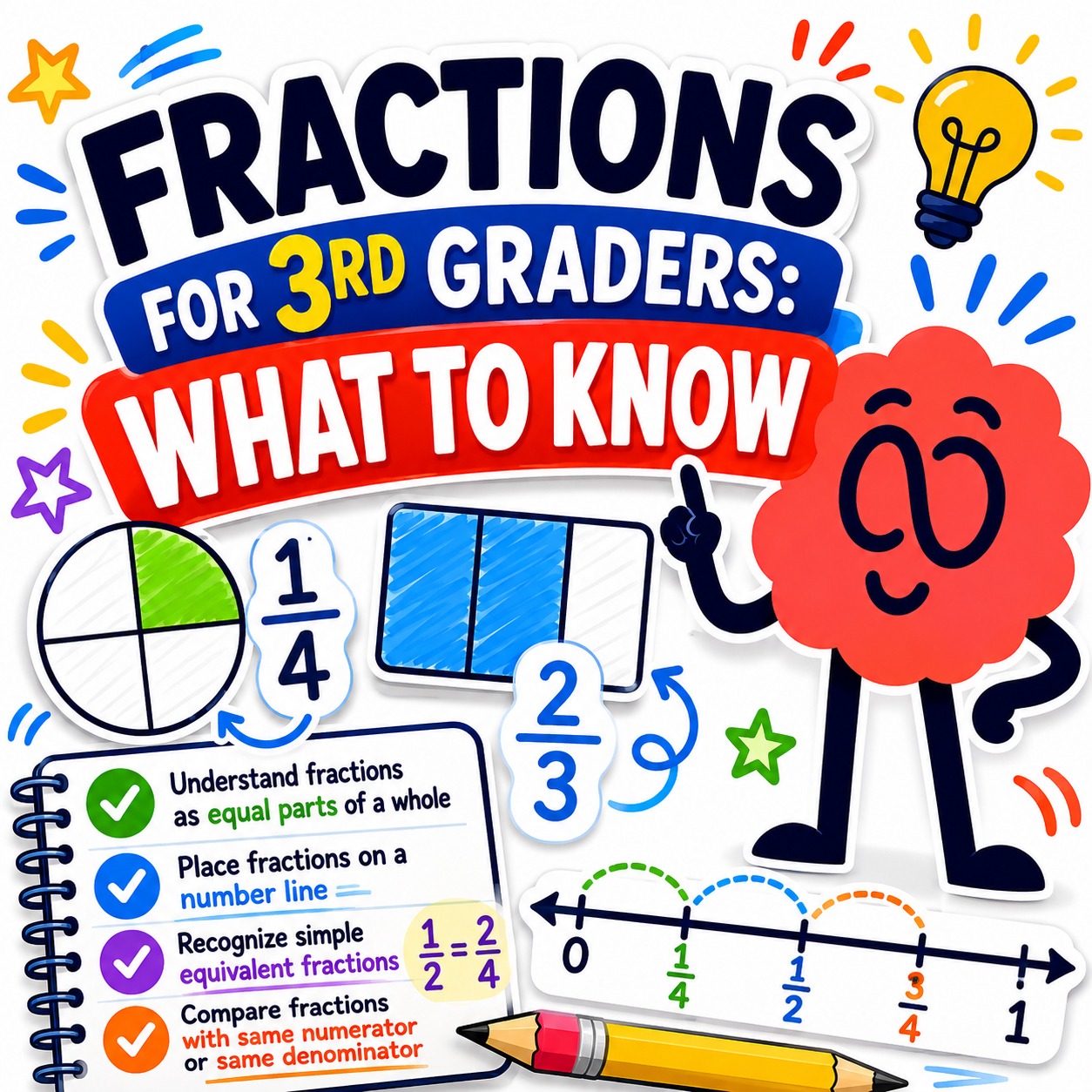
Placing fractions on a number line is the skill that moves fractions from a visual shape concept to a number concept. Students learn to divide the space between 0 and 1 into equal parts and label the points along the line. For example, a number line divided into 4 equal parts has points at 0, 1/4, 2/4, 3/4 and 1. For a full breakdown of how this works and how to explain it at home, our Fractions on a Number Line Explained guide covers it step by step.
Fractions on a number line are one of the most important 3rd grade fractions concepts because they help students understand that fractions are real numbers.
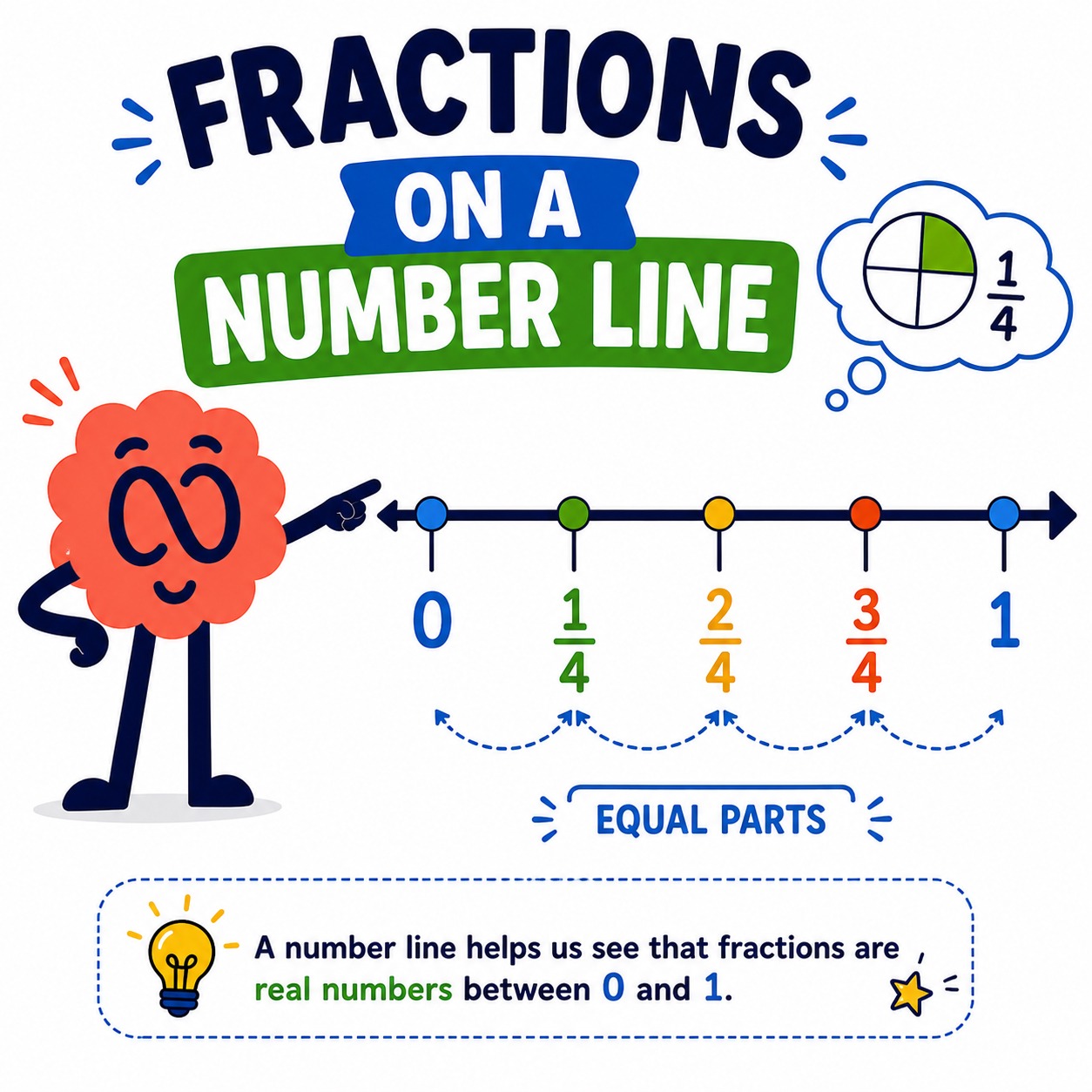
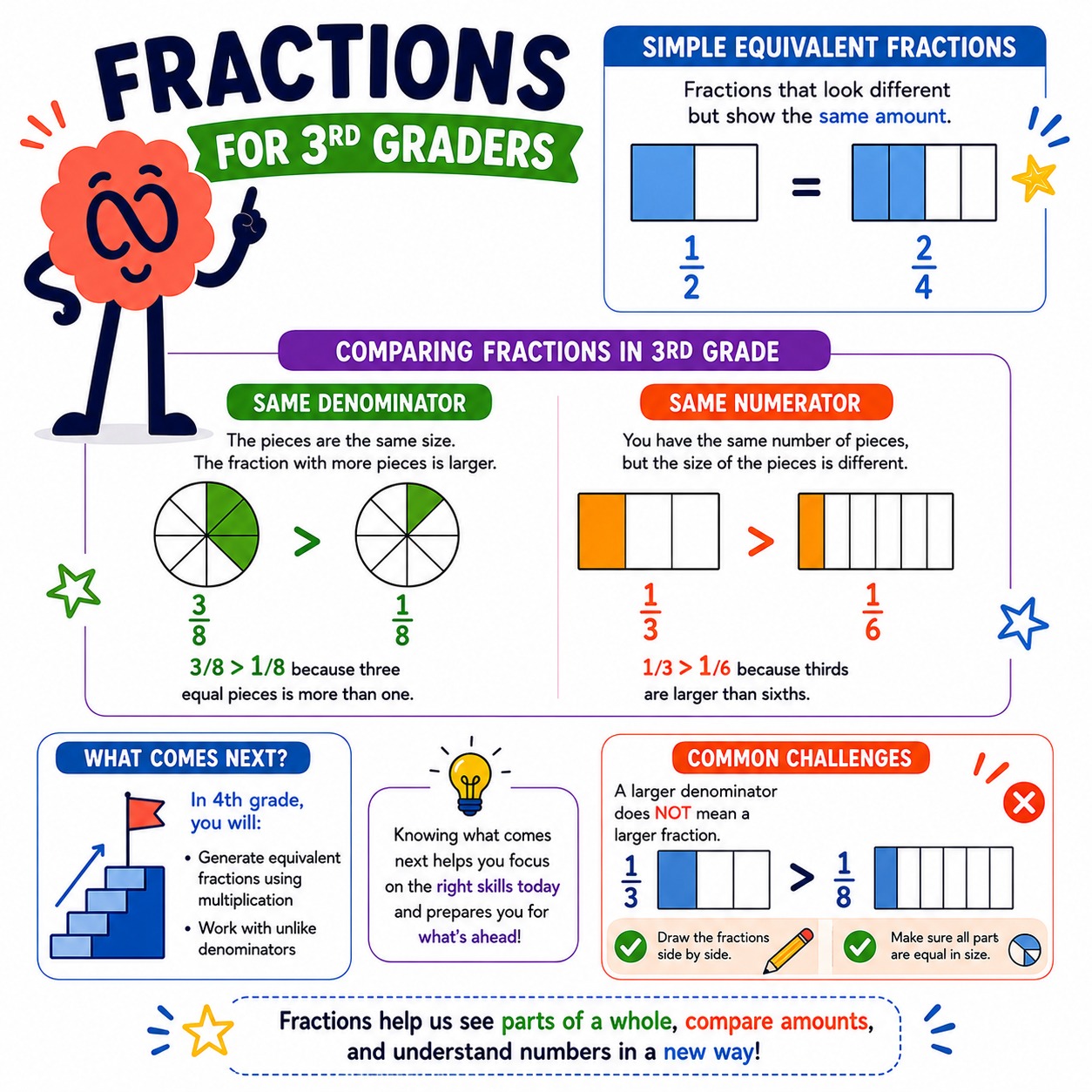
Equivalent fractions 3rd grade concepts focus on recognizing fractions that represent the same value. For example, 1/2 and 2/4 cover the same amount even though they look different. If you need a refresher, see our What Are Equivalent Fractions? guide.
Unlike 4th grade, students are not expected to use multiplication to create equivalent fractions. Instead, fractions for 3rd grade rely on visual models and simple examples. As a result, equivalent fractions 3rd grade skills help students build a stronger understanding of fraction relationships.
Comparing fractions is another key part of 3rd grade fractions. Students compare fractions only in specific situations.
When two fractions have the same denominator, the pieces are the same size. So the fraction with more pieces is larger. 3/8 > 1/8 because three equal pieces is more than one equal piece.
When two fractions have the same numerator, you have the same number of pieces from each. But the pieces are different sizes depending on the denominator. A smaller denominator means bigger pieces. So 1/3 > 1/6 because thirds are larger than sixths.
However, that second comparison trips up a lot of students. A bigger denominator feels like it should mean a bigger fraction. But it’s the opposite. The denominator controls the size of each piece, and more pieces means smaller individual pieces.
In 4th grade, fraction work expands significantly. Students move from simple equivalent fractions to generating equivalents with unlike denominators using multiplication.For a full look at what that grade level covers, our Fractions for 4th Graders guide breaks it down.
Additionally, knowing what comes next helps in two ways. It shows which 3rd grade skills are building blocks for 4th grade work, and it clarifies what is not expected of a 3rd grader yet.
One of the most common challenges in 3rd grade fractions is thinking that a larger denominator means a larger fraction. Students often assume 1/8 is bigger than 1/3 because 8 is greater than 3. However, 1/8 is actually smaller because the whole is divided into more pieces.
Fortunately, drawing the fractions side by side usually helps. As a result, fractions for 3rd grade become easier to understand.
Additionally, some students forget that fraction parts must be equal. Therefore, checking whether all pieces are the same size helps build a stronger understanding of fractions.
These simple activities help make fractions for 3rd graders more visual and easier to understand
Cut a sandwich, apple or piece of toast into equal parts and ask what fraction each piece represents. Then eat one piece and ask what fraction is left. This covers 3.NF.1 in a context that requires no materials and makes the equal-parts rule feel natural.
Fold a piece of paper in half, then open it and shade one part. That’s 1/2. Fold it in half again to get quarters and shade two sections. That’s 2/4. Ask whether 1/2 and 2/4 look the same. This is the simplest physical demonstration of equivalent fractions 3rd grade students can do at home.
Fill a 1/4 measuring cup four times into a full cup to show that 4/4 = 1 whole. Then use 1/2 and 2/4 cups to show equivalence physically. Cooking and baking naturally bring fractions up without making them feel like schoolwork.
Overall, fractions for 3rd graders focus on building a strong visual understanding before students begin more advanced fraction operations in later grades
Here’s what matters most about 3rd grade fractions.
• 3rd graders learn four skills: fractions as parts of a whole, fractions on a number line, simple equivalent fractions and comparing fractions with the same numerator or denominator.
• Equivalent fractions 3rd grade level means recognizing visual equivalence, not calculating it with multiplication.
• The most common misconception is thinking a larger denominator means a larger fraction. Drawing it out is the fastest fix.
By the end of 3rd grade, students should be able to identify a fraction as equal parts of a whole, place fractions on a number line between 0 and 1, recognize simple equivalent fractions like 1/2 = 2/4, and compare fractions that share the same numerator or the same denominator. These skills are set by Common Core standard 3.NF.
Yes, but at a simpler level than 4th grade. In 3rd grade, students recognize and explain equivalent fractions visually using denominators of 2, 3, 4, 6 and 8. They are not expected to generate equivalents by multiplying numerators and denominators. That formal method is introduced in 4th grade.
The 3rd grade fraction standards fall under 3.NF: Number and Operations — Fractions. The three main standards are 3.NF.1 (understanding a fraction as equal parts of a whole), 3.NF.2 (fractions on a number line) and 3.NF.3 (equivalence and comparison of fractions).
Use food, paper folding and measuring cups to make fractions visual and hands-on. Cut food into equal parts and ask what fraction each piece is. Fold paper to show equivalence. Fill measuring cups to show that 2/4 and 1/2 hold the same amount. Keeping it concrete is more effective at this age than worksheets alone.
1/8 is smaller than 1/3. Even though 8 is a bigger number than 3, a larger denominator means the whole is divided into more pieces, so each piece is smaller. One out of eight pieces is much smaller than one out of three pieces. Drawing both fractions side by side makes this clear immediately.
Adding fractions with like denominators is introduced in 4th grade. Adding fractions with unlike denominators comes in 5th grade. In 3rd grade, students build the foundational understanding of what fractions are, which makes those later operations easier to learn.
3rd grade fractions mark an important step in math learning because they introduce students to fractions as numbers and prepare them for more advanced fraction concepts in later grades.
Book a free assessment today and explore our Grade 3 math programs.