
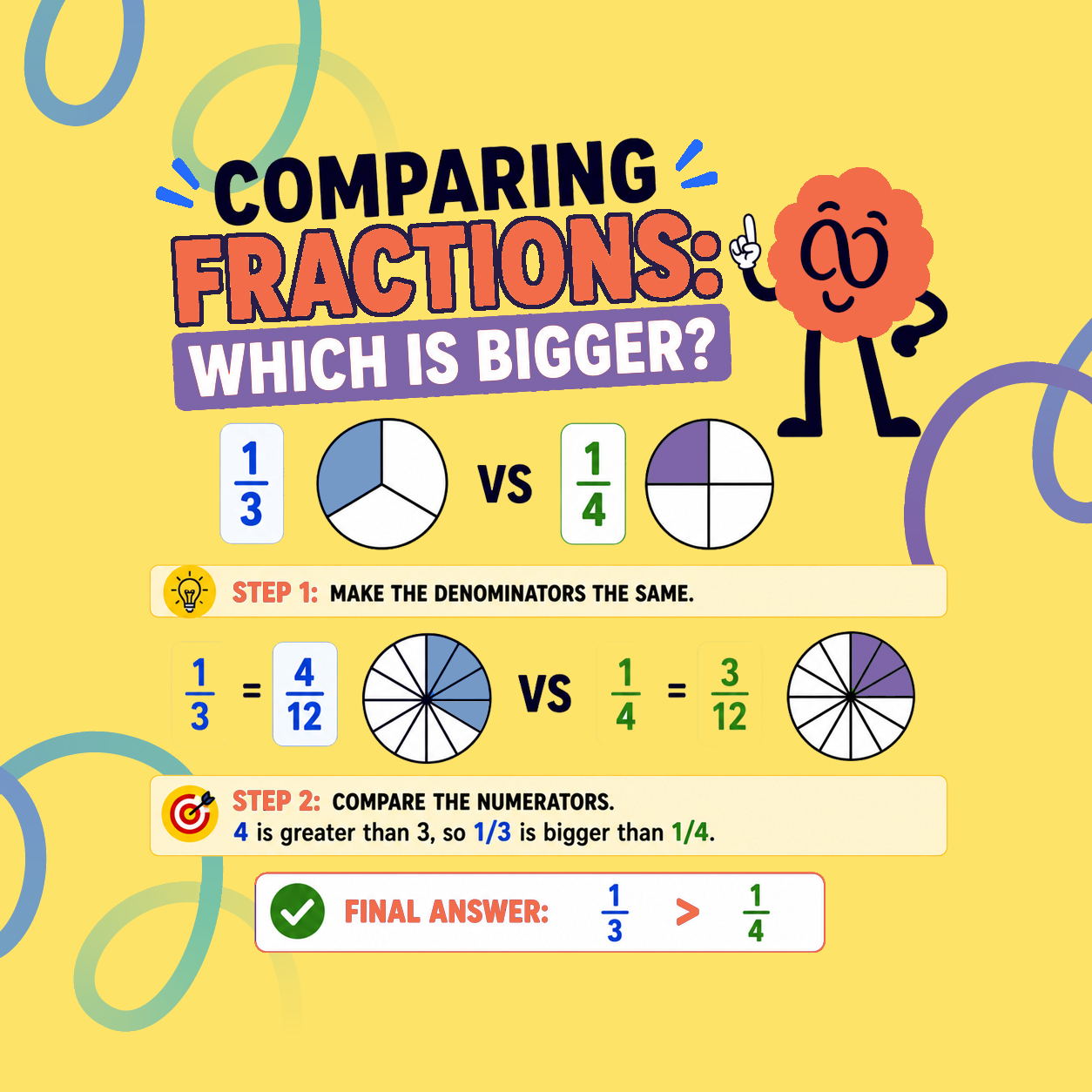
Comparing fractions, the easiest method is to give both fractions the same denominator. Once the denominators match, the fraction with the larger numerator is bigger. For example, to compare 1/3 and 1/4, convert them to 4/12 and 3/12, so 1/3 is bigger. If the denominators are already the same, just compare the numerators directly.
That one rule covers most situations. But comparing fractions gets a little more interesting once the numbers stop lining up so neatly, and there’s more than one method worth knowing.
How to Compare Fractions: The Quick Answer
There are really only three situations you’ll run into when comparing fractions.
Same denominator. Look at the numerators. The bigger numerator wins.
Same numerator. Look at the denominators. This one trips people up, because the bigger denominator actually means the smaller fraction.
Different numerators and denominators. Convert both fractions to a common denominator first, then compare.
Each of these situations gets its own section below, with a worked example of comparing fractions in action.
Method 1: Comparing Fractions with the Same Denominator
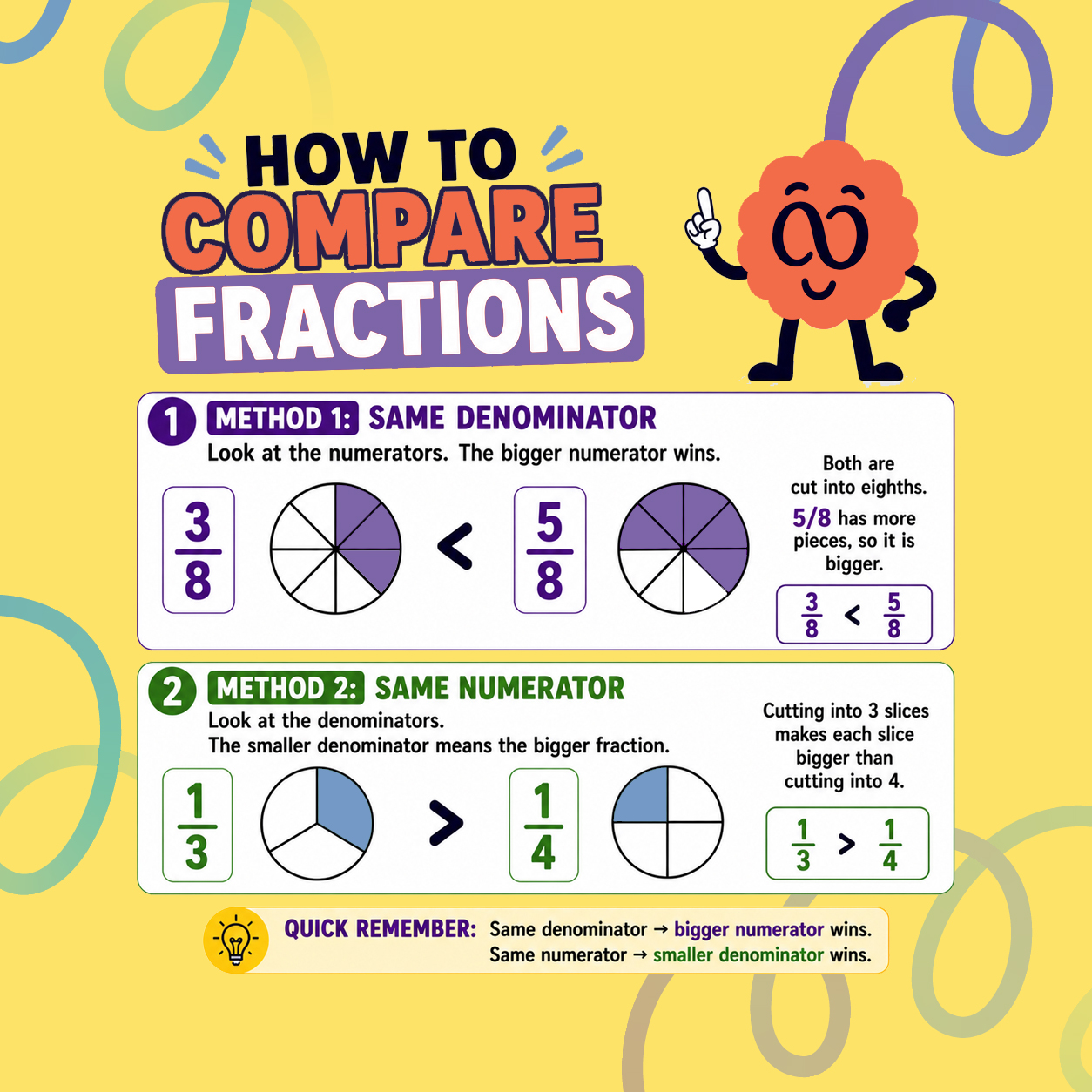
Comparing fractions with the same denominator is the easiest case. When two fractions share a denominator, the pieces are already the same size. So whichever fraction has more pieces is bigger.
Take 3/8 and 5/8.
Both are cut into eighths, so the pieces match. 5/8 has more of those pieces than 3/8, which means 5/8 is the bigger fraction.
3/8 < 5/8
No conversion needed. Just compare the top numbers.
Method 2: Comparing Fractions with the Same Numerator
Here’s where comparing fractions gets a little less obvious.
Take 1/3 and 1/4.
Both fractions have a numerator of 1, so it’s tempting to assume 1/4 is bigger because 4 is bigger than 3. That’s backward.
Think about cutting a pizza. Cutting it into 3 slices makes each slice bigger than cutting the same pizza into 4 slices. More slices always means smaller slices.
So 1/3 is bigger than 1/4, even though 3 is the smaller number.
1/3 > 1/4
When the numerators match, the fraction with the smaller denominator is the bigger fraction.
Method 3: Comparing Fractions with Different Denominators
Comparing fractions with different denominators is the case most people actually search for, since real fractions rarely come with matching numerators or denominators.
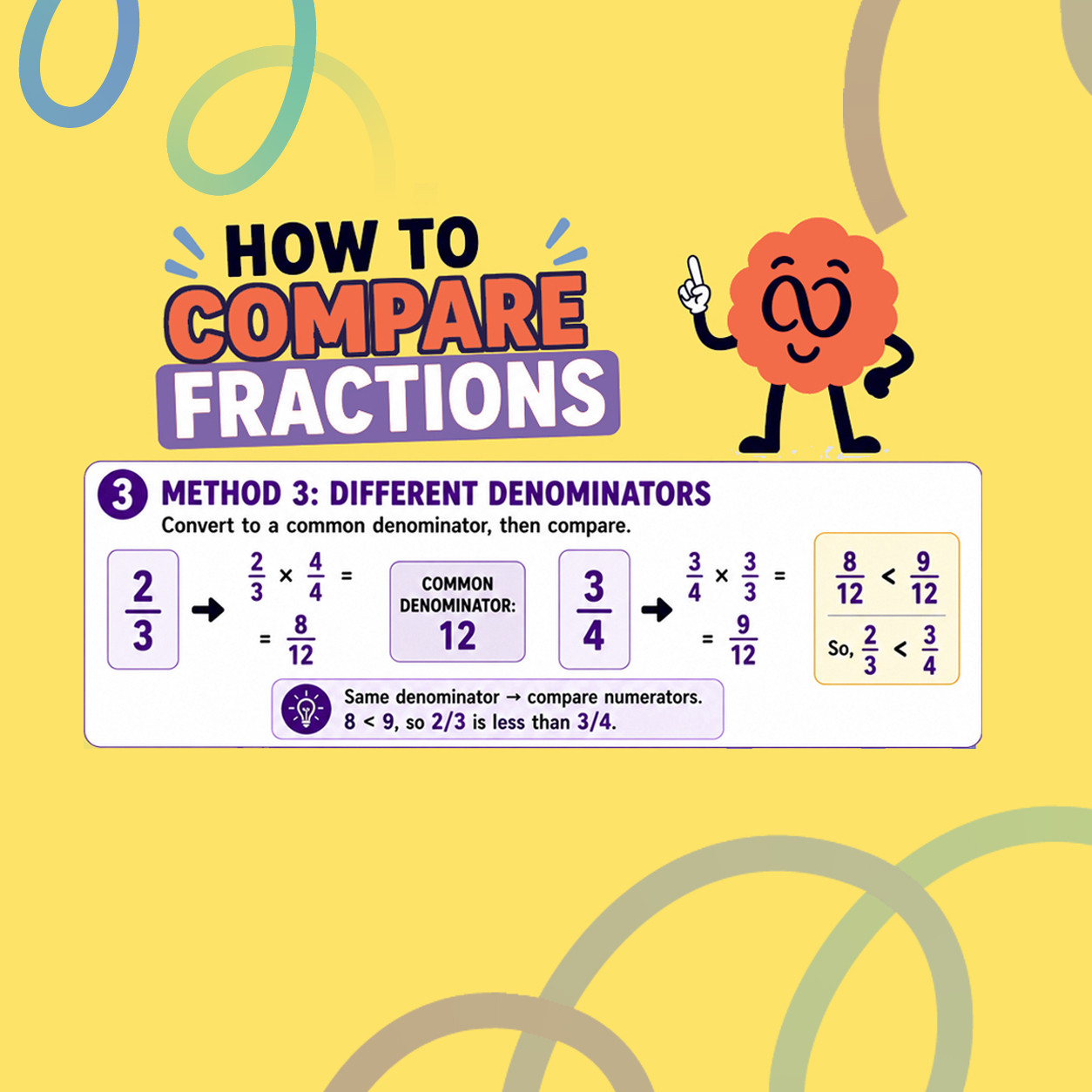
Take 2/3 and 3/4.
Neither the numerators nor the denominators match, so the fix is to give both fractions a common denominator. The smallest number that both 3 and 4 divide into evenly is 12.
2/3 becomes 8/12
3/4 becomes 9/12
This conversion works because 8/12 and 9/12 are equivalent fractions of the originals, just written with a different denominator. Once both fractions share that denominator, comparing them is simple.
8/12 < 9/12, so 2/3 < 3/4
If finding that shared denominator feels unfamiliar, it helps to review what Is a Common Denominator before tackling more comparison problems. And once the conversion is done, it’s worth checking whether the resulting fraction can be simplified, since a simplified fraction is easier to work with for whatever comes next.
This same method also applies when comparing a proper fraction to an improper fraction. It’s worth being clear on the different types of fractions first, since an improper fraction like 5/4 is automatically bigger than any proper fraction less than 1.
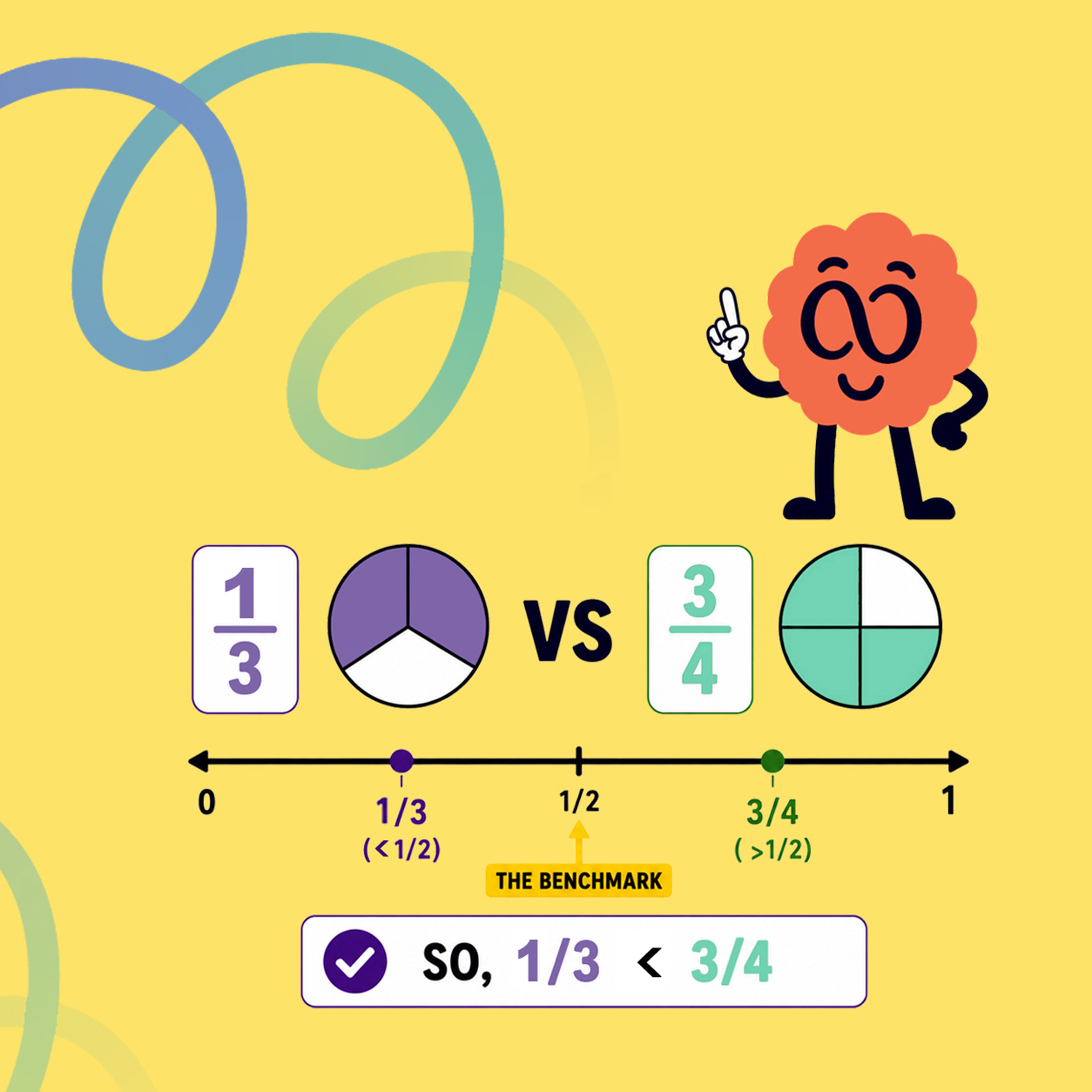
The Benchmark Fraction Shortcut: Is It More or Less Than 1/2?
Converting to a common denominator works every time, but it’s not always the fastest option. Sometimes the fastest method for comparing fractions is checking each one against a simple benchmark, like 1/2.
Take 5/9 and 3/7.
5/9 is more than half, since half of 9 would be 4.5, and 5 is bigger than that.
3/7 is less than half, since half of 7 would be 3.5, and 3 is smaller than that.
So 5/9 is bigger than 3/7, without ever finding a common denominator.
This shortcut only works cleanly when one fraction is clearly above 1/2 and the other is clearly below it. For a deeper look at how benchmark fractions work and when to use them, the full guide covers more examples.
The Common Mistake: Bigger Denominator Does Not Mean Bigger Fraction
The single most common error when comparing fractions is assuming that a bigger denominator automatically means a bigger fraction.
Take 1/8 and 1/4.
8 is a bigger number than 4, so it’s an easy trap to fall into thinking 1/8 is the larger fraction. It isn’t.
1/8 < 1/4
Picture a pizza again. Cutting it into 8 slices instead of 4 makes each slice smaller, not bigger. The denominator tells you how many pieces the whole was split into, not how big the fraction is.
Once that distinction clicks, this mistake becomes much rarer.
When Is Comparing Fractions Taught in School?
Comparing fractions isn’t taught all at once. It builds up over a few grades.
In Grade 3, students usually start with visual comparison, using fraction bars or circles to see which piece looks bigger.
By Grade 4, the common denominator method becomes the standard approach, especially for fractions that don’t share a numerator or denominator.
In Grade 5, cross-multiplication sometimes gets introduced as a faster shortcut, though it works best once the common denominator method is already solid.
Knowing where a particular grade lands in that sequence makes it easier to tell whether a struggle is normal for that stage or a sign that an earlier skill needs more practice. Once you know how to compare fractions confidently, the rest of fraction arithmetic gets noticeably easier.
Key Takeaways
These are the core rules worth remembering about comparing fractions.
• When denominators match, the bigger numerator wins.
• When numerators match, the smaller denominator wins.
• When neither matches, convert to a common denominator before comparing.
• Comparing 1/2 is a fast shortcut when one fraction is clearly bigger or smaller than half.
• A bigger denominator never automatically means a bigger fraction.
Frequently Asked Questions
How do you compare fractions?
Give both fractions the same denominator, then compare the numerators. The fraction with the larger numerator is bigger. If the denominators already match, skip straight to comparing the numerators.
Which fraction is bigger, 1/2 or 3/4?
3/4 is bigger. Converting 1/2 to fourths gives 2/4, and 3/4 is larger than 2/4.
How do you compare fractions with different denominators?
Convert both fractions to a common denominator first. Once the denominators match, compare the numerators directly.
What fraction is bigger, 2/3 or 3/4?
3/4 is bigger. Converting both to twelfths gives 8/12 and 9/12, and 9/12 is the larger value.
Does a bigger denominator always mean a smaller fraction?
Not always. It only works that way when the numerators are the same. With different numerators, the denominator alone doesn’t decide which fraction is bigger.
Why does comparing fractions feel tricky at first?
Comparing fractions feels tricky because the rule changes depending on whether the denominators match, the numerators match or neither matches. Once each case gets its own rule, it stops feeling random.
Comparing fractions is a key Grade 3 through Grade 5 skill, and it’s often the source of avoidable test errors. If a student is second-guessing themselves on which fraction is bigger, the right support builds the underlying intuition, not just the rule.
Book a free assessment today and explore our Grade 3, Grade 4 and Grade 5 math programs.