
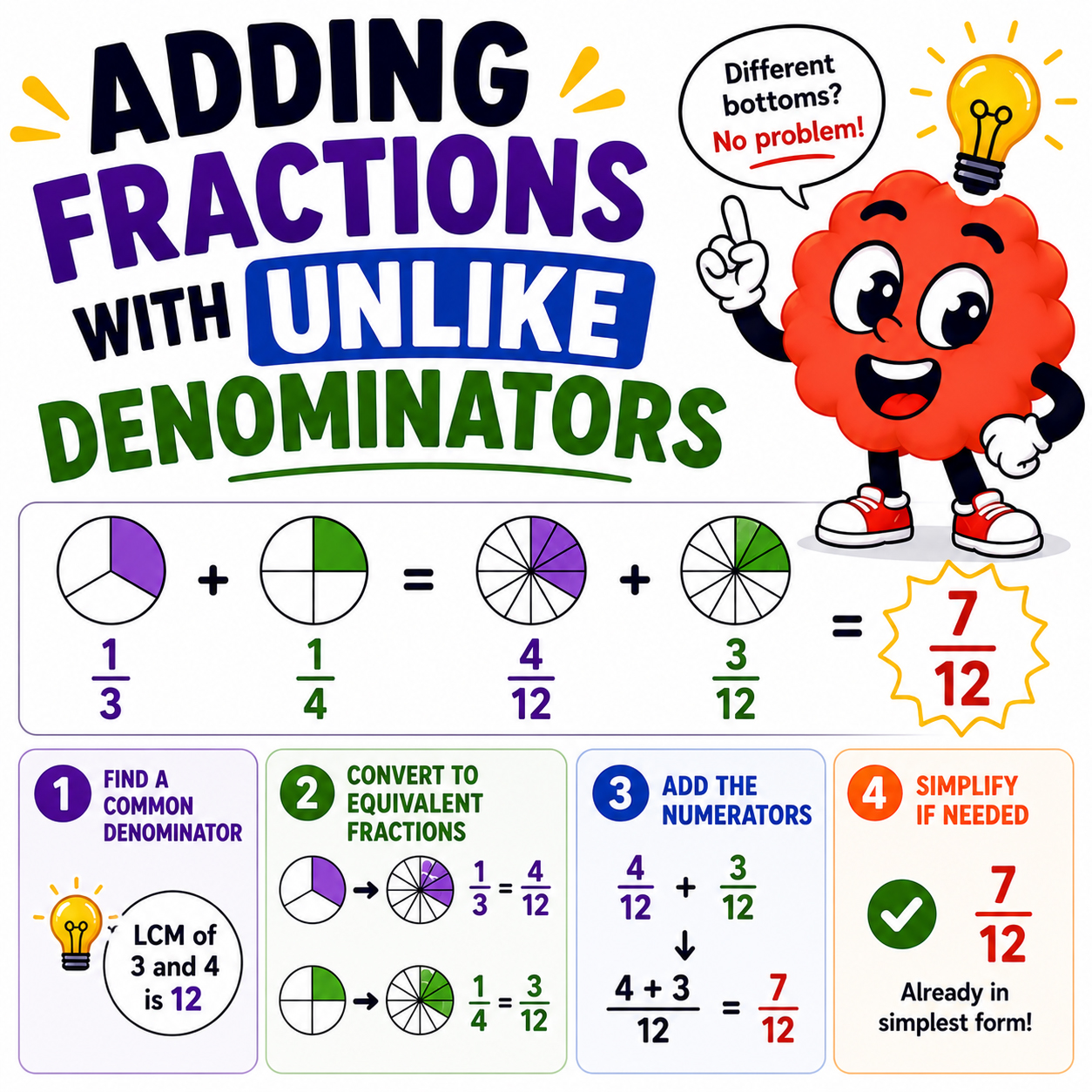
Adding fractions with unlike denominators can seem tricky at first, but the process becomes much easier once both fractions share a common denominator. To add fractions with unlike denominators, find a common denominator, convert each fraction to an equivalent fraction, add the numerators, and simplify if needed. For example, 1/3 + 1/4 becomes 4/12 + 3/12, which equals 7/12.
If you want a refresher on how to add fractions with different denominators from the very basics, start with our How to Add Fractions guide first. This post goes a step further, focusing specifically on the harder case: denominators that don’t match. That single difference is what makes adding fractions with unlike denominators feel so much trickier than adding fractions with the same denominator.
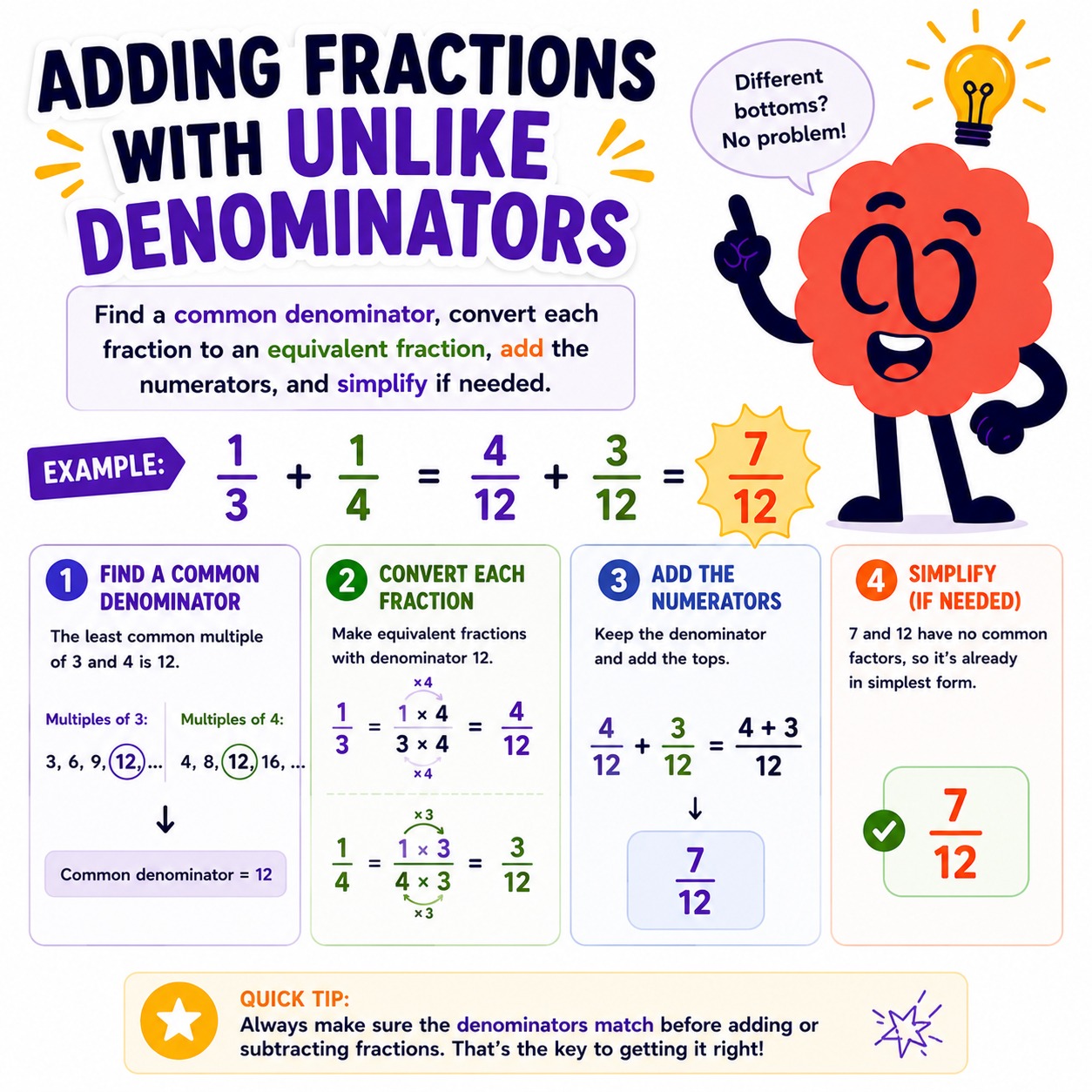
Here’s the same method broken into individual steps, with the reasoning behind each one.
Look for a number that both denominators divide into evenly. For 1/3 and 1/4, that number is 12, since both 3 and 4 divide into it.
Rewrite each fraction using the new denominator.
1/3 becomes 4/12
1/4 becomes 3/12
Once both fractions share a denominator, the denominators stay put and only the numerators get added.
4/12 + 3/12 = 7/12
Check whether the answer can be simplified, the same way you would with any fraction. 7/12 has no shared factor other than 1, so it’s already in its simplest form.
Final answer:
1/3 + 1/4 = 7/12
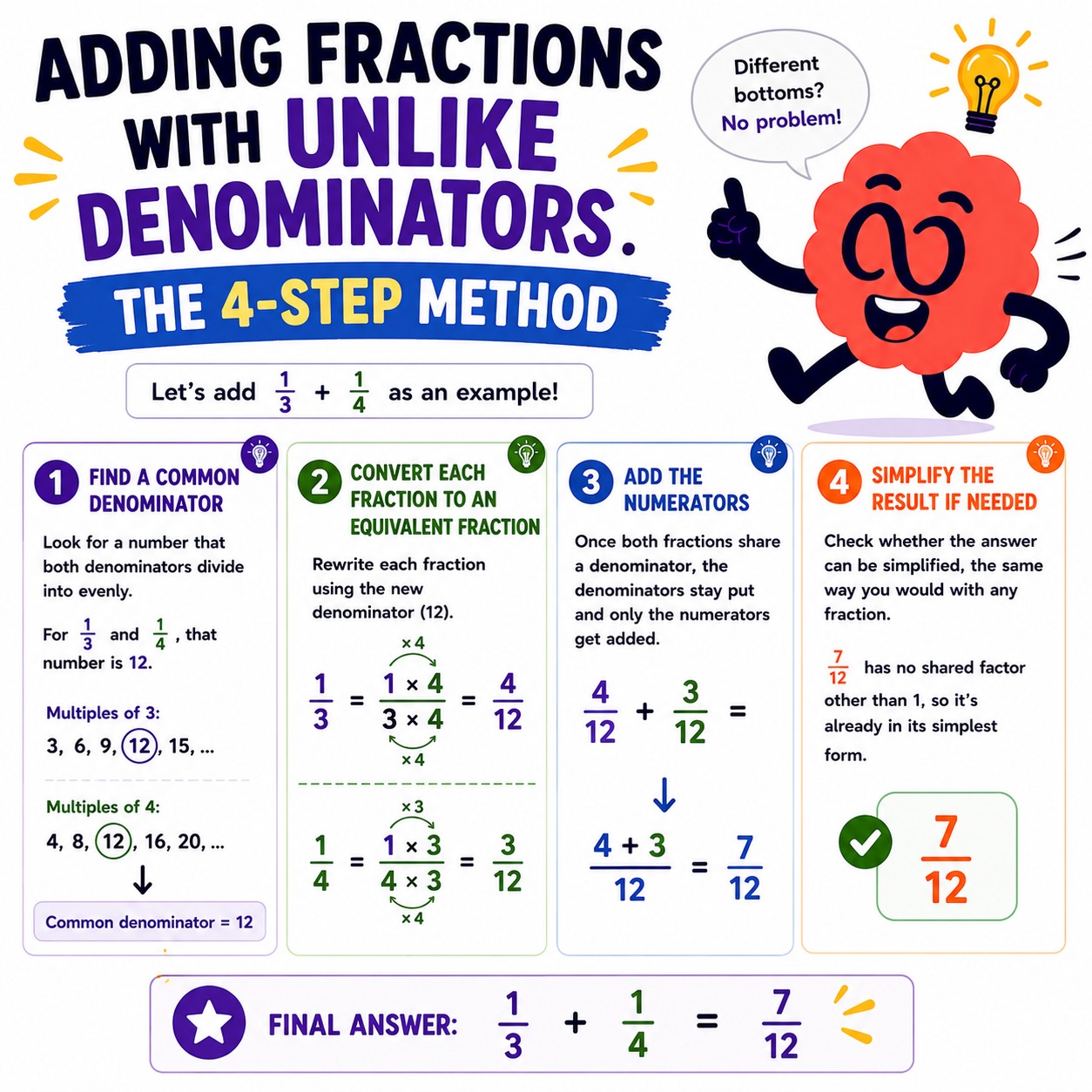
Understanding adding fractions with like denominators first can make adding fractions with unlike denominators feel much less intimidating.
When two fractions already share a denominator, adding them is much simpler. Just add the numerators and keep the denominator the same.
3/8 + 2/8 = 5/8
No conversion needed, because the pieces are already the same size. That’s exactly the condition that steps 1 and 2 of the 4-step method are designed to create before any numerators get added.
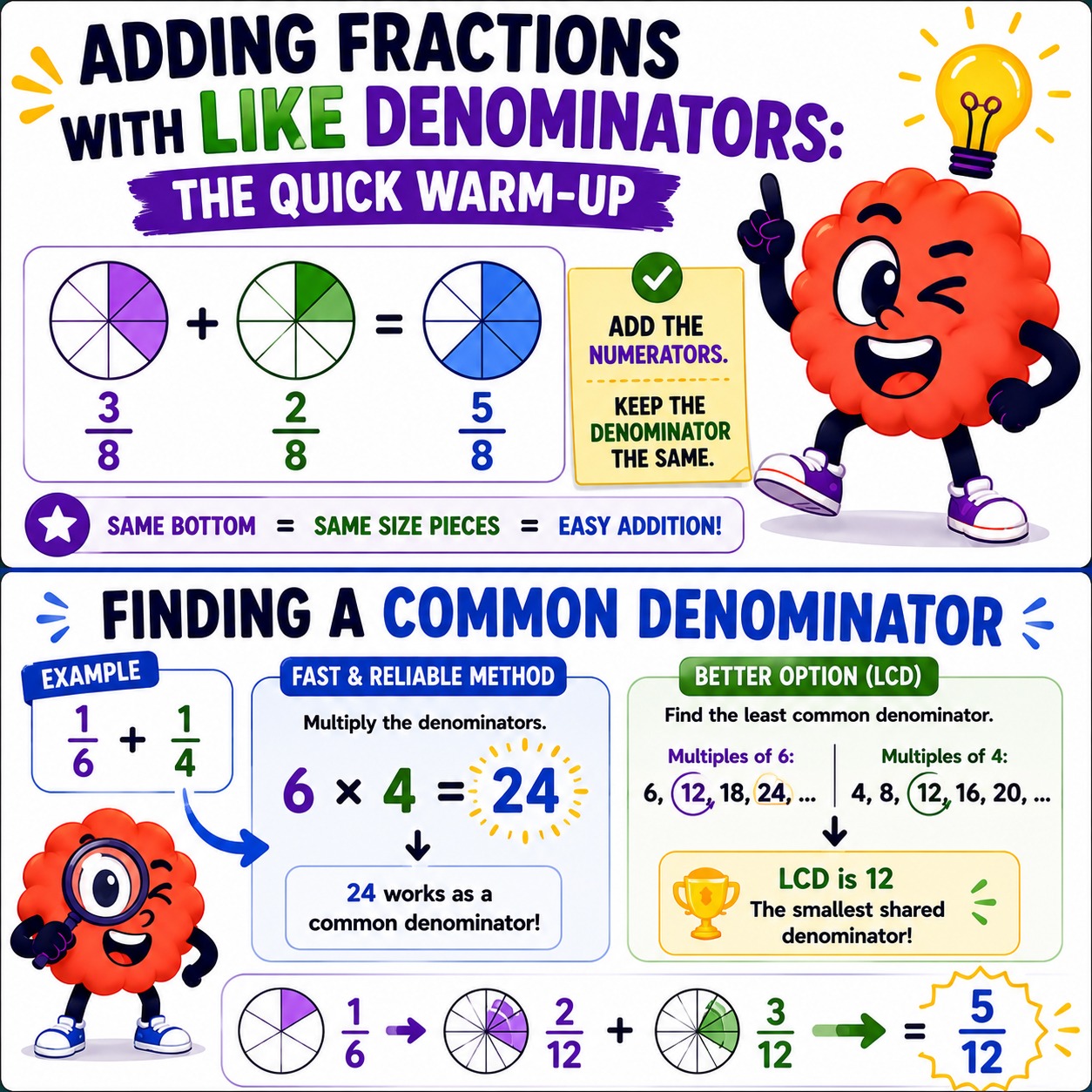
Finding a common denominator is the part of adding fractions with unlike denominators that trips up the most people. The fastest reliable way to find one is to multiply the two denominators together. It won’t always be the smallest possible option, but it always works.
Take 1/6 and 1/4.
6 × 4 = 24
So 24 works as a common denominator, even though a smaller one exists. The smallest shared denominator is called the least common denominator, or LCD. For 6 and 4, the LCD is 12, since 12 is the smallest number both divide into evenly.
The LCD keeps the numbers smaller, which usually makes the rest of the problem easier to manage. If you're still unsure why a common denominator is needed in the first place, our guide on common denominators explains the idea in more detail.
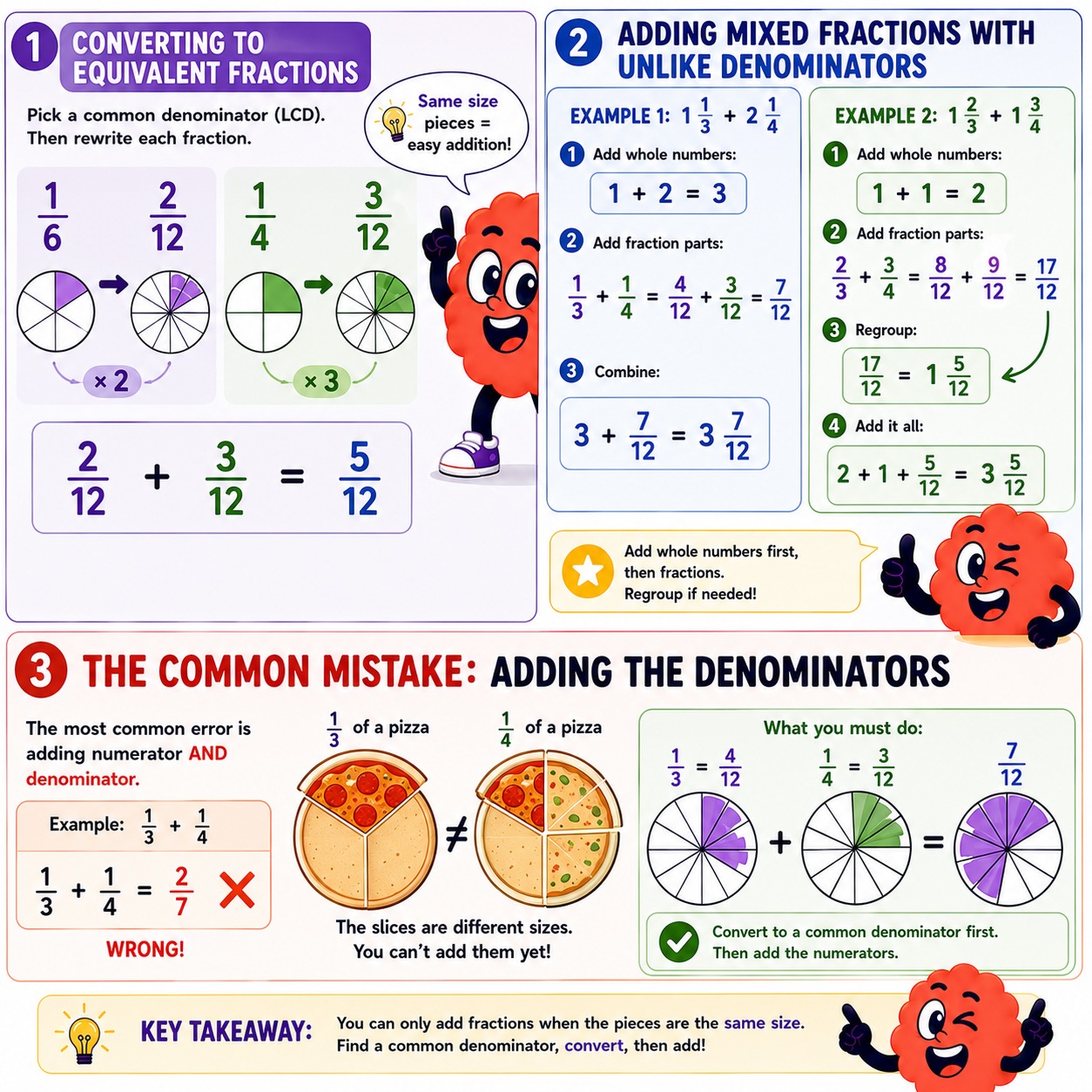
Understanding how to add fractions with different denominators starts with converting them into equivalent fractions. Once a common denominator is chosen, both fractions need to be rewritten using it.
Continuing with 1/6 and 1/4 using the LCD of 12:
1/6 becomes 2/12
1/4 becomes 3/12
Both of these are equivalent fractions of the originals, just written differently. This conversion step is what makes adding fractions with unlike denominators possible, since fractions can only be added once the pieces they represent are the same size.
2/12 + 3/12 = 5/12
Adding fractions with unlike denominators gets an extra layer when mixed numbers are involved, since the whole number parts get handled separately from the fraction parts.
Take 1 1/3 + 2 1/4.
Add the whole numbers first:
1 + 2 = 3
Then add the fraction parts using the same 4-step method:
1/3 + 1/4 = 4/12 + 3/12 = 7/12
Combine both results:
3 + 7/12 = 3 7/12
Sometimes the fraction parts add up to more than 1, which means a bit of regrouping is needed. Take 1 2/3 + 1 3/4.
Add the whole numbers:
1 + 1 = 2
Add the fraction parts:
2/3 + 3/4 = 8/12 + 9/12 = 17/12
Since 17/12 is more than 1, rewrite it as a whole number plus a fraction:
17/12 = 1 5/12
Add that extra whole number into the total:
2 + 1 + 5/12 = 3 5/12
Final answer:
1 2/3 + 1 3/4 = 3 5/12
The same process used for adding fractions with unlike denominators applies to mixed numbers as well.
The most common error when adding fractions with unlike denominators is adding the denominators along with the numerators. This error shows up constantly whenever someone tries adding fractions with unlike denominators without converting first.
For 1/3 + 1/4, that mistake looks like this:
2/7 ❌
That answer is wrong, and it’s worth understanding exactly why. Imagine cutting one pizza into 3 slices and a different pizza into 4 slices. A slice from the first pizza is a different size than a slice from the second. Adding the slice counts together doesn’t tell you anything useful until both pizzas are cut into matching sized pieces first.
That’s the entire reason a common denominator comes before adding anything. Once that distinction clicks, this mistake mostly goes away.
These situations make adding fractions with unlike denominators feel a lot less abstract.
A recipe needs 1/3 cup of sugar and 1/4 cup of brown sugar.
Ask: “How much sugar is that in total?”
1/3 + 1/4 = 7/12 cup combined.
One sibling eats 1/6 of a cake and another eats 1/4 of it.
Ask: “How much of the cake is gone now?”
1/6 + 1/4 = 5/12 of the cake.
One activity takes 1/4 of an hour and another takes 1/3 of an hour.
Ask: “How much total time did both activities take?”
1/4 + 1/3 = 7/12 of an hour.
Here’s what matters most about adding fractions with unlike denominators.
• It always starts with finding a common denominator.
• Both fractions must be converted to equivalent fractions before the numerators get added.
• Only the numerators get added. The denominator stays the same once it matches.
• Mixed numbers need their whole number parts added separately, with regrouping if the fraction parts add up to more than 1.
• The most common mistake is adding the denominators directly, which ignores that they represent different sized pieces.
Find a common denominator, convert both fractions to that denominator, add the numerators and simplify the result if possible.
Multiplying the two denominators together is the fastest reliable shortcut. It may not give the smallest possible denominator, but it always produces a number both fractions can convert into.
Add the whole number parts separately, then add the fraction parts using a common denominator. If the fraction parts add up to more than 1, regroup the extra into the whole number total.
Find a common denominator if the denominators don’t already match, convert each fraction to that denominator, add the numerators and simplify the answer.
Denominators describe the size of the pieces, not a quantity to total. Adding them directly ignores that the pieces being combined are different sizes until a common denominator makes them match.
Understanding the difference between adding fractions with like denominators and adding fractions with unlike denominators is an important part of building fraction fluency. With like denominators, the numerators can be added right away. Unlike denominators, both fractions first need to be converted to a shared denominator before adding.
Once the fraction parts are added together, simplifying the result is usually the last step, the same way it is in any other fraction addition problem. From here, the next useful skill is combining addition and subtraction in the same problem, which is exactly what comes up in real test questions — covered in our Adding and Subtracting Fractions Together guide.
Adding fractions with unlike denominators is the Grade 4 and Grade 5 skill that trips up the most students, and the most parents trying to help with homework. Our tutors walk through it step by step until it clicks.
Book a free assessment today and explore our Grade 4 and Grade 5 math programs.