

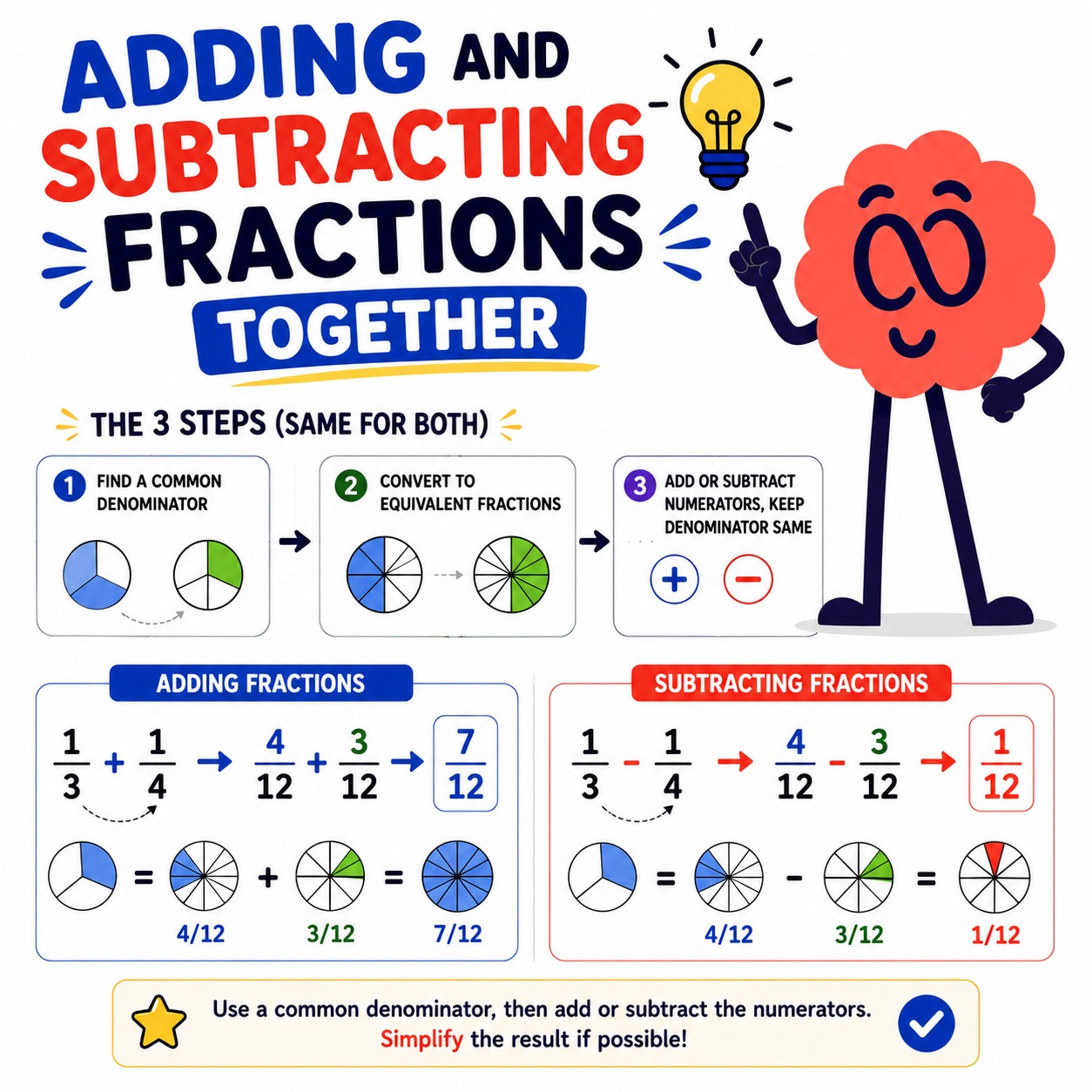
Adding and subtracting fractions, the first step is the same for both operations: if the denominators are different, find a common denominator and convert each fraction to an equivalent fraction using it. Once the denominators match, add or subtract the numerators and keep the denominator the same. For example, 1/3 + 1/4 becomes 4/12 + 3/12 = 7/12, while 1/3 − 1/4 becomes 4/12 − 3/12 = 1/12. Simplify the result if possible. That's the whole method for how to add and subtract fractions in a nutshell.
Most guides treat adding fractions and subtracting fractions as separate topics. This guide on adding and subtracting fractions puts them side by side, since homework usually mixes the two. Seeing how to add and subtract fractions with the same shared setup makes switching between them easier.
Adding and Subtracting Fractions: The Shared First Step
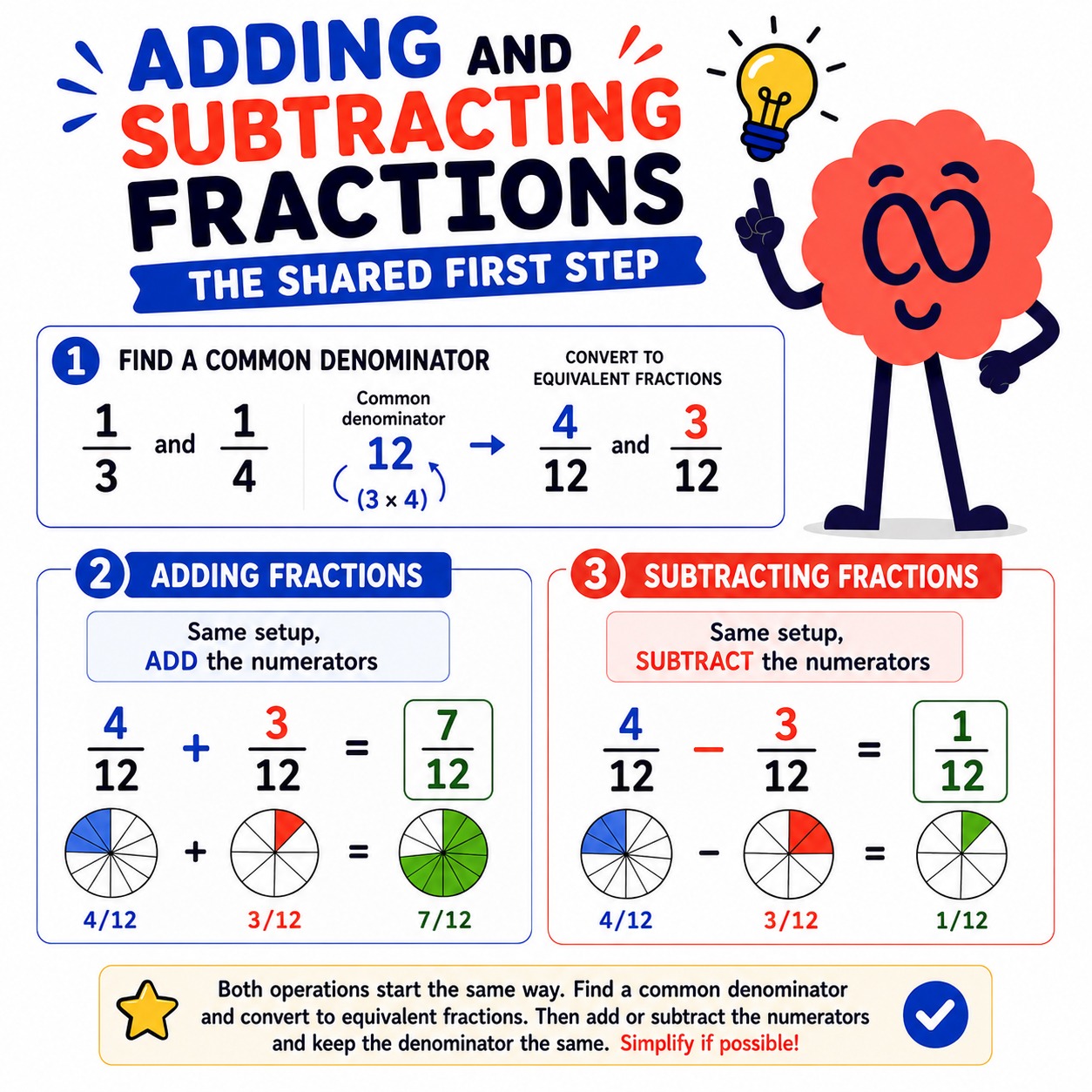
Both operations start the same way. If the denominators already match, skip ahead. If not, find a common denominator first. Our guide on what a common denominator is covers that step in more depth.
Take 1/3 and 1/4. The denominators don't match, so find a number both 3 and 4 divided evenly: 12. Convert each fraction: 1/3 becomes 4/12, and 1/4 becomes 3/12. From here, the path splits depending on the operation, which our guide on adding fractions with unlike denominators covers further.
Adding Fractions: Same Setup, Add the Numerators
Once the denominators match, adding fractions just means adding the numerators and keeping the denominator the same. That's half of how to add and subtract fractions covered. For the full method, see our guide on how to add fractions.
Using the same fractions from above: 4/12 + 3/12 = 7/12. The denominator stays at 12 the whole time. Only the numerators get combined.
Subtracting Fractions: Same Setup, Subtract the Numerators
Subtracting fractions uses the identical setup. That's the other half of how to add and subtract fractions. Once the denominators match, subtract the numerators instead of adding them. For the full method, see our guide on how to subtract fractions.
Using the same two fractions again: 4/12 − 3/12 = 1/12. Notice both operations started from the exact same converted fractions. Only the final step changed.
Adding and Subtracting Fractions with Mixed Numbers
Mixed numbers add an extra layer, since the whole number parts get handled separately from the fraction parts.
Take 2 1/3 + 1 1/4. Add the whole numbers first: 2 + 1 = 3. Then add the fraction parts using the same shared first step: 1/3 + 1/4 = 4/12 + 3/12 = 7/12. Combine both results: 3 7/12.
Subtraction works the same way, but sometimes needs a regrouping step. Take 3 1/2 − 1 3/4. Rewrite 1/2 as 2/4: 3 2/4 − 1 3/4. Since 2/4 is smaller than 3/4, borrow one whole from the 3, turning 3 2/4 into 2 6/4. Subtract: 2 6/4 − 1 3/4 = 1 3/4.
Adding and Subtracting Fractions in the Same Problem
This is the scenario worksheets rarely cover well: a single problem that requires both adding and subtracting fractions in sequence.
Take 1/2 + 1/3 − 1/4. Find a common denominator for all three: 12 works for 2, 3, and 4. Convert each one: 1/2 becomes 6/12, 1/3 becomes 4/12, and 1/4 becomes 3/12. Work left to right: 6/12 + 4/12 = 10/12, then 10/12 − 3/12 = 7/12.
The shared setup step carries the whole problem. Once every fraction shares a denominator, adding and subtracting fractions in any order becomes simple arithmetic on the numerators.
The One Mistake That Affects Adding and Subtracting Fractions Equally
There's one mistake that trips up adding and subtracting fractions equally: skipping the common denominator step and combining the numerators and denominators directly.
For 1/3 + 1/4, that mistake looks like 2/7. For 1/3 − 1/4, it produces a result that isn't even a valid fraction. Both errors share the same root cause: treating the denominators as quantities to combine instead of a description of piece size. Once both fractions share a denominator, that risk disappears.
Practice Ideas for Adding and Subtracting Fractions at Once
These situations naturally call for adding and subtracting fractions together, not just one operation alone.
• Measuring cups: combine 1/3 cup and 1/4 cup of one ingredient, then subtract 1/6 cup that gets set aside.
• Money and time: add up 1/4 hour and 1/3 hour of two errands, then subtract 1/6 hour saved by combining a trip.
• Recipe scaling: add the fraction amounts for two ingredients, then subtract the portion that gets removed before serving.
Key Takeaways
• Adding and subtracting fractions both start with the exact same step: finding a common denominator if the denominators don't match. That shared step is the key to how to add and subtract fractions confidently.
• Once the denominators match, addition combines the numerators and subtraction takes them apart. The denominator never changes.
• Mixed numbers need their whole number parts handled separately, with regrouping if subtraction requires it.
• Multi-step problems just repeat the shared setup once, then apply each operation in order — the same pattern behind all adding and subtracting fractions problems.
• The most common mistake in both operations is skipping the common denominator and combining numbers directly.
Frequently Asked Questions
How do you add and subtract fractions in the same problem?
Find a common denominator for every fraction first. Convert each one, then work through the operations in order, while keeping the denominator the same throughout. That's the short version of how to add and subtract fractions when both show up together.
What is the first step when adding or subtracting fractions?
Check whether the denominators already match. If they don't, find a common denominator and convert each fraction before doing anything else. This step is identical whether you're adding or subtracting.
Can you add and subtract mixed numbers the same way as fractions?
Mostly yes, with one addition: handle the whole numbers separately from the fraction parts. Add or subtract the whole numbers, then add or subtract the fractions using the same common denominator method, and regroup if needed.
What is a common mistake when adding and subtracting fractions together?
The most common mistake is skipping the common denominator step and combining numerators and denominators directly. This treats denominators as quantities instead of a description of piece size, producing the wrong answer every time.
Mixing addition and subtraction in the same problem, the real test of adding and subtracting fractions together, is exactly the kind of multi-step challenge that reveals whether the basics have really sunk in.
If your child needs more practice pulling these skills together, our tutors can help close that gap.
Book a free assessment today and explore our Grade 4 and Grade 5 math programs.