
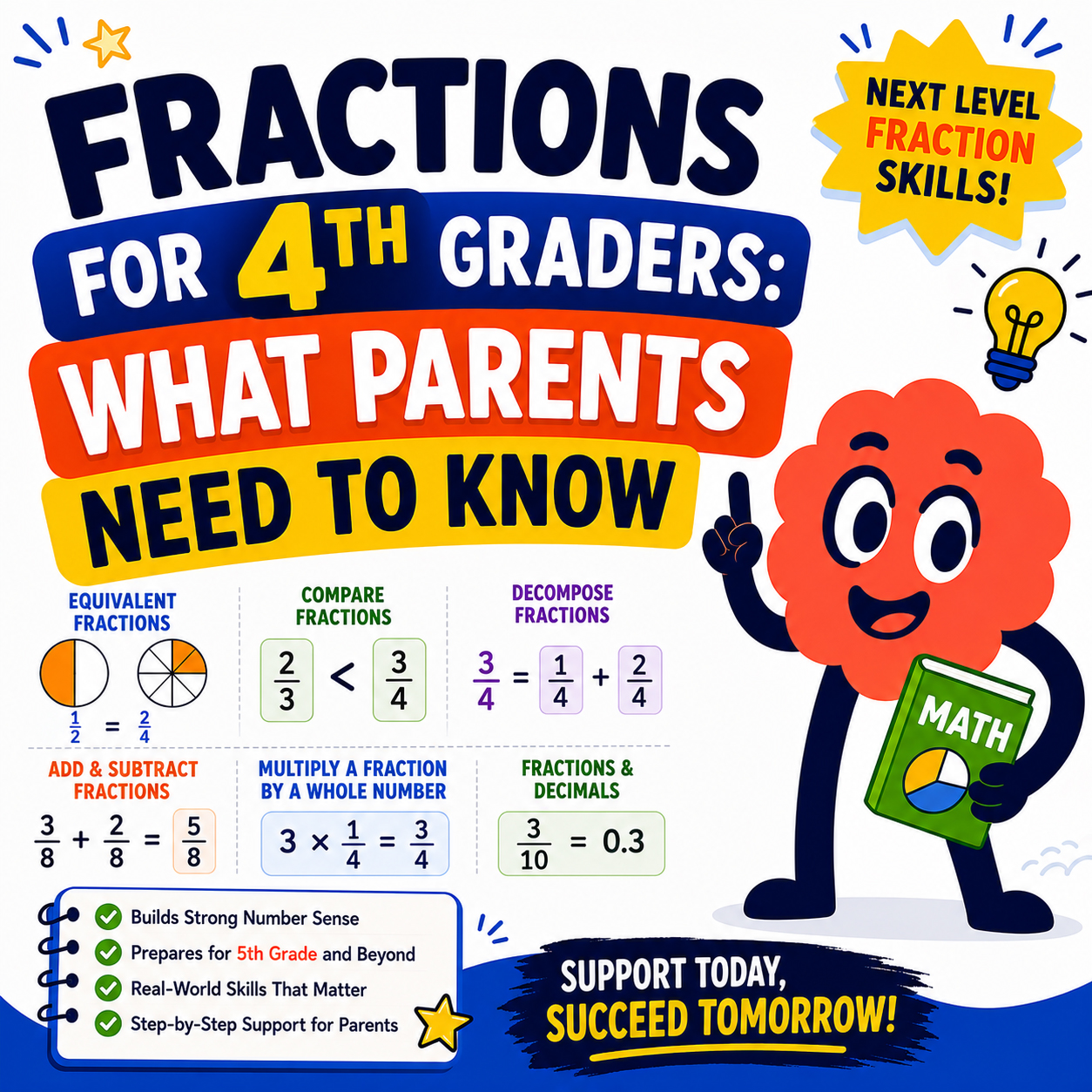
If you just started working on 4th grade fractions and already look confused, you are not alone. 4th grade fractions are a real step up from 3rd grade. Students go from recognizing simple equivalent fractions to actually building them using multiplication. That shift is big. Fractions for 4th grade cover five separate skill areas in one school year. So understanding what 4th grade fractions require makes a huge difference. This guide walks you through every major part of 4th grade fractions in plain and simple language.
What Do 4th Grade Fractions Actually Cover?
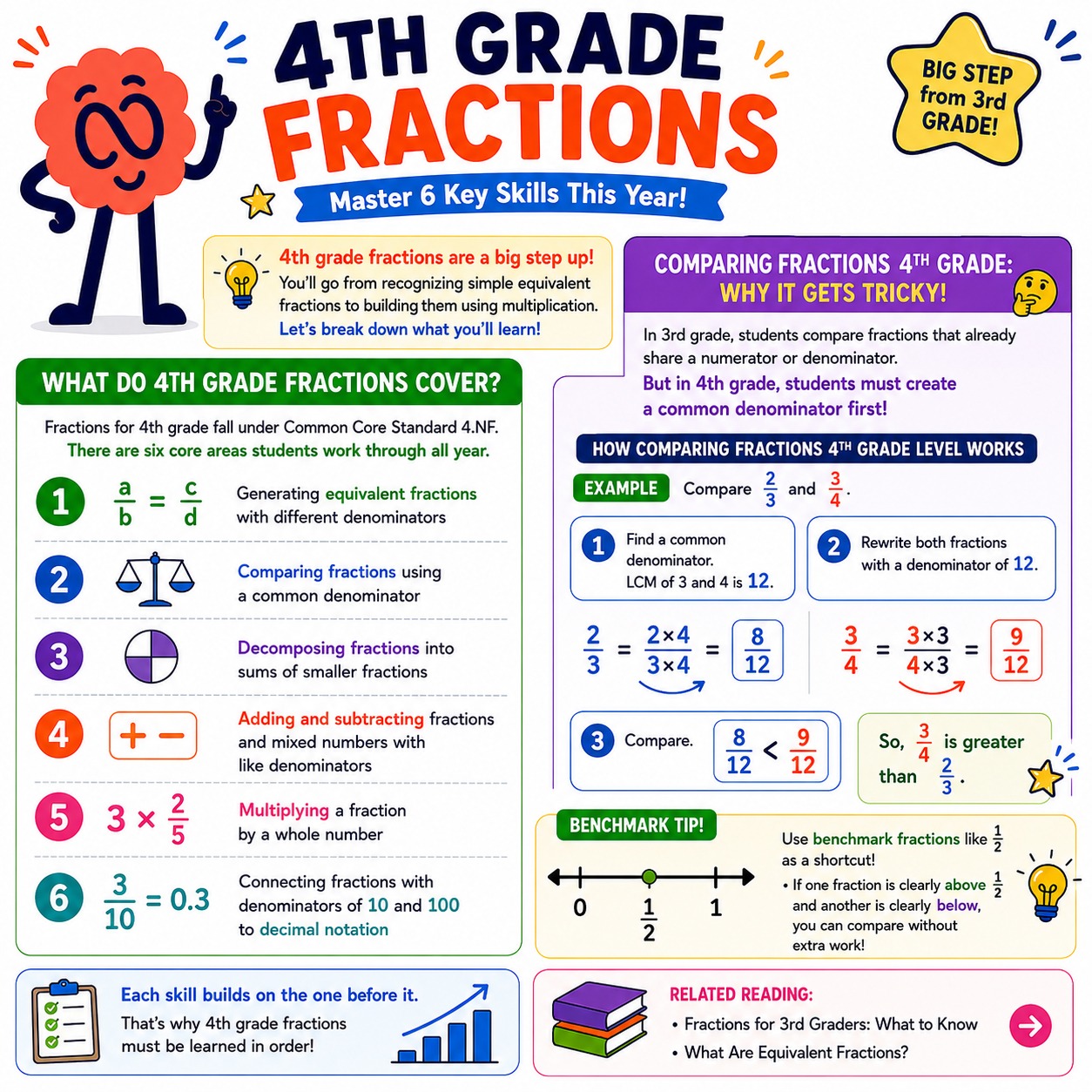
Fractions for 4th grade fall under Common Core Standard 4.NF. There are five core areas students work through all year:
• Generating equivalent fractions with different denominators
• Comparing fractions 4th grade level using a common denominator
• Decomposing fractions 4th grade style into sums of smaller fractions
• Adding and subtracting fractions and mixed numbers with like denominators
• Multiplying a fraction by a whole number
• Connecting fractions with denominators of 10 and 100 to decimal notation
Each skill builds on the one before it. So if a student struggles with equivalent fractions early in the year, comparing fractions 4th grade level becomes twice as hard. That is why 4th grade fractions need to be tackled in order.
→ Related Reading: Fractions for 3rd Graders: What to Know
Comparing Fractions 4th Grade: Why It Gets Tricky
How Comparing Fractions 4th Grade Level Works
In 3rd grade, students compare fractions that already share a numerator or denominator. Straightforward enough. But comparing fractions 4th grade style is a different task. Students now need to create a common denominator before they can compare at all.
Here’s a real example. Compare 2/3 and 3/4. You cannot just look at them side by side. First, rewrite both fractions with a denominator of 12.
2/3 = 8/12
3/4 = 9/12
Since 9/12 is greater, 3/4 wins. That is comparing fractions 4th grade level in action. Students also use benchmark fractions like 1/2 as a shortcut. If one fraction is clearly above 1/2 and another is clearly below, the comparison is done without any extra steps. That kind of number sense is a big part of fractions for 4th grade.
→ Related Reading: What Are Equivalent Fractions?
Decomposing Fractions 4th Grade
What Decomposing Fractions 4th Grade Actually Means
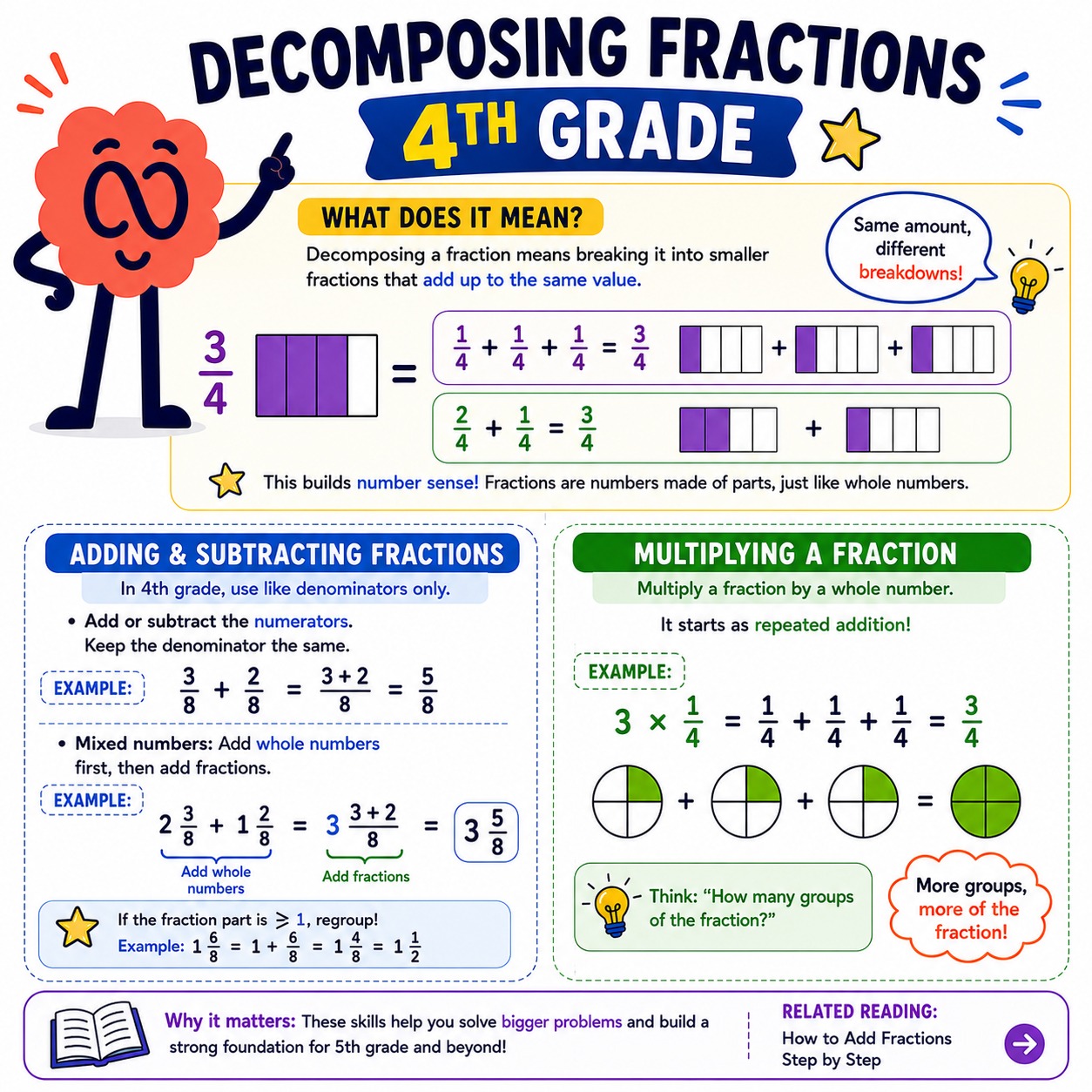
Decomposing fractions 4th grade style sounds harder than it really is. To decompose a fraction means to break it into smaller fractions that add up to the same amount.
Here is a simple example. 3/4 can be broken into 1/4 + 1/4 + 1/4. That is one way. But 3/4 also equals 2/4 + 1/4. Same value, different breakdown. That is decomposing fractions 4th grade level at work.
This skill matters because it builds real number sense. Students start to see fractions as numbers made of parts, just like whole numbers. And that understanding makes adding and subtracting fractions feel logical rather than random.
Adding, Subtracting and Multiplying Fractions for 4th Grade
In 4th grade, students add and subtract fractions with like denominators only. Unlike denominators come in 5th grade. The rule is simple: add or subtract the numerators and keep the denominator the same.
3/8 + 2/8 = 5/8
Mixed numbers follow the same idea. Add the whole numbers first, then add the fractions. Sometimes the fraction parts add up to more than 1 and students need to regroup. That step catches most kids off guard.
Multiplying a fraction by a whole number is also part of fractions for 4th grade. It starts as a repeated addition. Three groups of 1/4 equal 3/4. So 3 x 1/4 = 3/4.
→ Related Reading: How to Add Fractions Step by Step
Common Mistakes in 4th Grade Fractions
These mistakes come up again and again with 4th grade fractions.
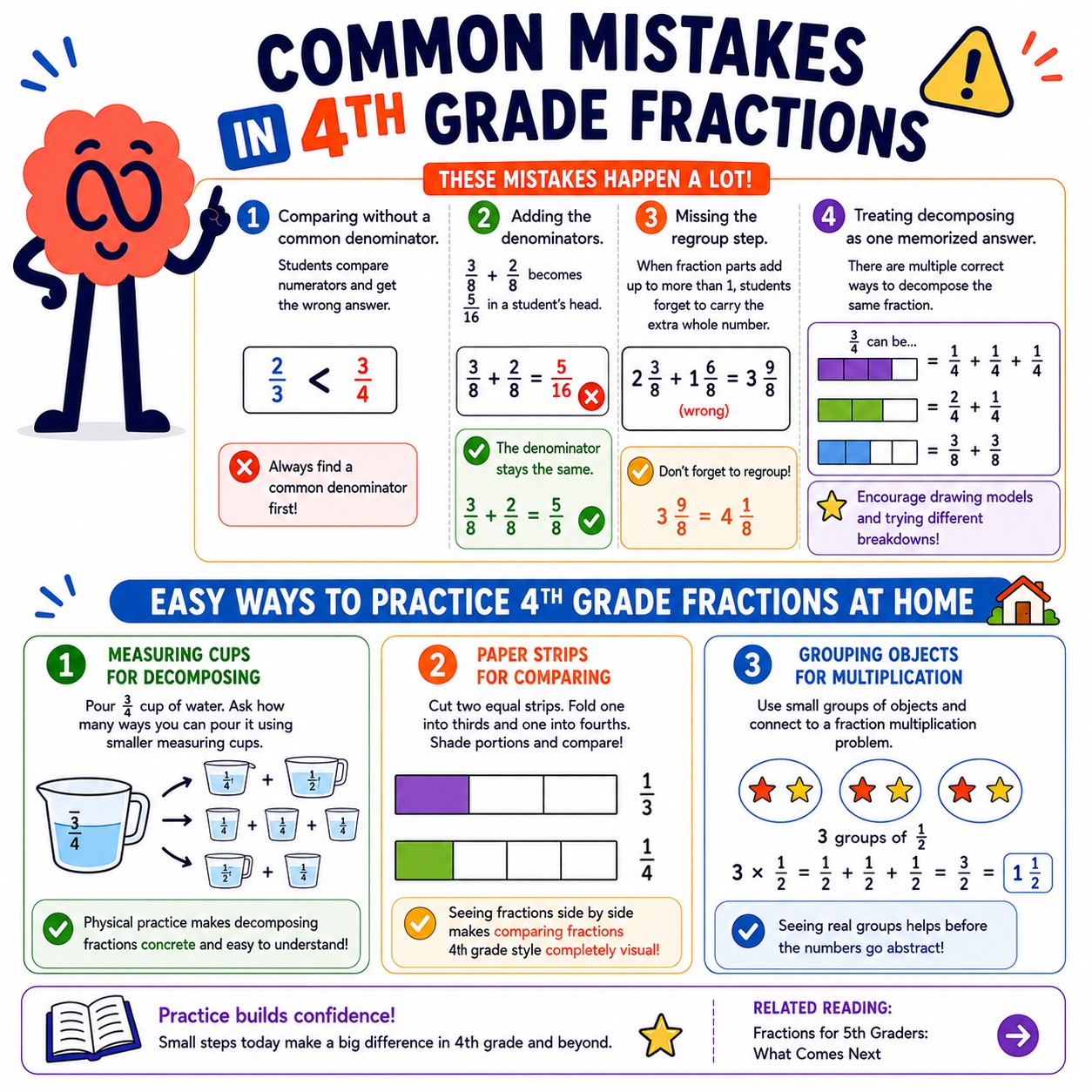
Comparing without a common denominator. When comparing fractions 4th grade level, some students skip the rewrite step and just compare numerators. That gives the wrong answer almost every time.
Adding the denominators. So 3/8 + 2/8 becomes 5/16 in a student’s head. Very common. The denominator stays the same. Always.
Missing the regroup step. When fraction parts add up to more than 1, students often forget to carry the extra whole number. Careful checking fixes this.
Treating decomposing fractions 4th grade as one memorized answer. There are multiple correct ways to decompose the same fraction. Encourage drawing models and trying different breakdowns.
Easy Ways to Practice 4th Grade Fractions at Home
These activities are simple and they actually work.
- Measuring cups for decomposing. Pour 3/4 cup of water and ask how many ways you can pour it using smaller cups. Physical practice makes decomposing fractions 4th grade level feel concrete.
- Paper strips for comparing. Cut two equal strips. Fold one into thirds and one into fourths. Shade portions and hold them side by side. It makes comparing fractions 4th grade style completely visual.
- Grouping objects for multiplication. Set out small groups of objects and connect the count to a fraction multiplication problem. Seeing real groups helps before the numbers go abstract.
→ Related Reading: Fractions for 5th Graders: What Comes Next
Key Takeaways
Here is the bottom line: 4th grade fractions cover a lot of ground but every skill connects to the next. Comparing fractions 4th grade level builds on equivalent fractions. Decomposing fractions 4th grade style builds toward adding and subtracting. Each piece matters. Keep practice hands-on, keep pressure low and celebrate small wins along the way. 4th grade fractions are not easy. But with the right support and a little patience, 4th grade fractions are very manageable.
Faqs
What fractions do 4th graders learn?
4th grade fractions cover equivalent fractions, comparing fractions 4th grade level, decomposing fractions, adding and subtracting with like denominators, multiplying by whole numbers and connecting fractions to decimals.
What does decomposing fractions 4th grade mean?
Decomposing fractions 4th grade style means breaking a fraction into smaller parts that add up to the same value. For example, 3/4 = 1/4 + 2/4.
Do 4th graders add fractions with unlike denominators?
No. Fractions for 4th grade only covers like denominators. Unlike denominators come in 5th grade.
How is comparing fractions 4th grade different from 3rd grade?
In 3rd grade, students compare fractions that share a numerator or denominator. Comparing fractions 4th grade level requires finding a common denominator first.
How can I help at home with 4th grade fractions?
Use hands-on tools like measuring cups and paper strips. Physical activities make 4th grade fractions stick far better than worksheets alone.
Book a free assessment today and explore our Grade 4 math programs.