
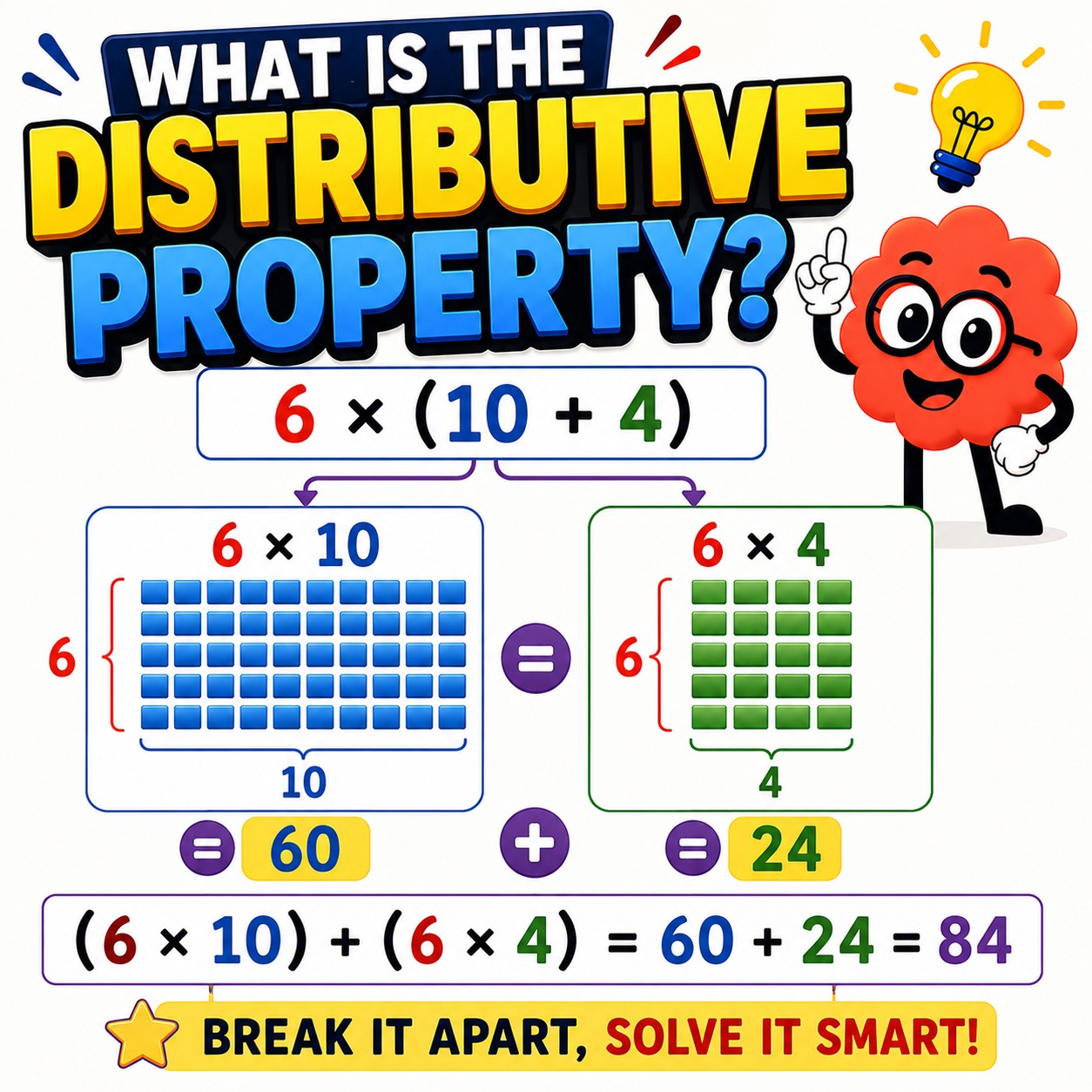
The distributive property of multiplication says multiplying a sum or difference by a number is the same as multiplying each part separately, then adding or subtracting the results. For example, 6 x (10 + 4) = (6 x 10) + (6 x 4) = 60 + 24 = 84.
It's one of the most useful mental math tricks in elementary math, even with a fairly dry name. If the question is simply what is distributive property in math, here's the answer: a shortcut for breaking a hard multiplication problem into two easy ones.
What Is the Distributive Property? (Quick Answer)
The distributive property of multiplication means a number multiplied by a sum (or difference) can be multiplied by each part separately, then combined. For addition: a x (b + c) = (a x b) + (a x c). For subtraction: a x (b - c) = (a x b) - (a x c). Both work the same way, just with a minus sign instead of a plus.
Breaking Down a Tricky Number: 7 x 8
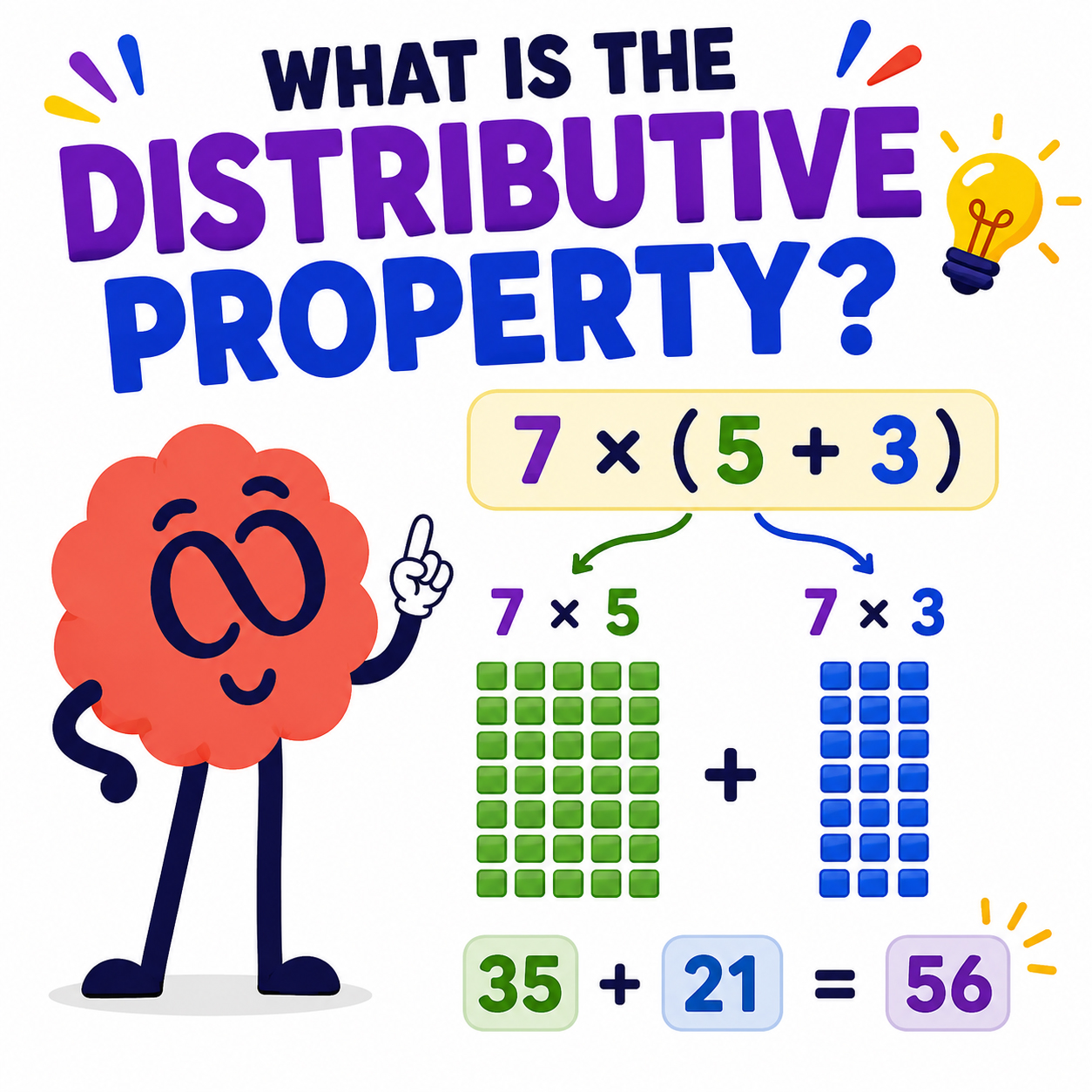
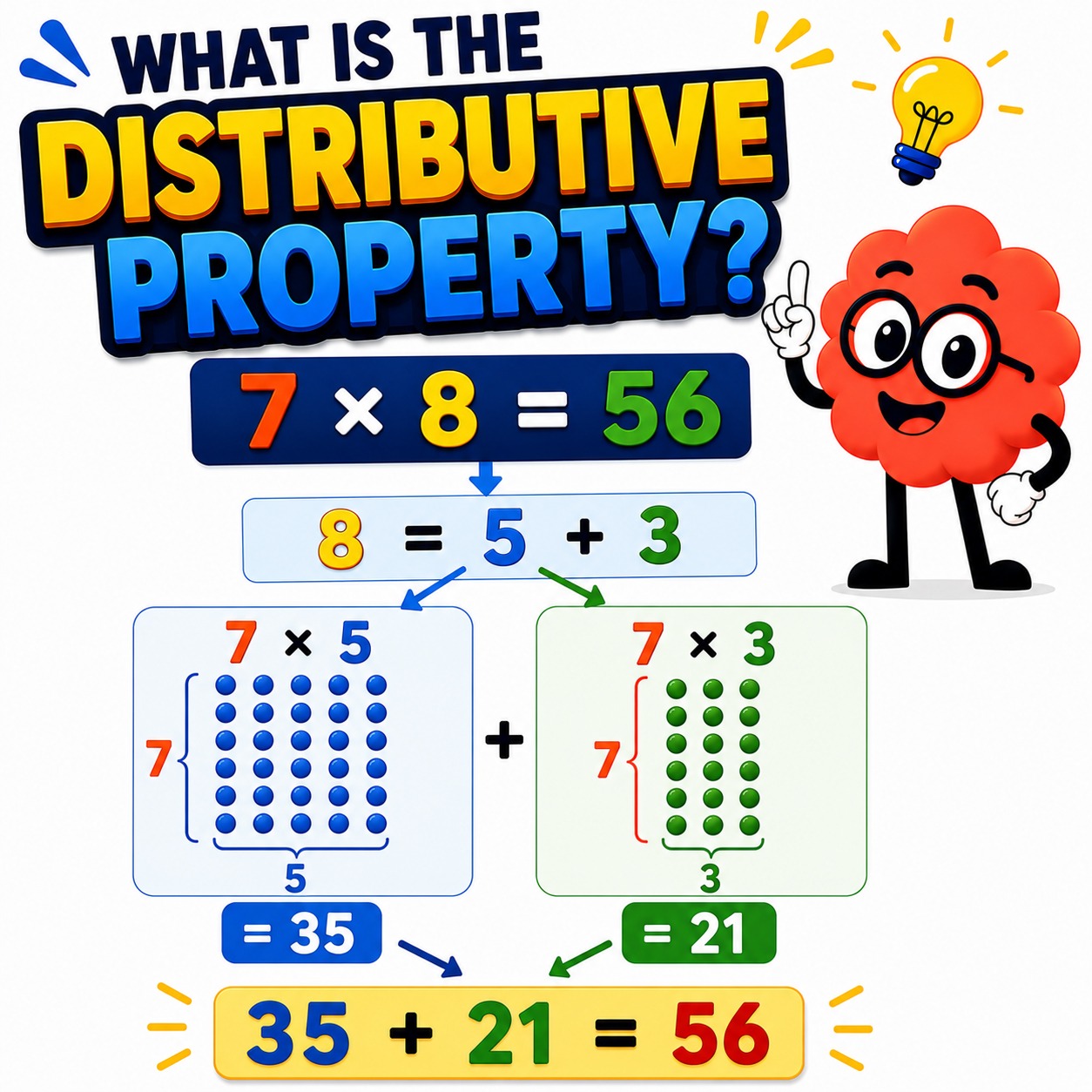
7 x 8 doesn't have a clean shortcut like doubling, which makes it a good candidate for the distributive property of multiplication. Break 8 into 5 + 3: 7 x 8 = 7 x (5 + 3) = (7 x 5) + (7 x 3) = 35 + 21 = 56. Both smaller facts are easier to work out than 7 x 8 on its own, and adding 35 + 21 is simple enough to do in your head.
Why This Property Makes Mental Math Easier
The real value of the distributive property of multiplication is speed. Any awkward problem can be split into two friendlier ones. 9 x 6 becomes (10 x 6) - (1 x 6) = 60 - 6 = 54. 13 x 4 becomes (10 x 4) + (3 x 4) = 52. This is the same logic behind how to teach times tables efficiently: once friendly numbers like 10 and 5 are solid, almost any problem can be broken into pieces built from them.
The Distributive Property with Subtraction
The subtraction version works identically, breaking a number down by taking a piece away instead of adding one. Take 9 x 8. Think of 8 as 10 - 2: 9 x 8 = 9 x (10 - 2) = (9 x 10) - (9 x 2) = 90 - 18 = 72. Rounding up to a friendly number and subtracting the extra is often faster than building up from scratch.
Distributive property Examples
Distributive property examples show up constantly outside of math class. Buying 8 tickets at $12 each: break it into 8 x (10 + 2) = 80 + 16 = $96. Tiling a room that's 6 feet by 14 feet: 6 x 14 = 6 x (10 + 4) = 60 + 24 = 84 square feet. Anywhere a total needs figuring out fast, this property tends to be doing the work behind the scenes.
A Quick Note on a Common Mix-Up
The distributive property of multiplication is often confused with the associative property of multiplication or the commutative property of multiplication, but it's doing something different. Those two properties rearrange or regroup numbers that are already being multiplied together. The distributive property of multiplication connects multiplication to addition or subtraction, by breaking one factor into parts. It's the only one of the three that involves two different operations at once.
What Grade Is This Taught?
The distributive property of multiplication is typically introduced in 3rd grade and reinforced in 4th grade, especially once two-digit multiplication comes into play. It's one of the core ideas behind the area model and long multiplication, both of which lean on breaking numbers into friendlier place-value chunks.
Common Mistakes
The most common mistake with the distributive property of multiplication is distributing to only one part of the sum instead of both. 6 x (10 + 4) is not 60 + 4, it's (6 x 10) + (6 x 4). Every part inside the parentheses needs its own multiplication. Another mistake is mixing up addition and subtraction inside the parentheses, like treating 8 as 10 - 2 but then adding the extra piece instead of subtracting it.
Key Takeaways
- The distributive property of multiplication means a x (b + c) = (a x b) + (a x c), and the same works for subtraction.
- It's the trick behind breaking an awkward problem like 7 x 8 into easier pieces.
- The distributive property of multiplication is different from the commutative and associative properties, since it connects multiplication to addition or subtraction.
- Every part inside the parentheses needs its own multiplication, not just one part.
- It's the foundation behind the area model and long multiplication taught in later grades.
Frequently Asked Questions
What is the distributive property of multiplication?
It's the rule that multiplying a sum or difference by a number is the same as multiplying each part separately, then combining the results. For example, 4 x (5 + 2) = (4 x 5) + (4 x 2) = 28.
What is the distributive property of 7 x 8?
Break 8 into 5 + 3: 7 x (5 + 3) = (7 x 5) + (7 x 3) = 35 + 21 = 56. This is the distributive property of multiplication in action, and any split of 8 works as long as both pieces get multiplied by 7 and added back together.
What is an example of the distributive property of multiplication?
9 x 6 can be solved as (10 x 6) - (1 x 6) = 60 - 6 = 54. This example of the distributive property of multiplication turns an average fact into an easy one.
What is the distributive property of multiplication in math, simply put?
Split one of the numbers being multiplied into two friendlier parts, multiply each part separately, then add or subtract the results back together.
The distributive property of multiplication looks intimidating written out with letters and parentheses, but it's really just permission to break a hard multiplication problem into two easy ones. Once that clicks, the distributive property of multiplication shows up everywhere, from times tables to real-world math.
Book a free assessment today and explore our Grade 3 and Grade 4 math programs.