
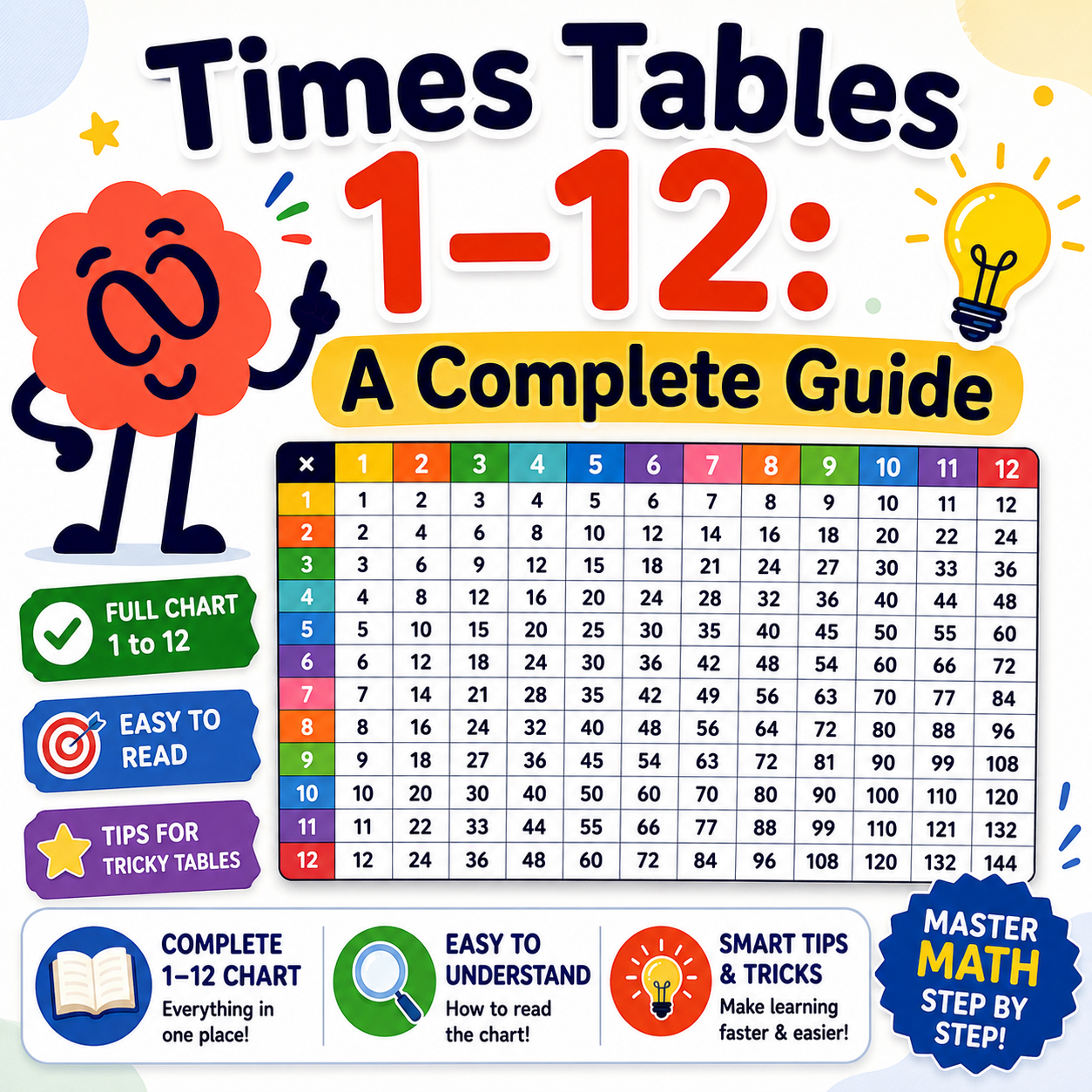
Looking for a multiplication table 1-12 that's actually useful? This is it. Below is a complete, easy-to-read chart, along with grade-by-grade guidance on which tables matter most right now, and a few quick tips for the numbers that trip kids up most.
Multiplication Table 1-12 (Full Chart)
Here's the full multiplication table 1-12. Find the first number down the left side, find the second number across the top, and follow both rows until they meet. That number is your answer.
[[table]]
×|1|2|3|4|5|6|7|8|9|10|11|12
1|1|2|3|4|5|6|7|8|9|10|11|12
2|2|4|6|8|10|12|14|16|18|20|22|24
3|3|6|9|12|15|18|21|24|27|30|33|36
4|4|8|12|16|20|24|28|32|36|40|44|48
5|5|10|15|20|25|30|35|40|45|50|55|60
6|6|12|18|24|30|36|42|48|54|60|66|72
7|7|14|21|28|35|42|49|56|63|70|77|84
8|8|16|24|32|40|48|56|64|72|80|88|96
9|9|18|27|36|45|54|63|72|81|90|99|108
10|10|20|30|40|50|60|70|80|90|100|110|120
11|11|22|33|44|55|66|77|88|99|110|121|132
12|12|24|36|48|60|72|84|96|108|120|132|144
[[/table]]
How to Read a Multiplication Chart
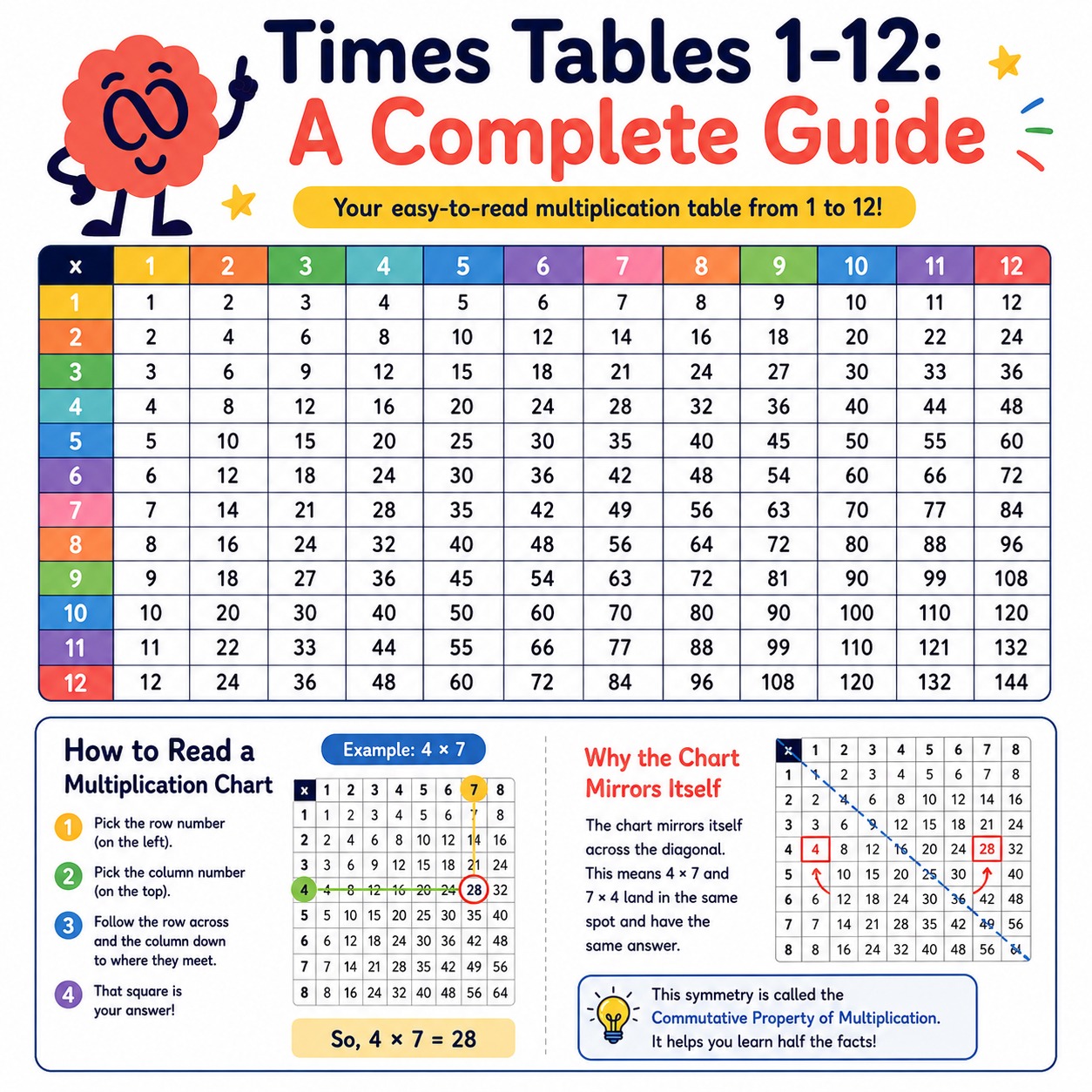
Reading the multiplication table 1-12 gets easy fast once you know the trick. Pick a row number and a column number, then trace across and down until they meet at the same square. That square holds the product. Notice the chart mirrors itself across the diagonal, since 4 x 7 and 7 x 4 land in the same spot with the same answer. This post on multiplication facts explains why that happens and how it can cut memorization load in half.
Which Tables Matter Most, and When?
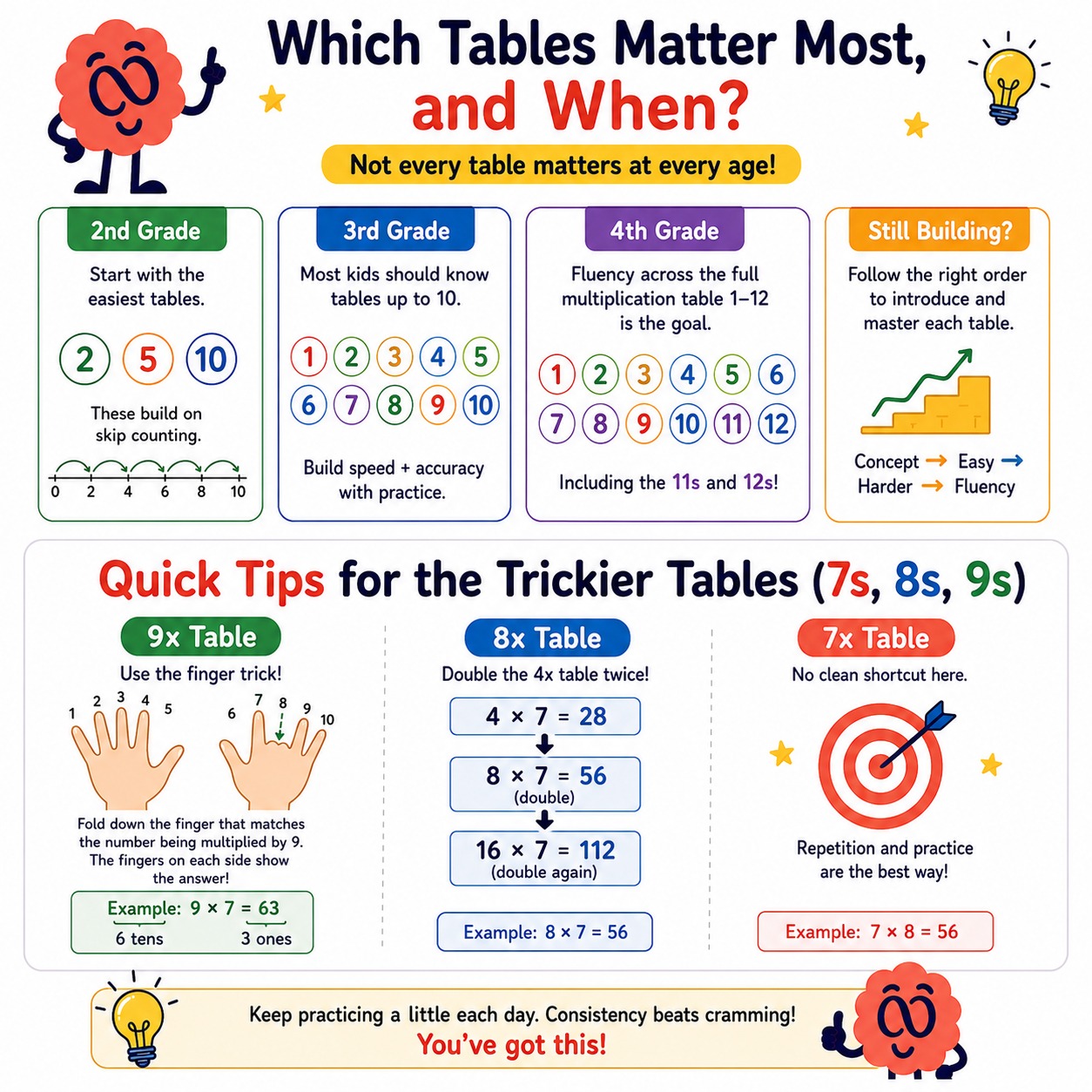
Not every table matters at every age. In 2nd grade, kids usually start with 2s, 5s, and 10s, which lean heavily on skip counting. By 3rd grade, most kids are expected to know tables up to 10. By 4th grade, real fluency across the full multiplication table 1-12 is the goal, including the 11s and 12s. For kids still building the basics, this guide on how to teach times tables walks through the right order to introduce them.
Quick Tips for the Trickier Tables (7s, 8s, 9s)
Even with a full multiplication table 1-12 close by, the 7x table, 8x table, and 9x table are almost always the last ones to click, and that's completely normal. For the 9x table, the finger trick works well: fold down the finger matching the number being multiplied by 9, and the fingers on either side show the answer. For the 8x table, doubling the 4x table twice gets the job done. The 7x table doesn't have a clean shortcut, so it usually just takes more repetition.
Individual Table Reference (4x, 6x, 7x, 8x, 9x)
Here's each tricky table pulled straight out of the multiplication table 1-12 above, so you don't have to scan the full times tables chart 1-12 to find them.
4x Table
4, 8, 12, 16, 20, 24, 28, 32, 36, 40, 44, 48. The 4x table is just the 2x table doubled, which makes it one of the easier ones once the 2s are solid.
6x Table
6, 12, 18, 24, 30, 36, 42, 48, 54, 60, 66, 72. The 6x table lines up with the 2x and 3x tables, since 6 is 2 x 3.
7x Table
7, 14, 21, 28, 35, 42, 49, 56, 63, 70, 77, 84. The 7x table has the fewest overlapping patterns with other tables, so plan on extra practice here.
8x Table
8, 16, 24, 32, 40, 48, 56, 64, 72, 80, 88, 96. The 8x table doubles the 4x table, so if the 4s are solid, the 8s are just one extra step.
9x Table
9, 18, 27, 36, 45, 54, 63, 72, 81, 90, 99, 108. The digits in each product up to 9 x 10 always add up to 9, which is a handy way to check an answer.
Printable vs. On-Screen: Which Works Better for Practice?
A printed multiplication table 1-12 taped up somewhere visible works well for quick reference during homework. An on-screen version works better for active practice, like a blank chart filled in from memory and checked against the full multiplication table 1-12 after. Neither format matters as much as how often it actually gets used, so pick whichever fits best.
Common Mistakes to Avoid with the Multiplication Table 1-12
The biggest mistake is treating the chart as something to memorize outright, front to back. It's a reference tool first, and a memorization aid second. Another common mistake is skipping straight to the 7x, 8x, and 9x tables out of order, before the easier ones are automatic. And practice often stops as soon as the chart is memorized, when a bit of ongoing review keeps the facts from fading.
Key Takeaways
- Use the multiplication table 1-12 above as a quick reference, not just something to memorize cold.
- Focus on 2s, 5s, and 10s first, then build toward the full multiplication table 1-12 by 4th grade.
- The 7x table usually takes the most repetition of any table.
- Doubling the 4x table gives you the 8x table almost for free.
- Pick printable or on-screen practice based on whichever actually gets used.
Frequently Asked Questions
What is the multiplication table 1-12?
It's a complete grid showing the product of every number from 1 to 12 multiplied by every other number from 1 to 12, used as a quick reference and practice tool. The multiplication table 1-12 above covers the full range.
How do I memorize the multiplication table 1-12?
Start with the easiest tables (2, 5, 10), then work up to the trickier ones (7, 8, 9) using tricks like doubling and the finger trick, with short daily practice.
What is the 7 times table?
7, 14, 21, 28, 35, 42, 49, 56, 63, 70, 77, 84. It's often the last table kids memorize, since it shares fewer patterns with other tables.
What is the easiest way to learn the 9x table?
The finger trick is the fastest way in. Fold down the finger matching the number you're multiplying by 9, and the fingers on either side show your answer.
Is there a trick for the 8 times table?
Yes. Double the 4x table. If 4 x 6 = 24 is already solid, then 8 x 6 is just double that, or 48.
A solid multiplication table 1-12 is one of the most useful math references to keep on hand during the elementary years. Our tutors can help if more hands-on support building fluency is needed.
Book a free assessment today and explore our Grade 2 and Grade 3 math programs.