
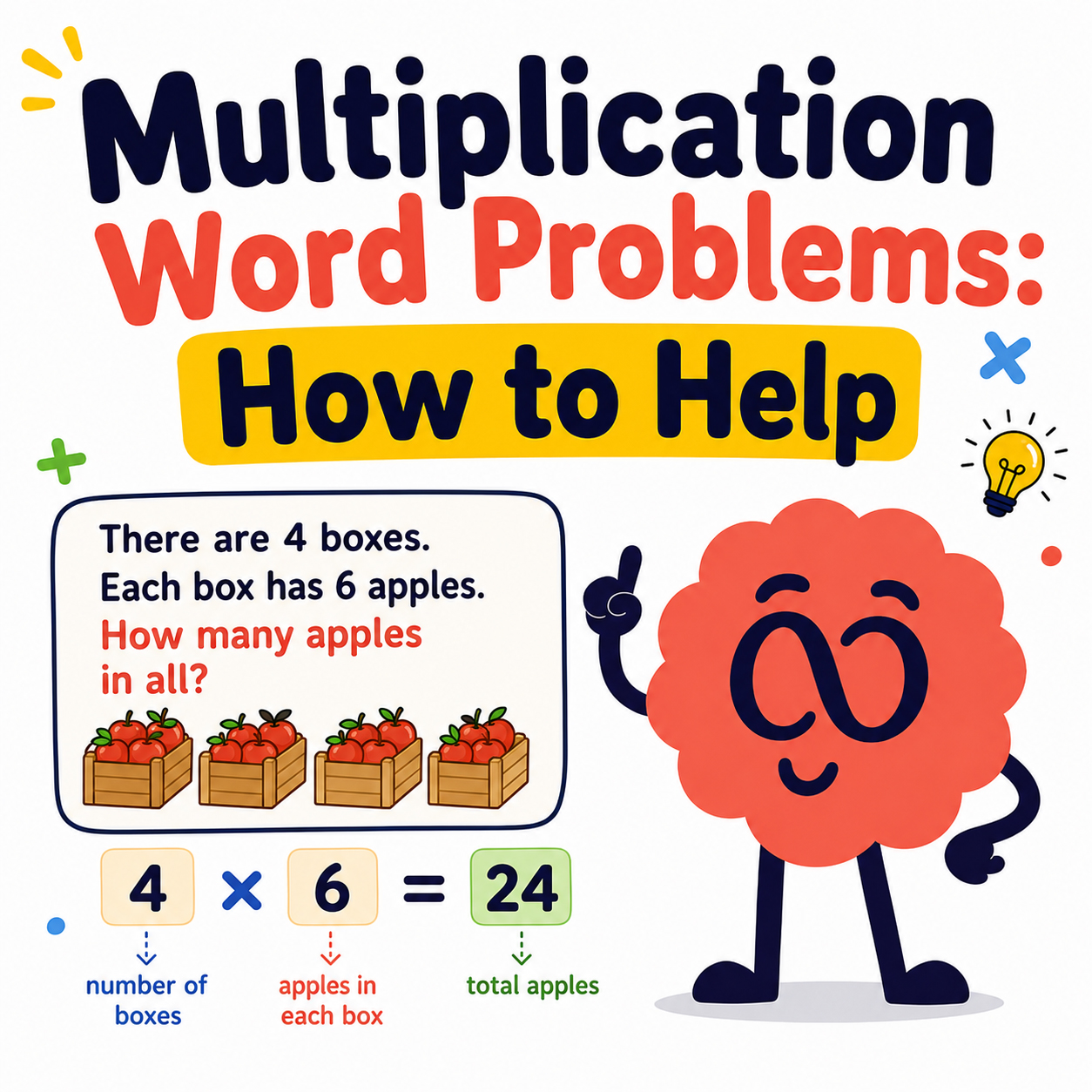
Multiplication word problems trip up a lot of people, and it's usually not the math itself that's the problem. It's translating the sentence into an equation in the first place. Once the words turn into numbers, the multiplication part is often the easy half, especially once the basic facts are automatic.
Here's a simple method for spotting multiplication inside a word problem, plus worked examples organized by grade level, from straightforward single-step problems up to the multi-step versions that show up in 5th grade.
How to Solve Multiplication Word Problems (Quick Answer)
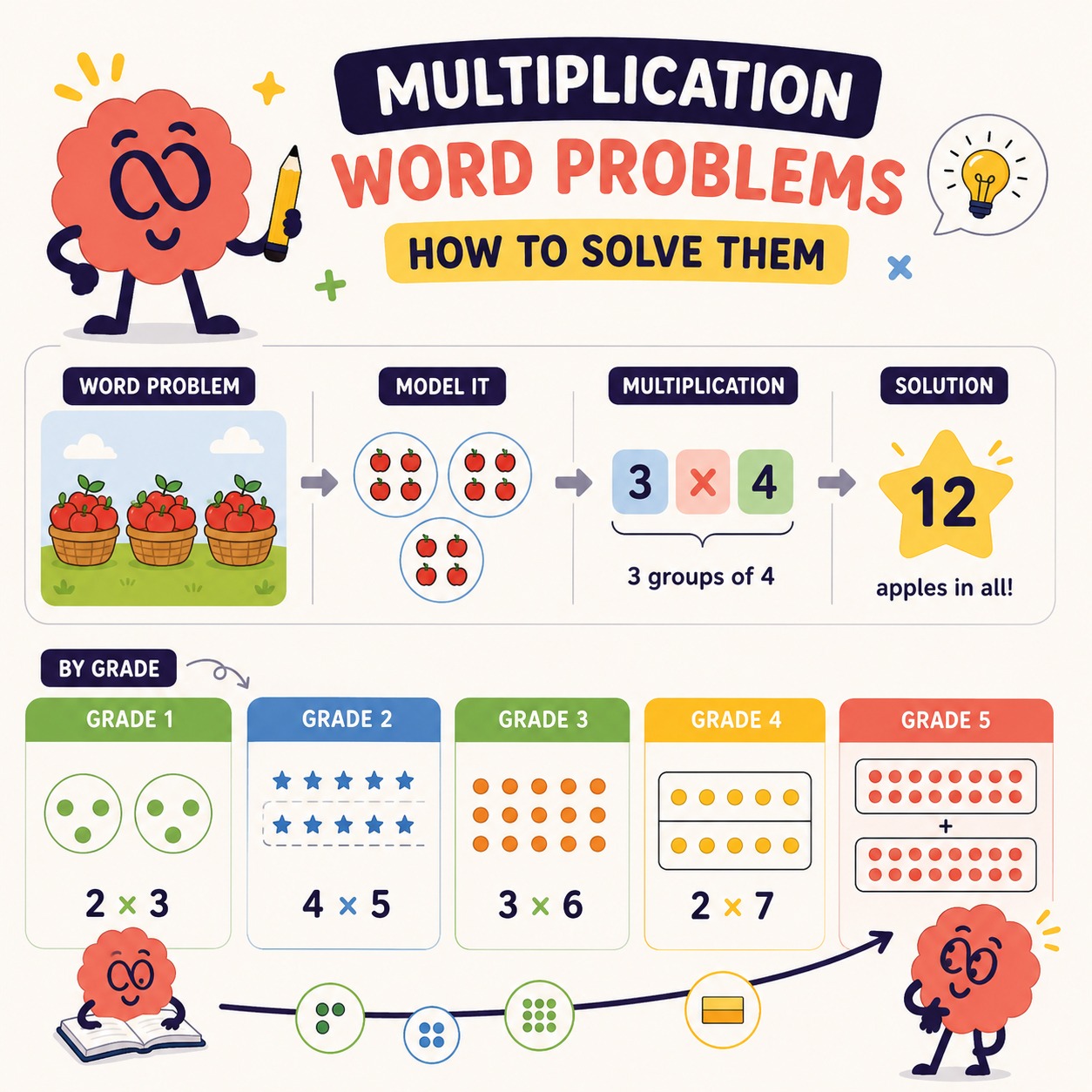
The fastest way through multiplication word problems is to look for specific keywords that signal multiplication, figure out what's being repeated and how many times, then write the equation before solving it. Getting the equation right matters more than the actual multiplication, which usually comes down to solid multiplication facts once the setup is correct.
The Keyword Trick: Spotting Multiplication in a Word Problem
Certain words show up constantly in multiplication word problems, and learning to spot them turns a confusing sentence into a straightforward equation. Common signals include “groups of,” “each,” “every,” “per,” “times,” and “in all” or “altogether” in the question itself. “Each box has 8 crayons” signals multiplication (8 x number of boxes). “3 times as many” signals multiplication directly. The pattern to look for is a fixed amount repeated some number of times, which is exactly what multiplication represents, and exactly the idea behind how to teach times tables in the first place.
Multiplication Word Problems By Grade (with Examples)
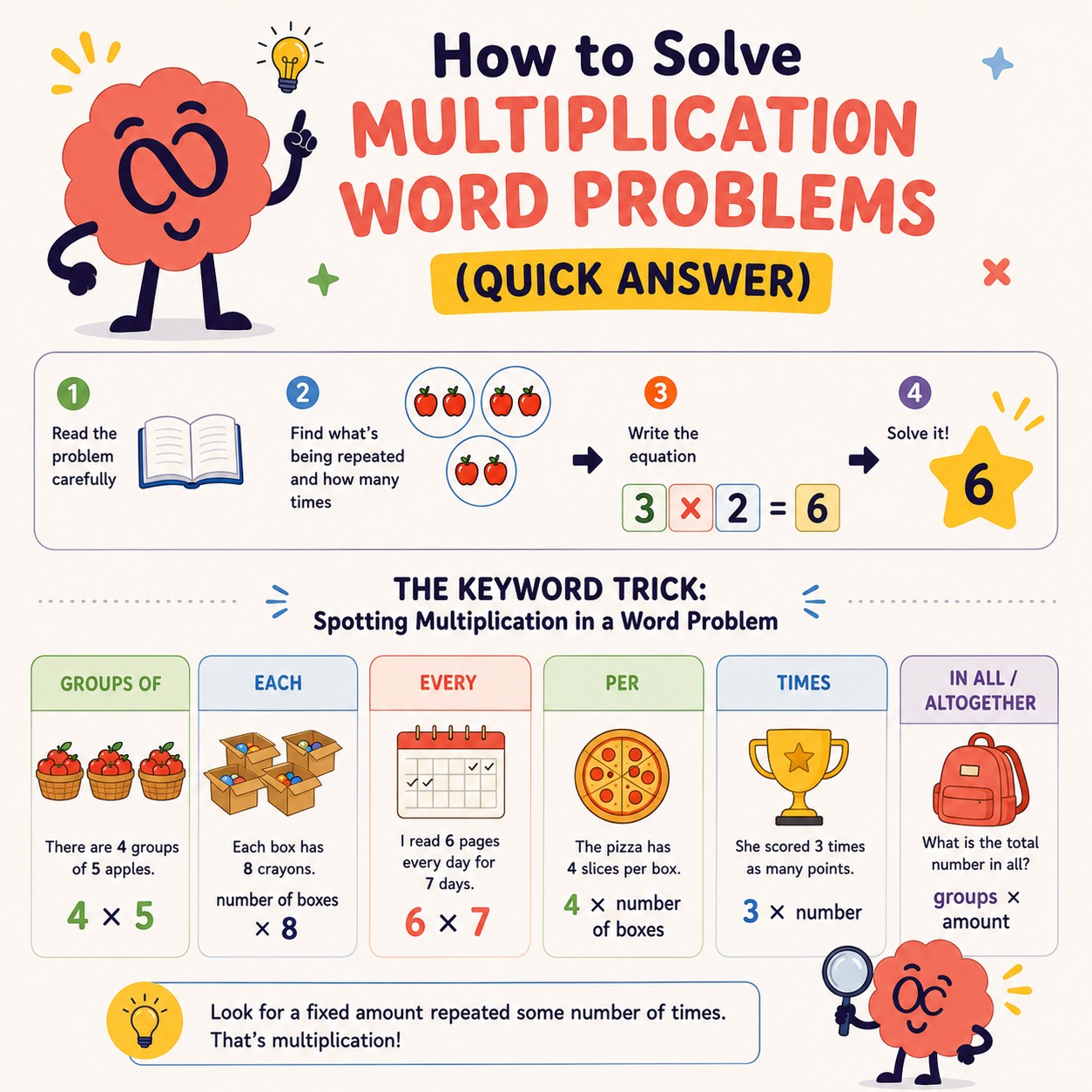
At the 3rd grade level, multiplication word problems are usually single-step, with small, friendly numbers. For anyone still building the basics before tackling word problems, 2nd grade multiplication covers the foundation these problems build on.
- A classroom has 5 tables, and each table seats 4 students. How many students fit in the classroom? (5 x 4 = 20 students)
- A pack of stickers has 6 stickers, and there are 7 packs. How many stickers in total? (6 x 7 = 42 stickers)
- Each shelf holds 9 books, and there are 3 shelves. How many books fit on all the shelves? (9 x 3 = 27 books)
- A garden has 4 rows of tomato plants, with 8 plants in each row. How many tomato plants are in the garden? (4 x 8 = 32 plants)
4th Grade Multiplication Word Problems (with Examples)
By 4th grade, multiplication word problems by grade start using larger numbers and occasionally combine two steps.
- A theater has 14 rows with 22 seats in each row. How many seats does the theater have? (14 x 22 = 308 seats)
- A bakery bakes 36 muffins every day. How many muffins does it bake in a 7-day week? (36 x 7 = 252 muffins)
- A school orders 18 boxes of pencils, with 24 pencils in each box. How many pencils were ordered? (18 x 24 = 432 pencils)
- A parking garage has 12 floors, with 45 parking spots on each floor. How many total parking spots does the garage have? (12 x 45 = 540 spots)
5th Grade Multiplication Word Problems (with Examples)
In 5th grade, multiplication word problems often combine multiplication with another operation, or involve decimals.
- A concert venue has 45 rows with 60 seats each, but 120 seats are reserved. How many seats are available? ((45 x 60) - 120 = 2,580 seats)
- A runner covers 3.5 miles every day. How many miles does the runner cover in 12 days? (3.5 x 12 = 42 miles)
- A farmer plants 28 rows of corn with 34 plants in each row, then adds 3 more full rows. How many corn plants in total? ((28 x 34) + (3 x 34) = 1,054 plants)
Common Mistakes with Word Problems
The most common mistake is jumping straight to an operation without reading closely enough to catch the right keyword, especially confusing “each” (multiplication) with “more than” (addition). Another common mistake is multiplying the wrong two numbers, like using a total instead of a rate, or multiplying a quantity by itself instead of by the number of groups. Multi-step problems bring their own trap: solving only the first step and forgetting the second calculation the question actually asked for. Units cause trouble too, especially when a problem mixes measurements like feet and inches, or dollars and cents, without converting them first. Reading the question twice, once for the numbers and once for what's actually being asked, clears up most of these errors before they happen.
Key Takeaways
- Multiplication word problems are usually a reading challenge first and a math challenge second.
- Keywords like “each,” “every,” “per,” and “groups of” signal multiplication.
- Multiplication word problems by grade like 3rd grade problems are single-step with small numbers; 5th grade problems often combine two steps.
- Writing the equation before solving it catches most setup mistakes early.
- Reading the question twice, once for numbers and once for what's being asked, prevents the most common errors.
Frequently Asked Questions
How do you know if a word problem is multiplication or division?
Multiplication combines equal groups into a total. Division splits a total into equal groups or finds how many groups fit inside a total. If the total is missing, it's usually multiplication. If a group size or number of groups is missing, it's usually division.
What are some good multiplication word problem keywords?
“Each,” “every,” “per,” “times,” “groups of,” and “in all” or “altogether” are the most common signals for multiplication word problems.
Why are multiplication word problems harder than regular multiplication?
Because they add a translation step. The multiplication itself might be simple, but figuring out which numbers to multiply, and why, is a separate skill from just knowing multiplication facts.
How can multi-step word problems be made easier?
Break the problem into smaller questions and solve them one at a time, writing down each intermediate answer instead of trying to do the whole problem in one step.
Multiplication word problems get easier with practice, mostly because the keyword patterns start to feel familiar. Once the translation step becomes automatic, solving multiplication word problems is usually the fastest part of the whole assignment.
Book a free assessment today and explore our Grade 3 and Grade 4 math programs.