
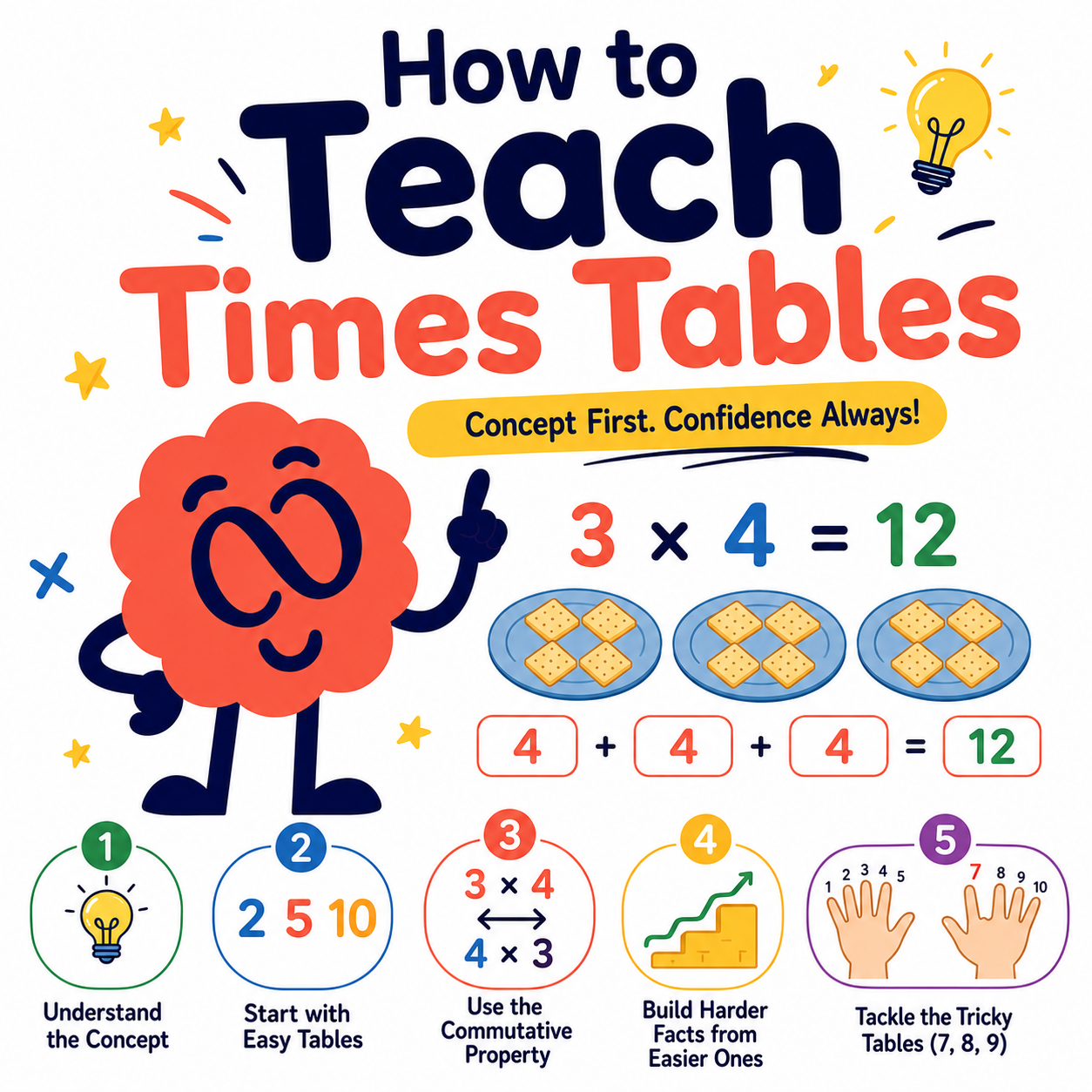
Wondering how to teach times tables? Here's the short version: start with the concept, not memorization. Multiplication should mean “groups of” something before anyone memorizes a single fact. From there, move through the tables from easiest to hardest, and use a couple of tricks to cut the workload in half.
Times tables trip up a lot of kids, and that's not because the concept is hard. It's usually because most people are taught to memorize first and understand later, which is backwards. Here's how to teach times tables the way that actually sticks.
How to Teach Times Tables: The Quick Answer
If you only take one thing from this guide on how to teach times tables, build the concept first. Multiplication means “groups of” a number, so 3 x 4 is three groups of four. Start with the easiest tables, 2, 5, and 10, then use the commutative property so 3 x 4 and 4 x 3 count as one fact.
Before You Start: Make Sure These Basics Are Solid
Before diving into how to teach times tables, check that a couple of basics are in place. Kids should be comfortable counting by 2s, 5s, and 10s. If skip counting still feels shaky, this guide to skip counting is a good place to start.
Step 1: Show What Multiplication Actually Means
This is the step most people skip, and it matters most. Understanding what multiplication represents matters more than memorizing facts, which is really how to teach multiplication at its core. Three plates with four crackers on each is 3 x 4. Adding 4 + 4 + 4 shows that multiplication is just a faster way to do that. This post on what is multiplication covers this from the beginning, and it's the foundation for how to teach times tables well.

Step 2: Start with the Easiest Tables (2, 5, 10)
Once the concept is solid, start with the tables that come easiest. The 2s are just doubling. The 10s follow an obvious pattern. The 5s land on 5 or 0 every time. This is where how to teach times tables starts feeling manageable.
Step 3: Use the Commutative Property to Cut the Work in Half
Here's a trick that saves real time. The commutative property means 3 x 4 and 4 x 3 give the same answer, so it only needs to be learned as one fact, not two. That cuts the total number of facts nearly in half. This post on the commutative property of multiplication explains it further.
Step 4: Build Harder Facts from Easier Ones (the Stepping-Stone Trick)
A known fact can help figure out an unknown one. Take 5 x 6 = 30: if that one's solid but 6 x 6 causes a freeze-up, point out that 6 x 6 is just one more group of 6, so it's 30 + 6 = 36.
Step 5: Tackle the Tricky Tables (7, 8, 9)
The 7s, 8s, and 9s are usually the last to click, and that's normal. By this point, more than half these facts are already covered through the commutative property and the stepping-stone trick. For the 9s, the finger trick works well: fold down the finger matching the number being multiplied by 9, and the fingers on either side show the answer.

Can You Really Memorize Tables in 5 Minutes?
Short answer: not all of them. A single table, like the 9s with the finger trick above, can click in about five minutes once the groundwork is in place. Real fluency takes consistent practice, which is the honest answer to how to teach times tables well.
Step 6: Practice Without It Feeling Like Drilling
Once the tables are understood, short and frequent practice beats long study sessions. Five minutes a day works better than thirty minutes once a week. Mix it into a car ride or dinner prep. This post on multiplication facts has more ways to help facts stick.
How to Teach Times Tables When Frustration Hits
Frustration usually means the pace is too fast. Back off to a table that's already solid, get an easy win, and stop there. That's the real fix for how to teach times tables when things get frustrating.
When Should Kids Know Their Times Tables?
Most kids work on times tables through 2nd and 3rd grade, with fluency expected by the end of 3rd grade. Knowing how to teach times tables by grade level helps set realistic expectations. For a full reference, this complete times tables chart covers every table from 1 to 12.
Common Mistakes to Avoid When Teaching Times Tables
The biggest mistake is jumping to memorization before the concept is solid. Flashcards work, but only after multiplication itself is understood. Another mistake is teaching tables in order, 1 through 12, instead of easiest to hardest. Knowing how to teach times tables well comes down to avoiding these habits.
Key Takeaways
- Build the “groups of” concept before memorizing anything. That's the core of how to teach times tables well.
- Start with the easiest tables (2, 5, 10) to build early confidence.
- Use the commutative property to cut the number of facts to learn in half.
- Use the stepping-stone trick to build unknown facts from known ones.
- Keep practice short, frequent, and low-pressure. This is how to teach times tables without turning it into a fight.
Frequently Asked Questions
What is the easiest way to teach multiplication tables?
Build the “groups of” concept first, then start with the 2s, 5s, and 10s. That's the short answer for how to teach multiplication tables at any age.
How do you explain times tables to a child?
Use objects to show groups. Three groups of four crackers is 3 x 4, which is the logic behind how to teach times tables overall.
What is an easy trick to learn tables?
The commutative property and the stepping-stone trick both cut down how many new facts actually need to be memorized.
How do you memorize tables in 5 minutes?
A single table, like the 9s with the finger trick, can click in about five minutes. Memorizing every table takes longer and needs regular practice.
What's the fastest way to learn how to teach times tables?
Follow the concept-first method above: groups of, easiest tables first, then the commutative property.
Learning times tables pays off for years. Once how to teach times tables clicks, it becomes the foundation for long multiplication and fractions later. Our tutors can help if more structured support is needed.
Book a free assessment today and explore our Grade 2 and Grade 3 math programs.