
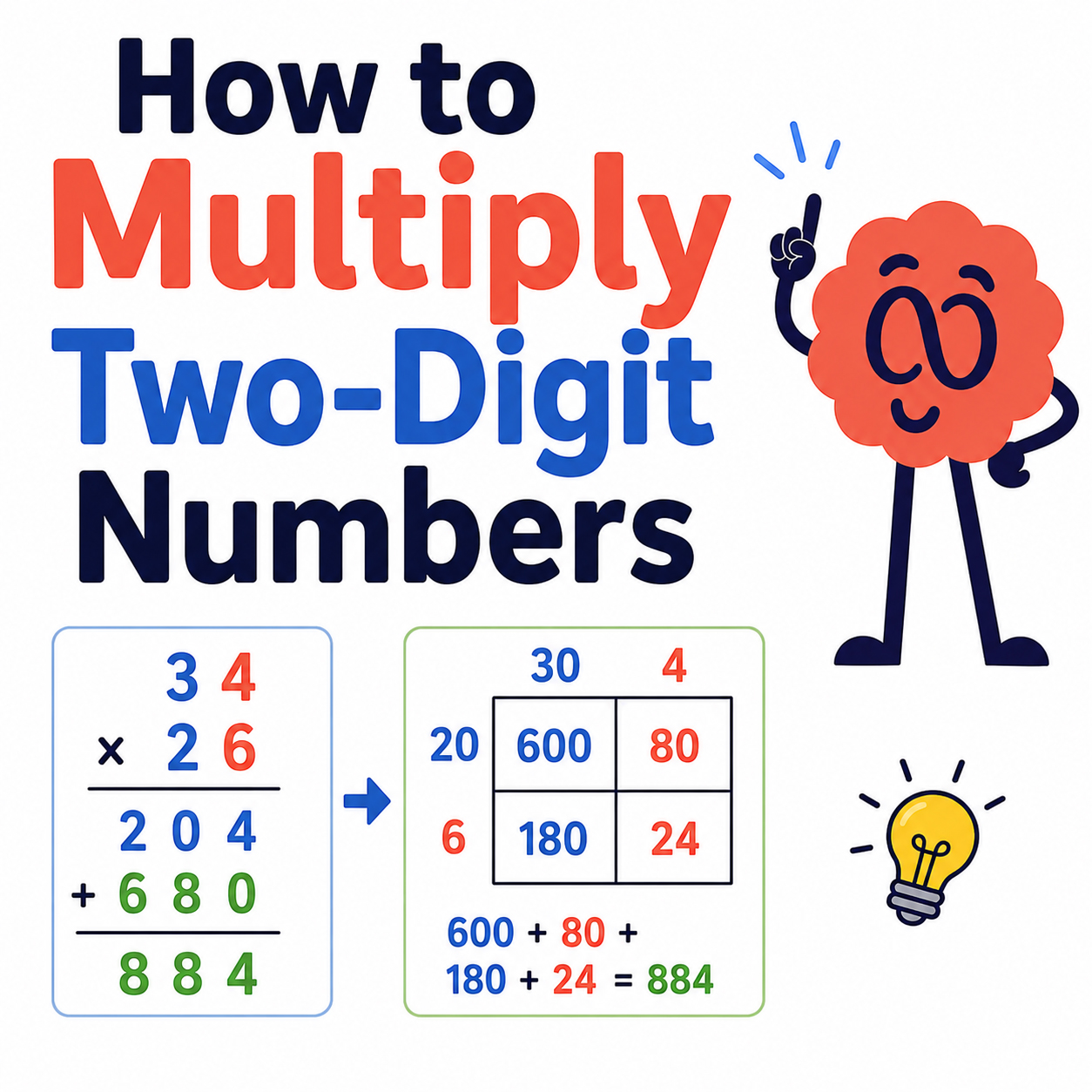
Long multiplication is the standard step-by-step method for multiplying numbers larger than 10. The numbers get lined up by place value, multiplied in stages, and the partial results are added together to get the final answer.
There are a couple of different ways to actually do long multiplication, and schools don't all teach it the same way. Here's how to do long multiplication using the two most common methods, side by side, plus which one tends to work better depending on how a problem is being worked through.
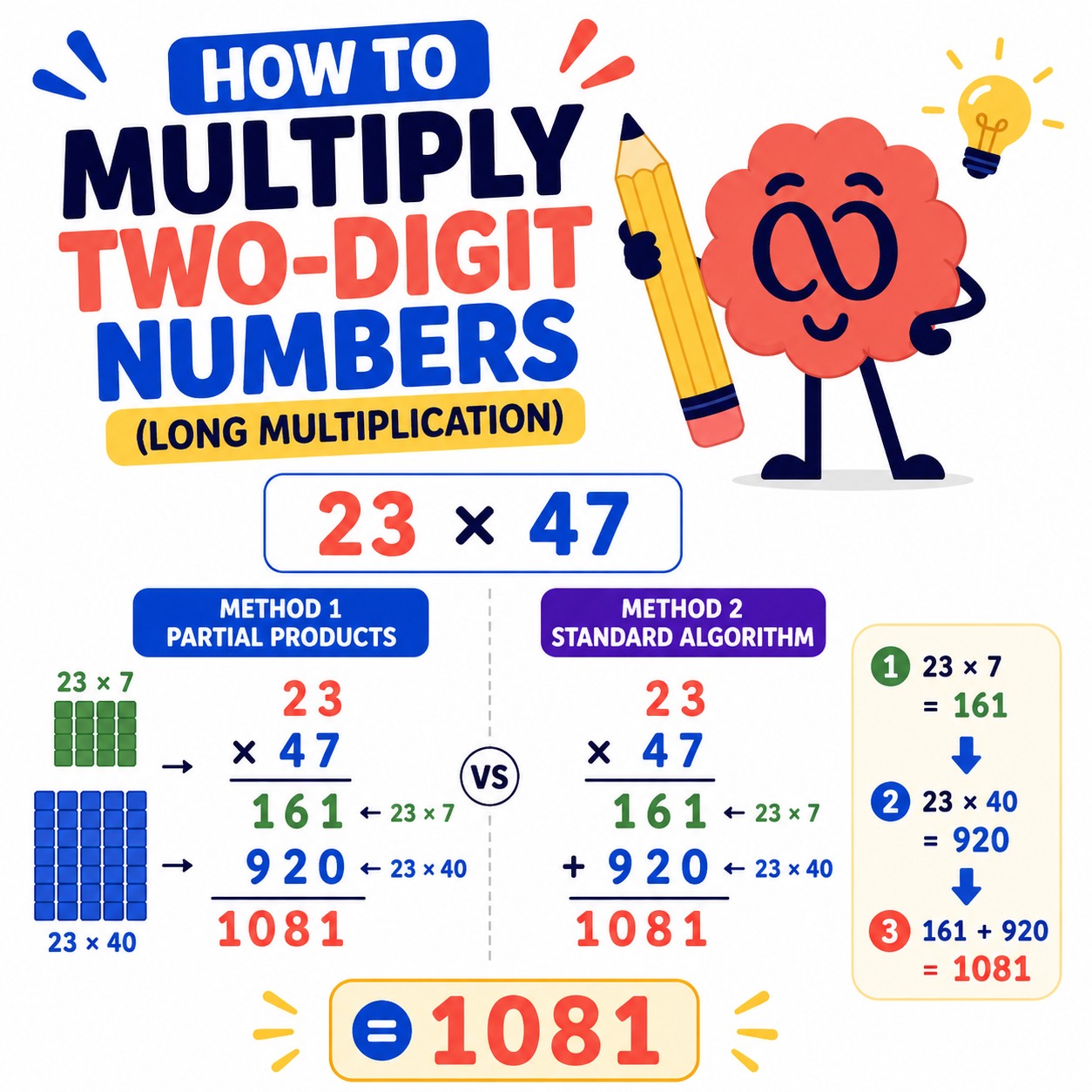
What Is Long Multiplication? (Quick Answer)
Long multiplication is the method used for multiplying numbers with more than one digit, once the answer is too big to solve from memory alone. Instead of multiplying everything at once, the problem is broken into smaller steps based on place value, and those smaller results get added together at the end. It's the standard way to figure out how to multiply two multi-digit numbers by hand.
How to Do Long Multiplication: The Column Method
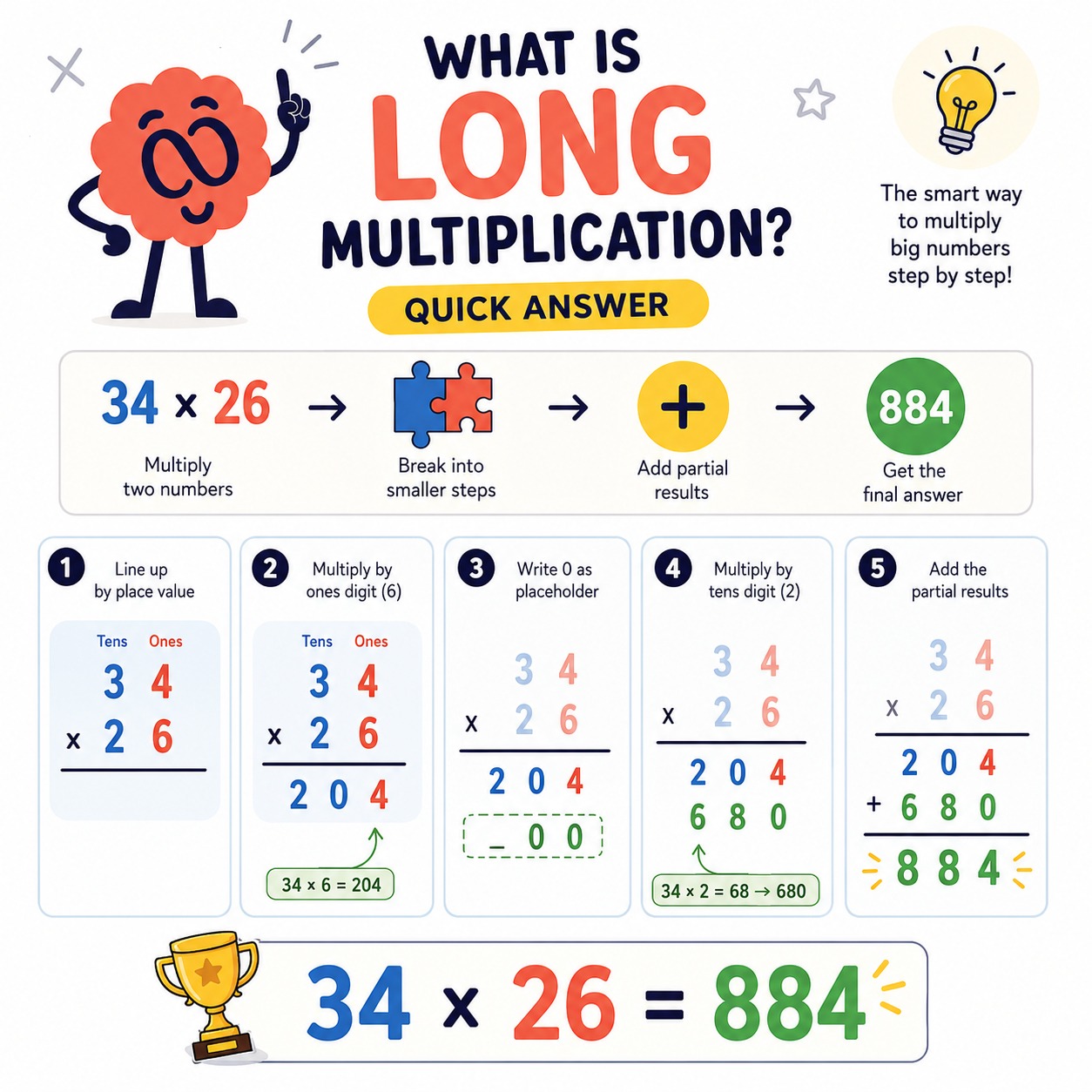
The column method is the version most people picture when they think of long multiplication. It's the classic approach for 2 digit by 2 digit multiplication, and it scales to larger numbers too. Here's how to do long multiplication step by step using 34 x 26 as the example:
- Line up 34 and 26 vertically, by place value, with 26 on the bottom.
- Multiply 34 by the ones digit of 26 (which is 6): 34 x 6 = 204.
- Write a 0 as a placeholder under the ones column of the next row, since the next digit represents tens, not ones.
- Multiply 34 by the tens digit of 26 (which is 2): 34 x 2 = 68. Write this starting in the tens column, next to the placeholder zero, giving 680.
- Add the two partial results: 204 + 680 = 884.
34 x 26 = 884. Each step multiplies by a single digit at a time, which keeps the numbers small enough to manage without a calculator.
How to Do Long Multiplication: The Box / Partial-Products Method
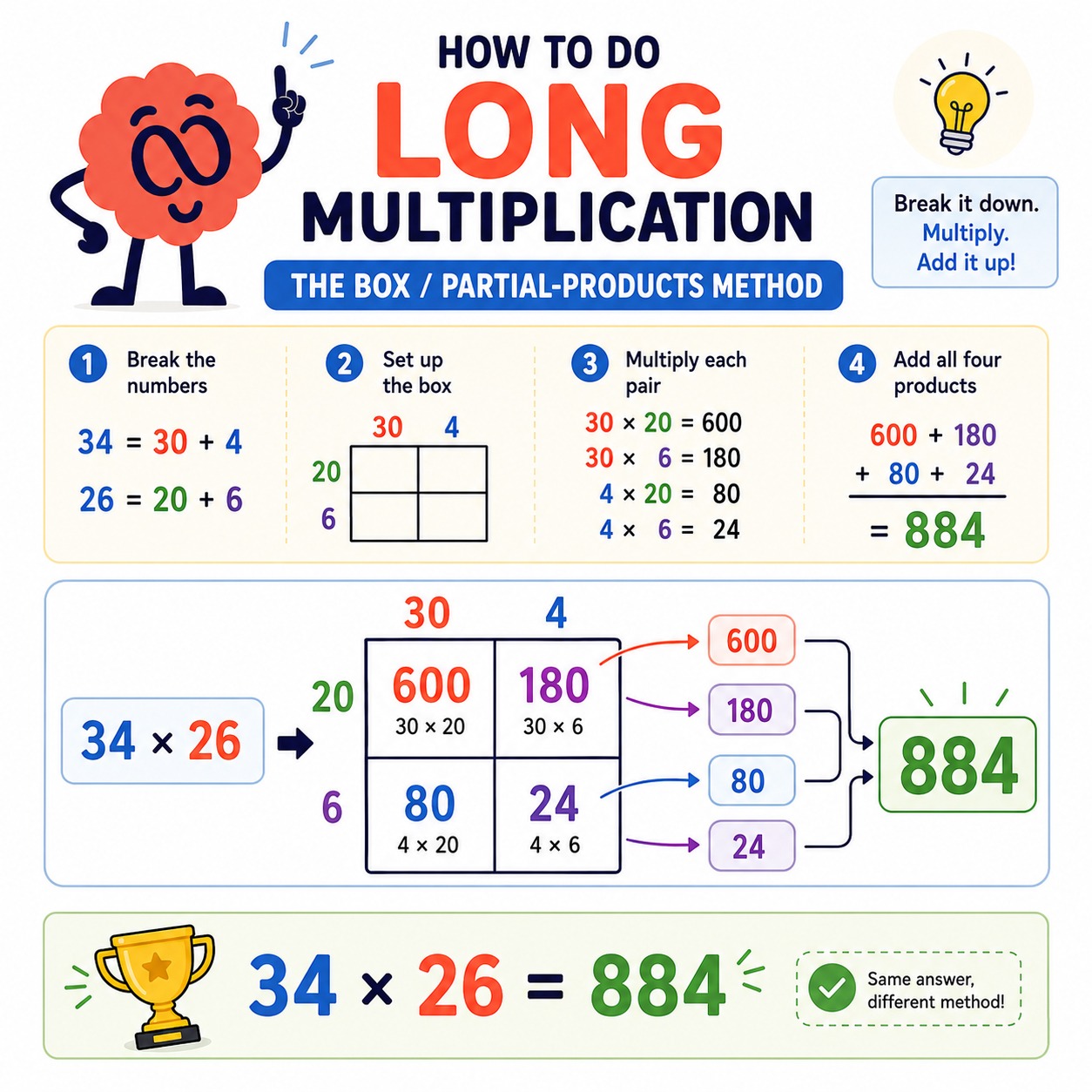
The box method (also called the partial-products method) uses the same math as the column method, just organized differently. It breaks both numbers into place value first, then multiplies every combination separately. Using the same problem, 34 x 26:
- Break 34 into 30 + 4, and 26 into 20 + 6.
- Draw a 2 x 2 grid. Label the top with 30 and 4, and the side with 20 and 6.
- Multiply each pair: 30 x 20 = 600, 30 x 6 = 180, 4 x 20 = 80, 4 x 6 = 24.
- Add all four partial products: 600 + 180 + 80 + 24 = 884.
Same answer, 884, reached by breaking the problem into four smaller, easier multiplication facts instead of two larger ones. This method uses the same logic as the distributive property, just spread across a grid instead of stacked in columns.
Which Method Works Best?
Neither method is objectively better, and the right one often comes down to how a person processes numbers. The column method is faster once it's automatic, since it involves fewer separate calculations. The box method is more visual and makes each step easier to double-check, which helps for anyone who benefits from seeing the place value broken out clearly rather than stacked. A Team Tuition has pointed out that matching the method to a person's learning style, visual, auditory, or hands-on, can make long multiplication click faster than forcing one single approach. Solid multiplication facts make either method faster, since less time gets spent working out the individual multiplication steps.
The Most Common Mistake: Forgetting the Place-Value Zero
In the column method, the biggest mistake is skipping the placeholder zero before starting the second row. That zero exists because the second digit being multiplied represents tens, not ones, so the result needs to shift one place to the left. Skip the zero, and the two partial products get added in the wrong place value, giving a wrong final answer. In the box method, the most common mistake is missing one of the four multiplication pairs, especially the smallest one, since it's easy to assume only the “big” parts matter.
Long Multiplication with Larger Numbers
The same logic scales up to three-digit numbers and beyond, just with more partial products to keep track of. Take 213 x 42. Using the column method: 213 x 2 = 426, then 213 x 40 = 8,520 (with the placeholder zero for the tens digit), then add: 426 + 8,520 = 8,946. The box method would break this into six pairs instead of four, since 213 splits into three place-value parts (200, 10, 3) and 42 splits into two (40, 2). More pieces to track, but the exact same process either way.
What Grade Is This Taught?
Long multiplication is typically introduced in 4th grade, once basic multiplication facts and two-digit place value are solid. It builds directly on ideas like the distributive property, and it often gets taught around the same time as other visual methods, including the area model and lattice multiplication, which represent the same math in different formats.
Key Takeaways
- Long multiplication breaks a multi-digit problem into smaller, place-value-based steps.
- The column method stacks partial products vertically; the box method spreads them across a grid.
- Both methods for how to do long multiplication reach the same answer through the same underlying math.
- The placeholder zero in the column method is the single most common thing to forget.
- The same process scales up to three-digit numbers and beyond, just with more partial products.
Frequently Asked Questions
What is long multiplication?
It's the standard method for multiplying numbers with more than one digit, done by breaking the problem into place-value steps and adding the partial results together.
How do you do long multiplication step by step?
Line the numbers up by place value, multiply by one digit at a time (using a placeholder zero for each new row), then add all the partial results together for the final answer.
What is the formula for long multiplication?
There's no single formula, but the process is consistent: multiply each digit of one number by each digit of the other, respecting place value, then sum every partial product.
Is there a trick to long multiplication, or does it just take practice?
It's mostly a repeatable process rather than a trick. Once the placeholder zero and the ordering of steps are automatic, it becomes fast and reliable for numbers of any size.
Long multiplication looks like a lot of steps written out, but it's really the same handful of multiplication facts applied in order, over and over. Once either method feels automatic, multiplying numbers of any size becomes a matter of following the same process a few extra times.
Book a free assessment today and explore our Grade 4 math program.