
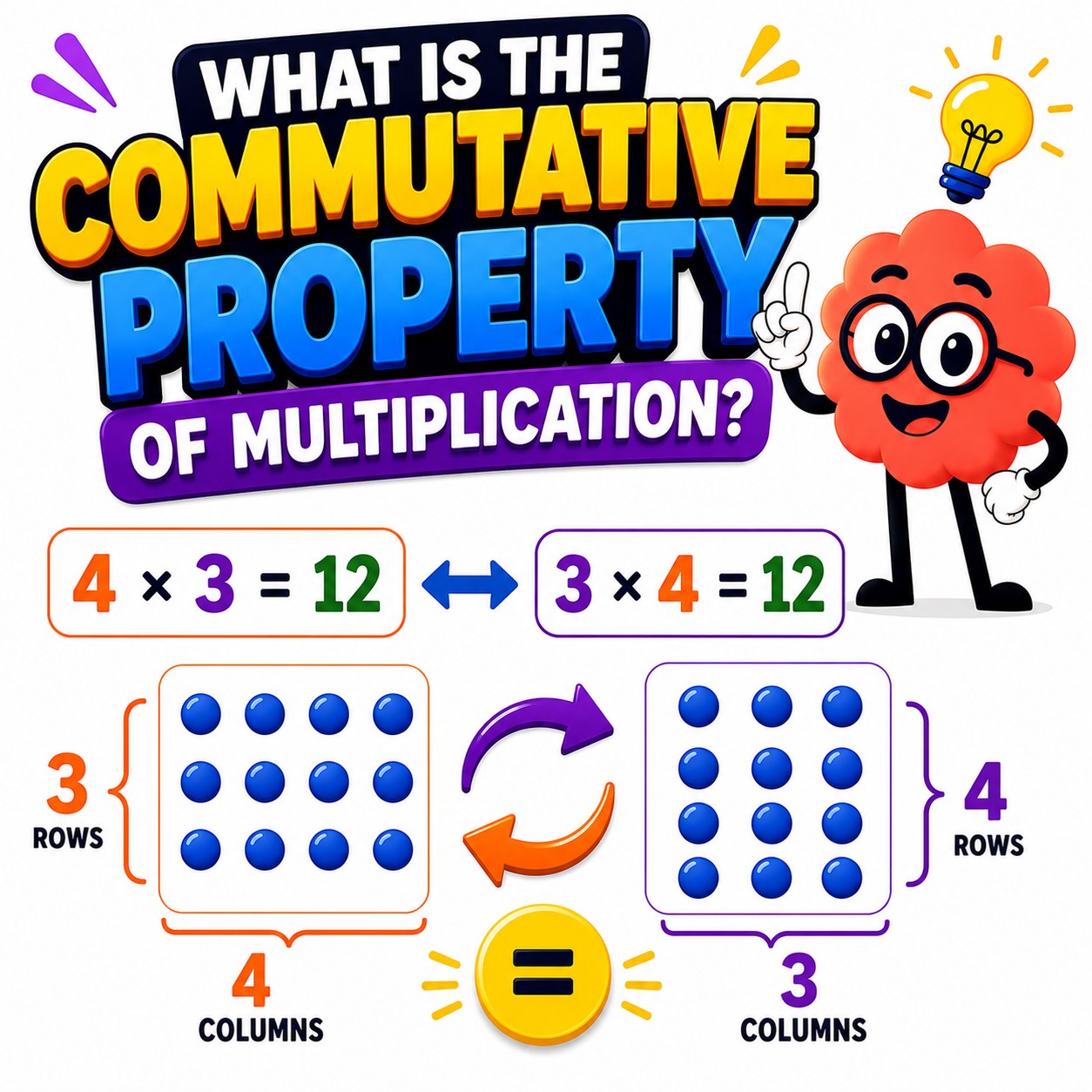
The commutative property of multiplication says that changing the order of the numbers being multiplied doesn't change the answer. For any two numbers a and b: a x b = b x a. For example, 4 x 3 and 3 x 4 both equal 12.
This is one of the first formal math “properties” that shows up in elementary school, usually as a vocabulary word on a worksheet before it's ever explained in plain language. Here's what it actually means, with none of the textbook jargon.
What Is the Commutative Property of Multiplication? (Quick Answer)
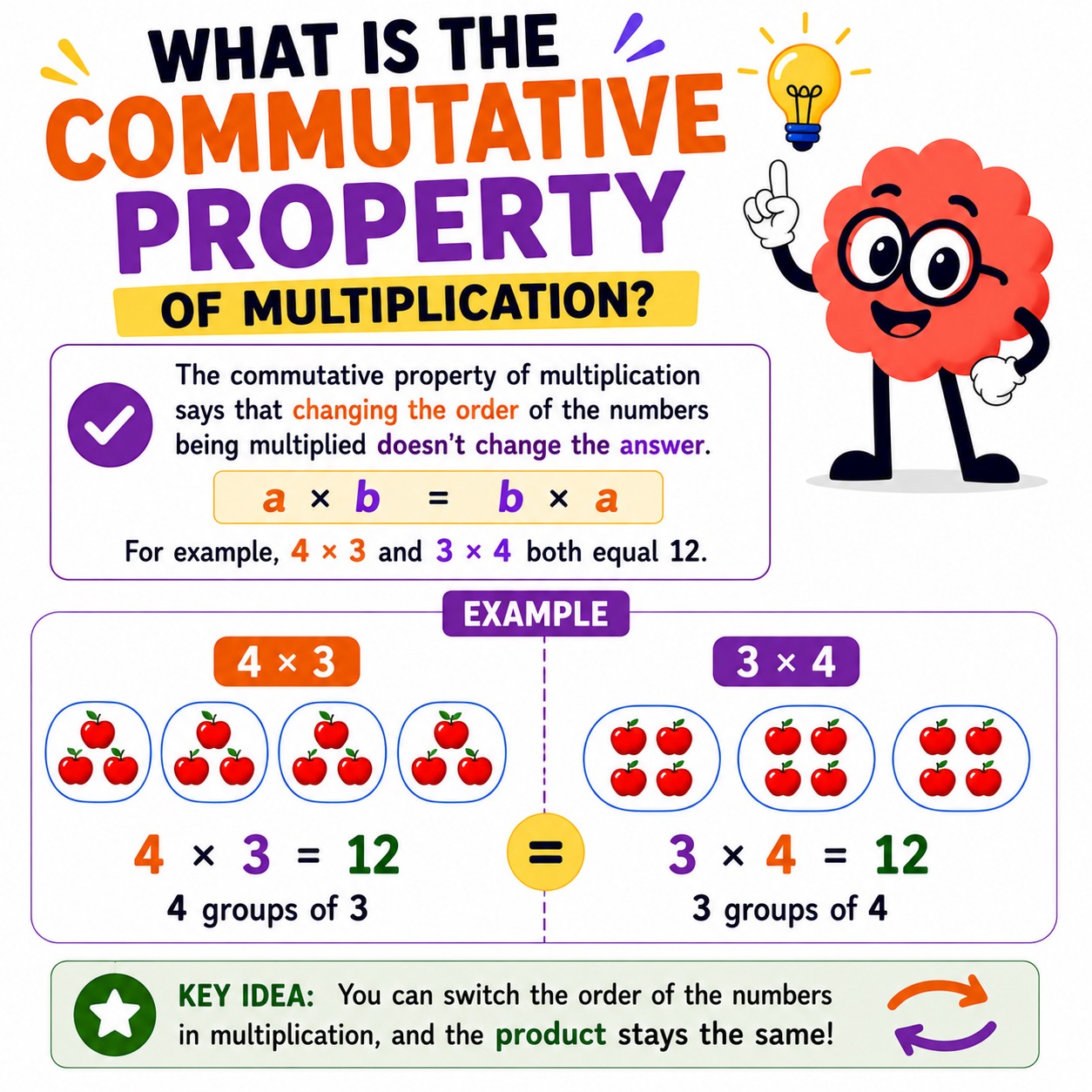
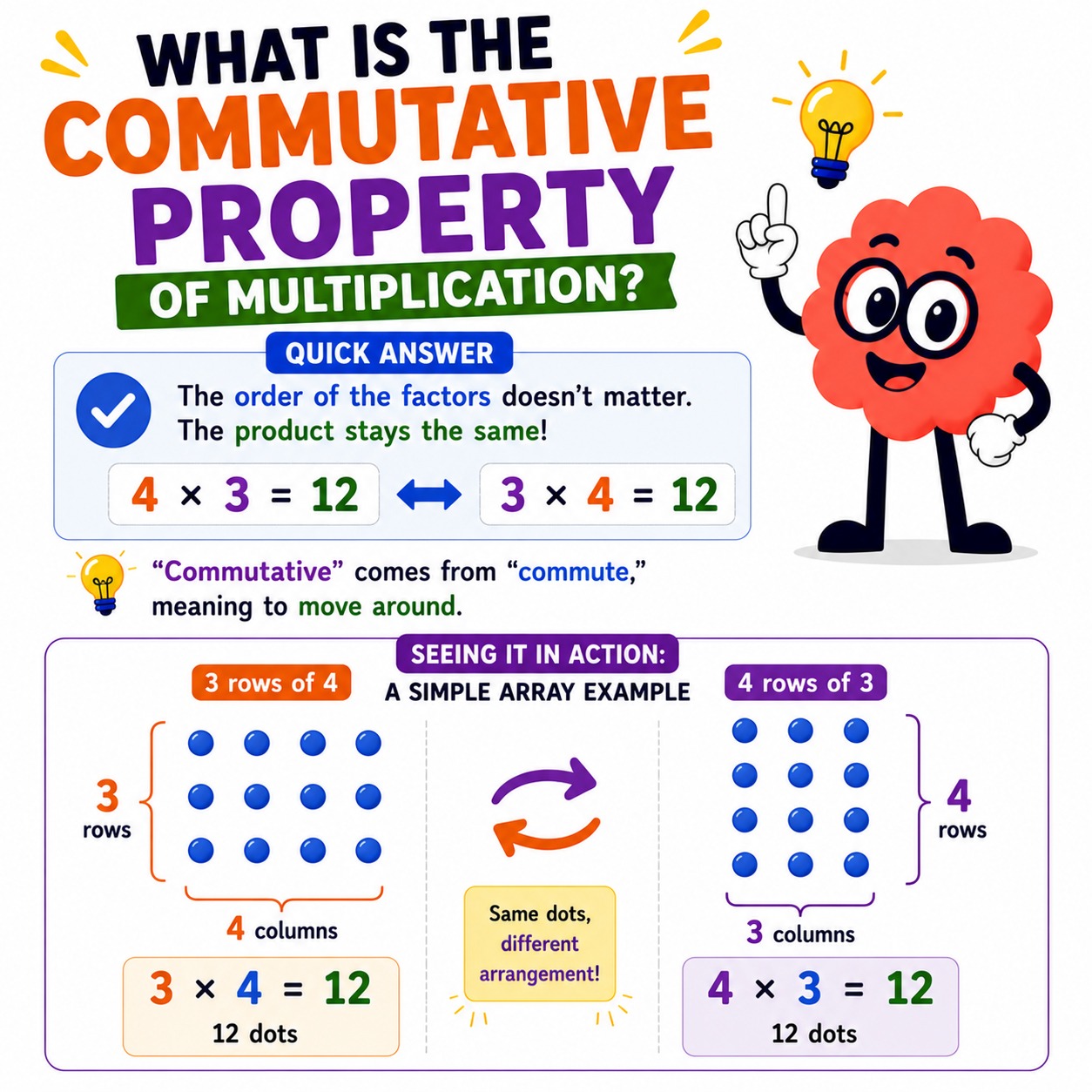
So what is commutative property of multiplication, in plain terms? It means the order of the factors doesn't matter. Multiplying 4 x 3 gives the same result as multiplying 3 x 4, because both equal 12. The word “commutative” comes from “commute,” meaning to move around, since the numbers can move around each other without changing the outcome.
Seeing It in Action: A Simple Array Example
An array makes this easy to see. Picture 3 rows of 4 dots. Counting them gives 12 dots total, or 3 x 4. Now turn that array on its side: 4 rows of 3 dots, still 12 dots, just arranged differently, or 4 x 3. That's the commutative property of multiplication in its simplest form.
Commutative vs. Associative Property: What's the Difference?
These two get mixed up constantly. The commutative property of multiplication is about order: a x b = b x a. The associative property of multiplication is about grouping, and it involves three or more numbers: (a x b) x c = a x (b x c). One example: 2 x 3 x 4 gives the same answer whether it's grouped as (2 x 3) x 4 or 2 x (3 x 4), both equal 24, but that's the associative property at work, not the commutative property of multiplication.
Why This Property Makes Multiplication Easier
The commutative property of multiplication cuts memorization work nearly in half. Once 6 x 7 is known, 7 x 6 is already known too, since it's the same fact written in a different order. This is exactly why learning times tables get faster once this property clicks: roughly half the facts on a standard chart are just repeats of the other half in reverse order.
Does Subtraction or Division Work This Way? (No, Here's Why)
No, and this trips a lot of people up. Subtraction and division both depend on order. 5 - 3 = 2, but 3 - 5 = -2, a completely different answer. The same goes for division: 10 / 2 = 5, but 2 / 10 = 0.2. Multiplication and addition are commutative. Subtraction and division are not.
What Grade Is This Taught?
The commutative property of multiplication is typically introduced in 3rd grade, right alongside the broader concept of what is multiplication. It's one of several “properties” taught around this age, usually alongside the associative and distributive properties, as the building blocks for mental math strategies used throughout upper elementary school.
Common Mistakes
The most common mistake is confusing the commutative property of multiplication with the associative property, since both involve rearranging numbers. It also gets mixed up with the distributive property, which involves breaking a number apart rather than reordering it. Another mistake is assuming the property applies to all operations. It only holds for addition and multiplication, not subtraction or division.
Key Takeaways
- The commutative property of multiplication means a x b = b x a. Order doesn't change the answer.
- An array flipped on its side is a simple way to see it visually.
- It's different from the associative property, which is about grouping three or more numbers, not order.
- It cuts fact memorization nearly in half, since each fact covers two orderings at once.
- Subtraction and division don't follow this rule.
Frequently Asked Questions
What are two examples of the commutative property?
2 x 5 = 5 x 2, and 6 x 9 = 9 x 6. These answer the common question of what is commutative property of multiplication in the simplest possible way: swap the order, get the same product.
What is the difference between the commutative and associative properties?
Commutative is about order (a x b = b x a). Associative is about grouping three or more numbers ((a x b) x c = a x (b x c)). They're related but not the same rule.
What property is (2 x 3) x 4 = 2 x (3 x 4)?
That's the associative property, not the commutative property. It shows that grouping can change without changing the answer, while the order of the numbers stays the same.
What is the associative property of multiplication?
It's the rule that grouping doesn't affect the product when multiplying three or more numbers. For a full breakdown, see the associative property of multiplication.
The commutative property of multiplication is a simple idea once the jargon is stripped away: order doesn't matter. It's one of the first math “rules” that gets a name, and understanding the commutative property of multiplication early makes times tables and mental math noticeably easier down the line.
Book a free assessment today and explore our Grade 3 math program.